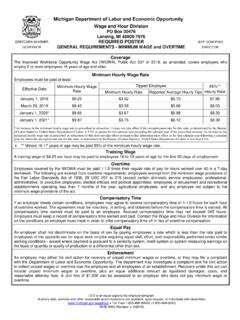
Transcription of ND MINIMUM WAGE & WORK CONDITIONS …
1 OVERTIME Admin. Code 46-02-07-02(4) MEAL PERIODS Admin. Code 46-02-07-02(5) PAID TIME OFF Admin. Code 46-02-07-02(12) - Applies unless a limitation below is met PAYDAYS & RECORD KEEPING 34-14-02, 03 and Admin Code 46-02-07-02 YOUTH EMPLOYMENT ch. 34-07 DEDUCTIONS FROM PAY A MINIMUM 30-minute meal period must be provided in shifts exceeding five hours when there are two or more employees on duty. Employees may waive their right to a meal period upon agreement with the employer. Employees do not have to be paid for meal periods if they are completely relieved of their duties and the meal period is at least thirty minutes in length.
2 Employees are not completely relieved if they are required to perform any duties during the meal period. Other breaks (such as 15 minute coffee breaks) are not required by law, but must be paid breaks if they are offered by the employer. Overtime pay must be paid at one and one-half times the employee s regular rate of pay for hours worked over forty in any work week. A work week is a seven consecutive-day period defined by the employer. Overtime is computed on a weekly basis, regardless of the length of the pay period.
3 Overtime is based only on hours worked. Paid holidays, paid time off, or sick leave need not be counted in computing overtime hours. Compensatory time is not legal in private employment for non-exempt employees overtime hours may not be banked and used for time off in another work week. Employees working more than one job under the control of the same employer must have all hours worked counted toward overtime. Exemptions from overtime are listed on the reverse side of this poster. Formulas for calculating overtime are available in Admin.
4 Code Section 46-03-01. Paid time off includes annual leave, earned time, personal days, or other provisions providing compensation for vacation. If sick leave is combined with such time into one balance, all of the hours are defined as paid time off. Sick leave is not defined as paid time off if it is kept in a separate balance. Once paid time off is made available for an employee s use, any unused portion of such time is considered wages upon separation from employment and must be paid at the regular rate of pay earned by the employee prior to separation.
5 No employment contract or policy may provide for forfeiture of earned paid time off upon separation. An employment contract or policy may require an employee to take vacation by a certain date or lose the vacation ( use it or lose it ), provided that the employee is given a reasonable opportunity to take the vacation. The employer must demonstrate that the employee had notice of such contract or policy provision. POSTING REQUIRED Must be posted in a conspicuous place in a commonly frequented area in which employees work.
6 Except for those amounts that are required under state or federal law to be withheld from employee compensation or where a court has ordered the employer to withhold compensation, an employer only may withhold from the compensation due employees: 1. Advances paid to employees, other than undocumented cash. 2. A recurring deduction authorized in writing. 3. A nonrecurring deduction authorized in writing, when the source of the deduction is cited specifically. 4. A nonrecurring deduction for damage, breakage, shortage, or negligence must be authorized by the employee at the time of the deduction.
7 Employees must be paid at least once each calendar month on the regular payday(s) designated in advance by the employer. Every employer must furnish to an employee each pay period a check stub or voucher indicating hours worked, rate of pay, required state and federal deductions, and any authorized deductions. When an employee is terminated from employment, separates from employment voluntarily, or is suspended from work as the result of an industrial dispute, unpaid wages or compensation become due and payable at the regular payday(s) established in advance by the employer for the period(s) worked by the employee.
8 When an employer terminates an employee, the employer shall pay those wages to the employee by certified mail at an address designated by the employee or as otherwise agreed upon by both parties. Employment & Age Certificates (work permits) are required for workers ages 14 & 15 and are available from the Department of Labor, Job Service offices, County School Superintendents offices, and local schools. Restricted hours for youth age 14 & 15: Maximum hours per day: 3 per school day, 8 per non-school day. Maximum hours per week: 18 per school week (any week in which school attendance is required any part of 4 or more days), 40 per non-school week.
9 May work only between (until from June 1st - Labor Day). Hazardous job duties for youth age 14 & 15: Workers ages 14 & 15 are prohibited from performing certain job duties defined as hazardous in labor law. RIGHT TO WORK 34-01-14 An individual s right to work may not be denied or abridged due to membership or nonmembership in any labor union or labor organization. EMPLOYMENT AT WILL 34-03-01 Employment relationships without a specific term exist at the will of both parties and can be terminated by either party upon notice to the other.
10 No MINIMUM length of notice (for example, a two-week notice) is required. Contracts specifying a term of employment can pre-empt the at-will provision. See REVERSE SIDE of this Poster for Additional Information. ND MINIMUM wage & WORK CONDITIONS SUMMARY State Capitol 600 East Boulevard Avenue Bismarck, ND 58505-0340 Hours: M-F - 8 (701)328-2660 1-800-582-8032 Fax - (701)328-2031 TTY - 1-800-366-6888 e-mail - web site - Effective Date: August 1, 2015 MINIMUM wage RATE: north dakota does not have a Training wage .