Transcription of New SEQRA Environmental Assessment Forms (EAFs)
1 New SEQRA Environmental Assessment Forms ( eafs ). Catskill Watershed Corporation, November 19, 2013. Program Overview State Training Requirements Review SEQRA Basics The Revised eafs ( Environmental Assessment Forms ). Reasons for Revisions Benefits What's Changed The Workbooks EAF Parts 1,2,3. Proposed Changes to SEQR Regulations State Training Requirements PB, ZBA, CPB members must complete four hours of training per year Training is approved by the governing board Training can come from a variety of sources and in a variety of formats To be eligible for reappointment, board members must complete the training Requirements may be waived or modified by resolution of the governing board if judged to be in the best interest of the municipality to do so. Failure to comply does not void decisions What is SEQRA ? The New York State Environmental Quality Review Act (refers to the Article 8 of the NYS Environmental Conservation Law).
2 SEQRA Regulations: Part 617 NYCRR. Often abbreviated SEQR. The basic purpose of SEQR is to incorporate the consideration of Environmental factors into the existing planning, review and decision-making processes of state, regional and local government agencies at the earliest possible time. and, if it is determined that the action may have a significant adverse impact, prepare or request an Environmental impact statement. (c). SEQR Terminology No agency involved in an action may undertake, fund or approve the action until it has complied with the provisions of SEQRA - (a) 26. Public bodies, such as planning boards and zoning boards of appeal, are agencies . Local governing boards, school boards, IDAs, and county legislatures are other examples. Types of Agencies under SEQR. Lead Agency an involved agency which coordinates the SEQRA review Involved Agency public body which undertakes, funds or approves a proposed action Interested Agency means an agency that lacks the jurisdiction to fund, approve or directly undertake an action but wished to participate in the review process because of its specific expertise or concern about the proposed action.
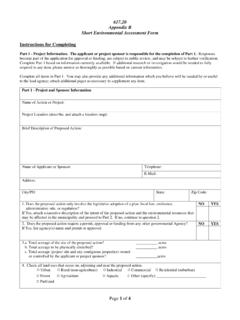
3 An interested agency has the same ability to participate in the review process as a member of the public Actions (1)projects or physical activities, such as construction or other activities that may affect the environment . (2)agency planning and policy making activities that may affect the environment . (3)adoption of agency rules, regulations and procedures, including local laws, codes, ordinances, executive orders and resolutions that may affect the environment (see (b)). SEQRA defines three Types of actions . The SEQR Process The Environmental Assessment form (EAF). "The Environmental Assessment form (EAF) means a form used by an agency to assist it in determining the Environmental significance or non- significance of actions. A properly completed EAF must contain enough information to describe the proposed action, its location, its purpose and its potential impacts on the . ( (m)). The EAF is used to decide whether or not an Environmental Impact Statement (EIS) will be prepared Short form (SEAF).
4 Full/ Long form (FEAF). Parts of the EAF. The lead agency is Part 1 responsible for reviewing Part 1 and Site and Project Descriptions verifying the accuracy Completed by the Project Sponsor/ of information with Applicant materials submitted for the project Part 2. Potential Impacts and Magnitudes Flag any problem Identify missing info Completed by Lead Agency Request revisions, if necessary Part 3 (may be optional). Importance of Impacts Identified in Part 2. Completed by Lead Agency, if necessary EAF Revision Timeline 1978 - Last substantial revision of Full form 1987 - Last substantial revision of Short form Nov. 2010 - DEC issues Draft Model Short and Full eafs 2011 Public Comment on eafs (see ). Jan. 2012 - DEC adopts revised Model eafs eafs are appendices to the regulations, which are not changing at this time 2012 - 2013. Public Comments on Workbooks Received Electronic Features Integrated within eafs Workbook Development built-in links to spatial data.
5 October 7, 2013 Revised eafs take effect October 31, 2013 EAF Mapper goes live Why are the eafs being revised? Elapsed time since last revision created need for several updates Newer areas of Environmental concern now incorporated, larger floods, greenhouse gas New structure makes Forms easier to use Electronic features vastly improved Companion Workbooks provide extensive guidance More info required in Pt 1 yet reduced need for additional studies; SEAF. applicable to more Unlisted Actions Scoping process is facilitated Differences New Forms Old Forms oriented toward project review; New Forms use gatekeeper question Does the proposed action only involve the legislative adoption of a plan, local law, ordinance, administrative rule, or regulation? (Part 1, Question 1, SEAF). If Yes, attach a If no, continue narrative description . to question 2.. and proceed to Part 2. Municipality is project sponsor . Differences New Forms Elimination of public controversy question Comment: Commentator objected to elimination of EAF, Part II, question 20, namely [i]s there, or is there likely to be, public controversy related to potential adverse Environmental impacts?
6 Boards use it as a smell test . Response: Question was eliminated as it has no bearing in determining whether an action should require the preparation of an Environmental impact statement and Environmental reviews should not be influenced by the relative popularity of a particular proposal. ( ). Differences - Short form The form is longer, making it more useful for Unlisted Actions (4 pages;. was 2). Asks questions about impacts to the state energy code, mass transit, biking and walking facilities, and other topics not addressed in the past Specific questions about stormwater discharge, retention ponds, dams, and waste lagoons; remediation of hazardous materials, impacts on human health Part 2 requires lead agency to identify impact as either none/ small impact or moderate to large impact . Differences - Full EAF, Part 1. Sections of questions are grouped together: Sponsor Information Government Approvals Planning and Zoning Project Details Setting of Proposed Action Additional Information 13 pages (was 10).
7 More logical flow of questions and answers New questions/ details include: Size and percentage of an Project phasing expansion Impacts on affordable Community services, school housing districts, park, fire and police Methane emission Subdivision type estimates Building space to be heated/ cooled Hazardous waste Outdoor lighting generation/ disposal The Workbooks The Workbooks provide detailed guidance, instructions, and information for accurate completion of the eafs For project sponsors in completing Part 1. For reviewing agencies in confirming responses in Part 1; determining the size and potential significance of impacts (Part 2); determination and statement of significance (Part 3). Internet Based Workbooks provide links to spatial data (GIS platform ) and other sources of information Pros and Cons Workbooks available in printable PDF. format (SEAF, 114 pp; FEAF, 301 pp). Workbooks are not the regulations The Workbooks (Part 1).
8 Contain background discussions and information on topics pertaining to the individual questions Background Information Answering the Question Full of illustrative examples, written and graphic Question 8 Question 3. Results Critical Environmental Area? NO. Structure on State or National Register of Historic Places? YES. In an archaeological area? NO. Wetland or waterbody regulated by federal, state, or local agency? YES. Threatened or endangered species? NO. 100-year floodplain? YES **. Workbooks (Part 2). Purpose of Part 2 is to use info from Part 1 to identify what, if any, impacts may occur as a result of the project; and to decide, for each question, whether there will be no impact or a small impact, or a moderate to large impact. Interpretation on the size or significance of an impact is at the discretion of the reviewing agency. Part 2 helps identify any topics that need further discussion in Part 3. Together, Parts 2 & 3 will help the reviewing agency determine if a negative declaration is appropriate, and if not, formulate a list or scope'.
9 Of Environmental topics that will need to be addressed further in an Environmental impact statement. Workbooks (Part 2) Determining if the potential impact is small, or moderate to large Magnitude is not just the physical size of the project, it considers the scale, context and severity of a project. Scale is the relationship of a building, structure, or land use, to its surroundings with regard to its size, height, bulk, and intensity. Includes: overall size of the project site number of buildings or structures proposed size of the parking lot height and other dimensions of buildings amount of traffic that will be generated amount of land to be cleared and graded Context refers to the conditions on the project site and its relation to adjacent parcels, the neighborhood, and the community as a whole. - Workbooks (Part 2) - Guidance For Each Question: Background Applicable Part 1 Information Analysis Will there be an impact?
10 If there is an impact, how big Q1: Conflicts with existing plans or zoning Q2: Change in use or intensity will it be? Q3: Impact on community character - Discussion on Small, Moderate to Q4: Impact on critical Environmental areas Large Impacts Q5: Impact on traffic, transportation, or pedestrian opportunities Scenarios (3 for each Q6: Impact on Energy question, typically) Q7: Impact on water or wastewater supplies or systems Q8: Impact on historic, archaeological, architectural, or aesthetic resources Q9: Impact on natural resources Q10: Impact on erosion, flooding or drainage Q11: Impact on human health SEAF Pt. 2, ( ). Will the proposed action impair the character or quality of the existing community? Applicable Part 1 Information Question 6 (primary information provided for this topic). Questions 1,3,4,5. Analysis Will there be a change to the visual or architectural character of the broader landscape or streetscape, or will it introduce a different sized structure than currently exists?