Transcription of New Source Performance Standards Subpart Dc for …
1 1 Environmental Assistance Program New Source Performance Standards Subpart Dc for Boilers Burning Distillate Oil Michigan Department of Environmental Quality Environmental Science & Services Division 800-662-9278 This fact sheet is designed to help owners of commercial, industrial, and municipal buildings operating small boilers that combust distillate oil alone or as a backup to natural gas, comply with the requirements found in a federal air regulation known as the New Source Performance Standards (NSPS). What is NSPS? The United States Environmental Protection Agency ( EPA) created NSPS in an effort to regulate new sources of air pollution and ensure that those sources pollute less than the older ones they replace. NSPS have been written for over 75 categories of sources ranging from small boilers to large municipal sewage sludge incinerators. The NSPS typically places limits on the emission of air pollutants such as carbon monoxide, sulfur dioxide and particulate matter, and requires Performance testing, recordkeeping, reporting and monitoring.
2 Where to Find Copies of the NSPS The EPA publishes the NSPS and all other federal regulations in the Code of Federal Regulations (CFR). The CFR is divided into 50 titles that represent broad areas subject to federal regulation. Environmental regulations are found in Title 40 (Protection of Environment). The Titles are further subdivided into Chapters, Parts and Subparts. The NSPS regulations are found in Part 60 (New Source Performance Standards ). Each regulation has its own Subpart within Part 60. For example, regulations applicable to small boilers are found in Subpart Dc ( Standards of Performance for Small Industrial-Commercial-Institutional Steam Generating Units). To obtain a copy of 40 CFR Part 60, Subpart Dc, go to , select Laws, Regulations & Dockets, select Code of Federal Regulations, and then select The Electronic Code of Federal Regulations (e-CFR).
3 From this page, use the browse option (drop-down box) to select Title 40 Protection of Environment and click on Go. Click on , then click the table of contents and scroll down to the Subpart Dc section. Jennifer M. Granholm, Governor July 2007 Steven E. Chester, Director 2 What Does this Fact Sheet Cover? This fact sheet examines the portion of Subpart Dc that applies to boilers that burn distillate oil alone or as a backup to natural gas. If your boiler burns or is equipped to burn other fuels, such as coal, then you will need to read the relevant parts of the standard that apply to that fuel usage. Subpart Dc FUEL DEFINITIONS Distillate Oil: Fuel oil numbers 1 and 2, as defined by the American Society for Testing and Materials in ASTM D396-78. According to this definition, distillate oil contains a maximum of percent sulfur by weight.
4 Natural Gas: (1) a naturally occurring mixture of hydrocarbon and non-hydrocarbon gases found in geologic formations beneath the earth s surface, of which the principal constituent is methane, or (2) liquefied petroleum (LP) gas, as defined in ASTM D1835-86, 87, 91, or 97. What Boilers are Subject to the Subpart Dc Standards ? Subpart Dc applies to steam generating units (boilers) from small commercial, industrial, and municipal buildings ( , schools, hospitals, churches, retail buildings, etc.) that meet all of the following: Combust any of several fuel types, including coal, oil, natural gas, and wood. (This fact sheet pertains to boilers capable of only burning distillate oil alone or as a backup to natural gas). Maximum design heat input capacity is greater than or equal to 10 million Btu/hr ( megawatts or 239 horsepower, assuming 80% thermal efficiency) and equal to or less than 100 million Btu/hr ( megawatts or 2,390 horsepower, assuming 80% thermal efficiency).
5 You can get the maximum design heat input capacity rating from the "boilerplate" on the boiler or contact the boiler's manufacturer. There may be different ratings for different fuels. Most boilers have the input ratings on the burner assemblies or on the American Society of Mechanical Engineers (ASME) plates. If only the output is listed, then assume 80 percent thermal efficiency, unless there is documentation proving otherwise. Calculate the boiler s heat input by dividing the heat output by Construction, modification, or reconstruction started after June 9, 1989. Construction is defined as fabrication, erection, or installation of a boiler. If construction began before June 9, 1989, but was not operational until after June 9, 1989, the boiler would not be subject to the regulation. A modification is defined as any physical or operational change to an existing boiler which results in an increase in the emission rate to the atmosphere of any pollutant to which the standard applies.
6 For example, if a natural gas-fired boiler was retrofitted to burn distillate oil, that would be considered a modification. A boiler meets the definition of reconstructed if the fixed capital cost of the one-for-one replacement of parts exceeds 50 percent of the fixed capital costs required to construct an entirely new comparable boiler. What Do I Need to Do? Jennifer M. Granholm, Governor July 2007 Steven E. Chester, Director 3 Boilers subject to Subpart Dc are subject to both federal and state requirements. In addition, the Michigan Department of Environmental Quality (MDEQ), Air Quality Division (AQD) has been given authority by the EPA to enforce federal air regulations, including the NSPS. This means that typically an inspector from the MDEQ, not EPA, will visit your facility.
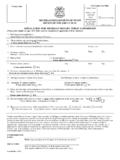
7 FEDERAL REQUIREMENTS1) Initial Notification: Send a written notification of the following information for each NSPS boiler: Within 30 days after commencing construction: Date of original construction or reconstruction, and anticipated startup. The design heat-input capacity of the boiler and identification of the fuels to be combusted in the boiler. The annual capacity (fuel consumption) at which you anticipate operating the boiler, based on all fuels fired and based on each individual fuel fired. If an emerging technology will be used for controlling sulfur dioxide (SO2) emissions. Within 15 days after startup: Date of actual startup. An acceptable notification form is attached. Submit the completed form or one you create to the appropriate MDEQ-AQD District Office (see attached map). Even if your boiler has been installed and operating for years, please comply with the initial notification requirement if you haven t already done so.
8 2) Opacity Performance Test Data: A standard for opacity applies only to Dc boilers with heat input capacities between 30 and 100 million Btu/hour. The opacity standard states that a boiler may not discharge gases with more than 20 percent opacity, except for one 6-minute period per hour of not more than 27 percent opacity. Any Subpart Dc boiler subject to the opacity limit must conduct an opacity Performance test, due 180 days after initial startup or within 60 days of achieving maximum production capacity. You are required to submit a test plan to the MDEQ at least 30 days prior to testing for particulate. EPA Reference Method 9 must be used when conducting any compliance tests regarding opacity. You must follow all of the testing procedures listed in Subpart A (General Provisions) of the NSPS. Jennifer M. Granholm, Governor July 2007 Steven E.
9 Chester, Director 4 3) Recordkeeping: Fuel Usage The amount of distillate oil and natural gas that a boiler combusts must be recorded on a monthly basis, in the form of fuel bills or meter readings. This monitoring option is not an exemption from compliance with any of the fuel certification (see below) or initial notification reporting requirements. Your facility must still provide certification that it will burn only distillate oil alone or as a backup to natural gas and must notify the AQD if a change in fuel use occurs. Monthly fuel usage records shall be maintained separately for each boiler for a period of two years. Use fuel bills if you only have one boiler at your facility. While reviewing fuel bills, remember that natural gas meters measure the volume of gas in units of cubic hundred feet (ccf, where the first c stands for the Roman numeral one hundred) or thousand cubic feet (mcf, where the m stands for the Roman numeral one thousand).
10 If you have two or more boilers, the fuel bill does not identify the amount of distillate oil and natural gas burned in each boiler. The easiest way to obtain monthly fuel usage records for more than one boiler is to install a dedicated fuel flow meter for each boiler and take meter readings on a calendar month basis. A fuel flow meter, however, requires an initial capital investment. If you choose not to install a fuel flow meter on each boiler, you may be able to prorate or predict the fuel usage based upon many different methods. Upon prior approval by the AQD District Supervisor, each individual boiler's distillate oil and natural gas usage may be calculated using an acceptable alternative method proposed by the facility. Fuel Supplier Certification NSPS Subpart Dc regulates the amount of sulfur dioxide (SO2) that may be emitted from boilers that combust distillate oil at all times, including periods of unit startup, shutdown, and malfunction.