Transcription of New Syllabus for Biotechnology subject for B.Sc. …
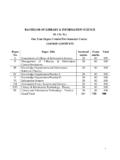
1 1 New Syllabus for Biotechnology subject for ( session 2011-12) Year Paper No. Title of paper Marks I year Paper I Introductory Biological Chemistry 50 Paper II Biophysical Chemistry 50 Paper III Cell Biology and Genetics 50 Practical 50 Total 200 II year Paper I Bioenergetics and Biomembranes 50 Paper II Animal and Plant Physiology 50 Paper III Biostatistics and Computers 50 Practical 50 Total 200 III year Paper I Molecular Biology and Genetic Engineering 75 Paper II Animal and Plant Biotechnology 75 Paper III Industrial and Environmental Biotechnology 75
2 Practical 75 Total 300 2 Part-I ( Biotechnology ) Paper-I, Introductory Biological Chemistry 50 Marks General account of the chemical nature of living cells. Carbohydrates: Classification, configurations and conformations, sugar derivatives, structural and storage polysaccharides. Amino acids: General properties, peptide bond, essential and non-essential amino acids. Lipids: Classification, properties of lipid aggregates, biological significance. Nucleic acid: Chemical structure and base composition, double helical structures, Tm, super-coiled DNA.
3 Protein chemistry: Classification, different levels of protein structure, forces stabilizing protein structure, protein folding, protein modification. Enzymes: Nomenclature, apoenzyme and holoenzyme, substrate specificity, coenzymes, factors affecting enzyme activity, regulation of enzyme activity, enzyme inhibition, isozymes, ribozymes, abzymes. Vitamins, water and fat soluble vitamins, deficiency and diseases . Paper II, Biophysical Chemistry 50 Marks Water: Structure and interactions, water as solvent, proton mobility, acid-base reactions, pH and buffers, isoelectric pH.
4 Photometry: Basic principles of UV-Visible spectrophotometry and colorimetry, instrumentation and application. Centrifugation: Principles and application, sedimentation coefficient, differential, density gradient and ultra-centrifugation. Chromatography: Ion Exchange, partition, gel filtration and affinity chromatography their principles and applications. Electrophoresis: Principle, types (polyacrylamide and agarose gel electrophoresis), applications, Isoelectric focusing. Microscopy: Principles and applications of light, phase contrast, fluorescence and electron microscopy.
5 Tracer technique: Applications of radioisotopes in Biotechnology , autoradiography. 3 Paper III, Cell biology and Genetics 50 Marks Cell theory, cell as basic unit of life. Structure and organization of prokaryotic and eukaryotic cells. Cell organelles- structure, function and integration, micro bodies. Cell division- mitosis and meiosis, Cell cycle, its regulation and cancer, Characteristic of cancer cells. Major signaling pathways of eukaryotic cells. Mendel s law of inheritance, Gene interactions.
6 Sex determination, linkage, crossing over, recombination and gene mapping. Chromosome structure and behaviour through the cell cycle, karyotype. Chromatin organization. Polytene and Lampbrush chromosome, Banding patterns in human chromosome, structural and numerical changes in chromosomes, hereditary defects. Extra-chromosomal inheritance, sex-linked inheritance in humans, Mutation at phenotypic level, biochemical level and molecular level. Gene frequencies in population, Hardy-Weinberg law.
7 Practical 50 Marks 1. Preparation of buffers. 2. Qualitative tests of sugars. 3. Estimation of sugar by anthrone method 4. Qualitative tests of proteins. 5. Estimation of protein by Lowry s method 6. Estimation of DNA by diphenylamine method 7. Estimation of RNA by orcinol method 8. Chemistry practicals- group analysis, gravimetry 9. Assay of salivary amylase activity 10. Isolation of casein from milk. 4 Part II ( Biotechnology ) Paper I, Bioenergetics and Biomembranes 50 Marks Fundamentals of thermodynamics- endergonic and exergonic processes, enthalpy, entropy, activation energy, free energy change, phosphoryl transfer reaction, oxidation reduction reaction, redox potential, equilibrium and non equilibrium thermodynamics, high energy compounds, causes of energy richness in ATP.
8 Glycolytic pathway and its regulation, homolactic fermentation, alcoholic fermentation, energetics of fermentation, glycogen breakdown, Citric acid cycle and its regulation, gluconeogenesis, Electron transport and oxidative phosphorylation, pentose phosphate pathway, glyoxalate pathway. Fatty acid oxidation- major and minor pathways of fatty acid oxidation, ketone bodies. Metabolic breakdown of amino acids, transamination, deamination, urea cycle. Biological membranes- membrane proteins, fluid mosaic model of membrane structure, erythrocyte membrane, plant cell membrane, bacterial cell wall.
9 Thermodynamics of transport, kinetics and mechanism of transport, active and passive transport, ATP-driven active transport, Ion gradient driven active transport. Paper II, Animal and Plant Physiology 50 Marks Photosynthesis: Photosynthetic pigments, electron transport, Photophosphorylation and Carbon fixation pathways. Fixation of atmospheric nitrogen by plants and microorganisms. Nitrate uptake and metabolism. Plant hormones: Cytokinins, Gibberellic acid, Auxins, Ethylene.
10 Abscissic acid- their physiological effects and mode of action. Nutrition- Macronutrients and micronutrients and their uptake by plants. Seed germination and dormancy. Photoperiodism. Vernalization, Flowering. Senescence. Abscission. Blood, its cellular and chemical composition, blood clotting. Respiratory system: diffusion of oxygen and carbon dioxide, transport of oxygen, role of he-moglobin, dissociation curve of oxyhemoglobin and its significance, Bohr s effect, transport of CO2 and chloride shift.