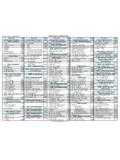
Transcription of NFIRS INCIDENT CODE GUIDE - Oregon
1 Helpful ps from the OSFM Analy cs & Intelligence Unit for comple ng INCIDENT reports. NFIRS INCIDENT CODE GUIDENFIRS INCIDENT CODE GUIDE TABLE OF CONTENTS INTRODUCTION 1 INCIDENT TYPE 2 BARKDUST FIRES 3 BARBECUE FIRES 4 CAR FIRES 5 CHIMNEY/FLUE FIRES 6 CIGARETTE FIRES 7 GREASE FIRE IN KITCHEN 8 DOWNED POWERLINES 9 TRAFFIC ACCIDENTS 10 CANCELLED EN ROUTE 11 EXPOSURES 12 AID GIVEN OR RECEIVED 13 CONFLAGRATIONS 14 DEFINITIONS 15 REPORTING REQUIREMENTS 16 On January 1, 2010, the Oregon Office of State Fire Marshal (OSFM)
2 Adopted the Na onal Fire INCIDENT Repor ng System ( NFIRS ) Version , as the standard which fire agencies in Oregon shall use to report incidents they respond to. NFIRS is a modular, all INCIDENT repor ng system designed by the Fire Administra on (USFA), with input from the fire service and other users of the data. The uniformity of defini ons used in NFIRS makes aggrega on of statewide and na onal data possible. This booklet is designed to assist those responsible for comple ng NFIRS reports. It contains many common situa ons and how they should typically be coded. However, these situa ons can and may vary. Professional judgment should always be applied. If you have any ques ons, please call us at 503 934 8250 or 877 588 8787 toll free. You may also e mail us at: Addi onal informa on on repor ng, annual reports, resource directories, sta s cs, and other reports may be found and downloaded from our website at: h Addi onal informa on on NFIRS can be found at INTRODUCTION 1 2 INCIDENT TYPE One of the most important fields in NFIRS is the INCIDENT Type.
3 It determines which NFIRS modules need to be completed to fully illustrate all the facts concerning the INCIDENT . The INCIDENT Type is defined as the actual situa on that emergency personnel found on the scene when they arrived. It is not always the type of INCIDENT ini ally dispatched to. INCIDENT Types are three digit codes which are grouped into 9 categories or Series: 100 Fire 200 Overpressure, rupture, explosion, overheat (no fire). 300 Rescue and Emergency Medical Service incidents 400 Hazardous condi on (no fire) 500 Service call 600 Good intent call 700 False alarm and false call 800 Severe weather and natural disaster 900 Special INCIDENT type For incidents that involve fire and hazardous materials or fire and EMS, use the fire codes. The NFIRS standard is to always use the lowest numbered series and code that applies to the INCIDENT . Throughout NFIRS , the use of codes that end in zero should be avoided when and where possible.
4 These are other codes that are generic and non specific, and should be used only when no other code applies. This is especially true with INCIDENT Types. An INCIDENT Type code should begin with a 1 for any INCIDENT that involves a fire. Conversely, if the INCIDENT did not involve actual flames, the INCIDENT Type code should not begin with a 1. Civilian casual es (deaths or injuries) should NOT be entered in Sec on H1 of the Basic Module unless the INCIDENT Type is in the 100 series. Seeing as entries in the civilian fields of Sec on H1 are only for civilian casual es as a direct result of a fire, the INCIDENT Type has to be in the 100 series. Civilians include emergency personnel who are not members of the fire department, such as police officers or u lity workers. 3 BARKDUST FIRES There has been and will most likely con nue to be varying viewpoints on how to properly code these types of incidents. What is important to note is that the methodology indicated below is based on the current NFIRS standard.
5 In order to obtain uniformity, it is important to maintain consistency with the standard. Barkdust fires (otherwise known as mulch) should be classified as INCIDENT Type 142 Brush or brush and grass mixture fire. This includes ground fuels lying on or immediately above the ground such as duff, roots, dead leaves, fine dead wood, and downed logs. Barkdust can be found on a variety of Property Use types from schools, to churches, to houses, and even in median strips in parking lots. The key here is to be as specific as possible and avoid using 900 Outside or special property, other. Almost all barkdust fires occur outside, so this code would not be helpful in data analysis. The Item First Ignited should be 72 Light vegeta on (not crop), which includes grass, needles, leaves, chaff, mulch, and compost. Provided the barkdust (or mulch) is not ar ficial, which most is not, the Material First Ignited should be 61 Wood chips, sawdust, wood shavings.
6 For this example, we will say this fire was on the median strip along a sidewalk and started by a cigare e tossed out of a car. EXAMPLE INCIDENT Type 142 Brush or brush and grass mix fire Property Use 938 Cared for plots of land Heat Source 61 Cigare e Area of Fire Origin 92 Street; on or near Item First Ignited 72 Lightweight vegeta on Material First Ignited 61 Wood chips Factors Contribu ng 11 Abandoned or discarded material Equipment Involved N/A BARBECUE FIRES Barbecues (or grills) are supposed to have fires in them, aren t they? Yes, but some mes the fire gets out of control and damages or spreads beyond the BBQ, this would be considered a BBQ fire. BBQ fires are not considered contained fires, even if the fire does not extend beyond the BBQ. Under the NFIRS standard, for an INCIDENT to be considered a confined fire ( INCIDENT Type 113 118) the following rules must apply: The fire must be confined to a non combus ble container.
7 A non combus ble container is not capable of igni ng and burning, is designed to come in contact with a non hos le flame, and may not be an appliance such as a dryer, oven, microwave, toaster, BBQ, etc. Most BBQs are located on porches, pa os, or decks. As such, BBQ fires should be coded as 111 Building fire or 112 Fire in a structure other than a building. Where a BBQ catches fire that is not in, on, or part of a structure or building, it should be coded as 162 Outside equipment fire. Although BBQs are generally used in residen al se ngs, they may be used in any type of Property Use. You will need to iden fy the appropriate Property Use, and as always, avoid using Property Use codes that end in 0 if possible. The Area of Fire Origin is o en 93 Courtyard, pa o, terrace, but is not restricted to this. The Heat Source would be 11 Spark, ember or flame from opera ng equipment. The Item First Ignited is usually 95 Film, residue; or the food on the BBQ which would be 76 Cooking materials.
8 Material First Ignited is also usually either 57 Food; or 31 Fat, grease. With propane BBQs, the Item First Ignited for a loose or damaged propane line would be 63 Flammable gas escaping before burner; and the Material First Ignited would be 12 LP gas. Below is an example of a BBQ fire on a covered pa o a ached to a house that was caused by an excess buildup of grease due to lack of cleaning. EXAMPLE INCIDENT Type 111 Building fire Property Use 419 1 or 2 family dwelling Area of Fire Origin 93 Pa o Heat Source 11 Flame from opera ng equipment Item First Ignited 95 Film, residue Material First Ignited 31 Fat, grease Factors Contribu ng 55 Failure to clean Equipment Involved 643 Grill, hibachi, barbecue 4 5 CAR FIRES The INCIDENT Type for a simple car fire is 131 Passenger vehicle fire. People o en park or work on their cars in the garage or carport (whether a ached or not). When a car is parked inside a garage or carport and catches fire, it would be coded as a car fire unless the fire spreads beyond the car.
9 In that case, the INCIDENT Type would become 111 Building fire, and the car would be considered contents of the structure. You will need to iden fy the appropriate Property Use. Avoid using Property Use codes that end in 0 if possible. Remember, the Area of Origin is somewhere in or on the car (the engine, trunk, etc.), so the code would be in the 8_ Transporta on, Vehicle Area category. The Heat Source could be anything from a lit cigare e that fell on the car seat, to an electrical arc, to overheated brakes. Judgment will need to be used when selec ng the Heat Source code. Mobile property informa on (year, make, model) is entered in Sec on H2 on the Fire Module. When entering the es mated value and loss, if a fire from a vehicle parked in a garage spreads beyond the vehicle, it is considered a part of the contents of the structure. Where more than one vehicle is burned, if the vehicles are all located on the same Property Use and owned by the same owner, they can all be included in the same INCIDENT report.
10 If they are located on different Property Uses or have different owners, separate exposure reports will have to be completed for each vehicle. Below is an example of a car parked in a garage that catches fire as a result of an electrical problem and the fire spreads to the garage. EXAMPLE INCIDENT Type 111 Building fire Property Use 419 1 or 2 family dwelling Area of Fire Origin 83 Engine area Heat Source 13 Electrical arcing Item First Ignited 95 Film, residue Material First Ignited 27 Lubrica ng oil Factors Contribu ng 33 Short circuit from worn insula on Equipment Involved N/A Complete mobile property sec on instead 6 CHIMNEY/FLUE FIRES Flue fires most o en occur in residen al buildings that have either a masonry fireplace or a factory built woodstove. Some mes they re found in a backyard shop. They are structure fires and INCIDENT Type = 114, if the fire is confined to the chimney or flue. If the fire escapes and the building catches on fire, then INCIDENT Type = 111.