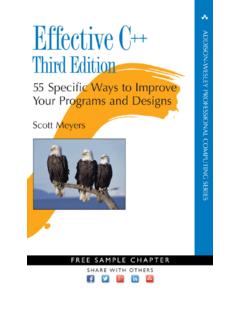
Transcription of ninth edition C++
1 P r o b l e m S o l v i n g with C++ ninth edition This page intentionally left blank Boston Columbus Indianapolis New York San Francisco Upper Saddle RiverAmsterdam Cape Town Dubai London Madrid Milan Munich Paris Montreal Toronto Delhi Mexico City S o Paulo Sydney Hong Kong Seoul Singapore Taipei TokyoP r o b l e m S o l v i n g with C++Walter SavitchUniversity of California, san DiegoContributor Kenrick mock University of alaska, anChorageninth editionEditorial Director: Marcia HortonAcquisitions Editor: Matt GoldsteinProgram Manager: Kayla Smith-TarboxEditorial Assistant: Kelsey LoanesMarketing Coordinator: Kathryn FerrantiProduction Director: Erin GreggManaging Editor: Scott DisannoSenior Operations Supervisor: Vincent SceltaOperations Specialist: Linda SagerCover Designer: Joyce WellsPermissions Manager: Timothy NichollsImage Permissions Manager: Karen SanatarMedia Producer: Renata Butera Media Project Manager: Wanda RockwellFull-Service Vendor: Hardik Popli, Cenveo Publisher ServicesComposition: Cenveo Publisher ServicesPrinter/Binder: Courier/WestfordCover Printer: Lehigh-Phoenix Color/HagerstownCredits and acknowledgments borrowed from other sources and reproduced, with permission, in this textbook appear on appropriate page within and Windows are registered trademarks of the Microsoft Corporation in the and other coun-tries.
2 Screen shots and icons reprinted with permission from the Microsoft Corporation. This book is not spon-sored or endorsed by or affiliated with the Microsoft 2015, 2012, 2009, 2007, 2005, 2003 Pearson Education, Inc. All rights reserved. Manufactured in the United States of America. This publication is protected by Copyright, and permission should be obtained from the publisher prior to any prohibited reproduction, storage in a retrieval system, or transmission in any form or by any means, electronic, mechanical, photocopying, recording, or likewise. To obtain permission(s) to use material from this work, please submit a written request to Pearson Education, Inc., Permissions Department, 501 Boylston Street, Suite 900, Boston, Massachusetts of the designations by manufacturers and sellers to distinguish their products are claimed as trademarks. Where those designations appear in this book, and the publisher was aware of a trademark claim, the designations have been printed in initial caps or all caps.
3 Library of Congress Cataloging-in-Publication Data Savitch, Walter J., 1943- Problem solving with C++ / Walter Savitch ; contributor, Kenrick Mock. -- ninth edition . pages cm Includes index. ISBN-13: 978-0-13-359174-3 (alkaline paper) ISBN-10: 0-13-359174-3 (alkaline paper)1. C++ (Computer program language) 2. Problem solving. I. Mock, Kenrick. II. Title. 2014 '3--dc23 201304848710 9 8 7 6 5 4 3 2 1 CW 15 14 13 12 11 ISBN 10: 0-13-359174-3 ISBN 13: 978-0-13-359174-3vPrefaceThis book is meant to be used in a first course in programming and computer science using the C++ language. It assumes no previous programming experi-ence and no mathematics beyond high school you have used the previous edition of this book, you should read the following section that explains the changes to this ninth edition and then you can skip the rest of this preface. If you are new to this book, the rest of this preface will give you an overview of the to the ninth EditionThis ninth edition presents the same programming philosophy as the eighth edition .
4 All of the material from the eighth edition remains, but with the fol-lowing enhancements: End-of-chapter programs are now split into Practice Programs and Program-ming Projects. Practice Programs require a direct application of concepts presented in the chapter and solutions are usually short. Practice Programs are appropriate for laboratory exercises. Programming Projects require ad-ditional problem solving and solutions are generally longer than Practice Programs. Programming Projects are appropriate for homework problems. Introduction to C++11 in the context of C++98. Examples of C++11 content includes new integer types, the auto type, raw string literals, strong enumera-tions, nullptr, ranged for loop, conversion between strings and integers, member initializers, and constructor delegation. Additional material on sorting, secure programming ( , overflow, array out of bounds), and inheritance. Correction of errata. Twenty-one new Practice Programs and ten new Programming Projects.
5 Ten new VideoNotes for a total of sixty-four VideoNotes. These VideoNotes walk students through the process of both problem solving and coding to help reinforce key programming concepts. An icon appears in the margin of the book when a VideoNote is available regarding the topic covered in the you are an instructor already using the eighth edition , you can continue to teach your course almost without in Topic OrderingThis book was written to allow instructors wide latitude in reordering the material. To illustrate this flexibility, we suggest two alternative ways to order vi Prefacethe topics. There is no loss of continuity when the book is read in either of these ways. To ensure this continuity when you rearrange material, you may need to move sections rather than entire chapters. However, only large sec-tions in convenient locations are moved. To help customize a particular order for any class s needs, the end of this preface contains a dependency chart, and each chapter has a Prerequisites section that explains what material needs to be covered before each section in that 1: Earlier ClassesTo effectively design classes, a student needs some basic tools such as control structures and function definitions.
6 This basic material is covered in Chapters 1 through 6. After completing Chapter 6, students can begin to write their own classes. One possible reordering of chapters that allows for such early coverage of classes is the following:Basics: Chapters 1, 2, 3, 4, 5, and 6. This material covers all control struc-tures, function definitions, and basic file I/O. Chapter 3, which covers ad-ditional control structures, could be deferred if you wish to cover classes as early as and namespaces: Chapter 10, Sections and of Chapter 11, and Chapter 12. This material covers defining classes, friends, overloaded operators, and , strings and vectors: Chapters 7 and 8 Pointers and dynamic arrays: Chapter 9 Arrays in classes: Sections and of Chapter 11 Inheritance: Chapter 15 Recursion: Chapter 14 (Alternately, recursion may be moved to later in the course.)Pointers and linked lists: Chapter 13 Any subset of the following chapters may also be used:Exception handling: Chapter 16 Templates: Chapter 17 Standard Template Library: Chapter 18 Reordering 2: Classes Slightly Later but Still EarlyThis version covers all control structures and the basic material on arrays be-fore doing classes, but classes are covered later than the previous ordering and slightly earlier than the default : Chapters 1, 2, 3, 4, 5, and 6.
7 This material covers all control struc-tures, function definitions, and the basic file I/O. Preface viiArrays and strings: Chapter 7, Sections and of Chapter 8 Classes and namespaces: Chapter 10, Sections and of Chapter 11, and Chapter 12. This material covers defining classes, friends, overloaded operators, and and dynamic arrays: Chapter 9 Arrays in classes: Sections and of Chapter 11 Inheritance: Chapter 15 Recursion: Chapter 14. (Alternately, recursion may be moved to later in the course.)Vectors: Chapter and linked lists: Chapter 13 Any subset of the following chapters may also be used: Exception handling: Chapter 16 Templates: Chapter 17 Standard Template Library: Chapter 18 Accessibility to StudentsIt is not enough for a book to present the right topics in the right order. It is not even enough for it to be clear and correct when read by an instructor or other experienced programmer. The material needs to be presented in a way that is accessible to beginning students.
8 In this introductory textbook, I have endeav-ored to write in a way that students find clear and friendly. Reports from the many students who have used the earlier editions of this book confirm that this style makes the material clear and often even enjoyable to C++ StandardThis edition is fully compatible with compilers that meet the latest ANSI/ISO C++ standard. At the time of this writing the latest standard is C++ TopicsMany advanced topics are becoming part of a standard CS1 course. Even if they are not part of a course, it is good to have them available in the text as enrichment material. This book offers a number of advanced topics that can be integrated into a course or left as enrichment topics. It gives thorough cov-erage of C++ templates, inheritance (including virtual functions), exception handling, and the STL (Standard Template Library). Although this book uses libraries and teaches students the importance of libraries, it does not require any nonstandard libraries.
9 This book uses only libraries that are provided with essentially all C++ PrefaceDependency ChartThe dependency chart on the next page shows possible orderings of chapters and subsections. A line joining two boxes means that the upper box must be covered before the lower box. Any ordering that is consistent with this partial ordering can be read without loss of continuity. If a box contains a section number or numbers, then the box refers only to those sections and not to the entire BoxesEach major point is summarized in a boxed section. These boxed sections are spread throughout each ExercisesEach chapter contains numerous Self-Test Exercises at strategic points. Com-plete answers for all the Self-Test Exercises are given at the end of each are designed for teaching students key programming concepts and techniques. These short step-by-step videos demonstrate how to solve problems from design through coding. VideoNotes allow for self-paced instruction with easy navigation including the ability to select, play, rewind, fast-forward, and stop within each VideoNote Practice and Assessment with MyProgrammingLabMyProgrammingLab helps students fully grasp the logic, semantics, and syn-tax of programming.
10 Through practice exercises and immediate, personalized feedback, MyProgrammingLab improves the programming competence of be-ginning students who often struggle with the basic concepts and paradigms of popular high-level programming self-study and homework tool, a MyProgrammingLab course consists of hundreds of small practice problems organized around the structure of this textbook. For students, the system automatically detects errors in the logic and syntax of their code submissions and offers targeted hints that enable students to figure out what went wrong and why. For instructors, a comprehensive gradebook tracks correct and incorrect answers and stores the code inputted by students for is offered to users of this book in partnership with Turing s Craft, the makers of the CodeLab interactive programming exer-cise system. For a full demonstration, to see feedback from instructors and students, or to get started using MyProgrammingLab in your course, visit Preface ixDISPLAY Dependency Chart*Chapter 16 contains occasional references to derived classes.