Transcription of North Carolina Extended Common Core State …
1 NC Extended CCSS Final 1 10/27/2011 North Carolina Extended Common core State standards Mathematics K-5 The Alternate Achievement standards for Students With the Most Significant Cognitive Disabilities Non-Regulatory Guidance states , ..materials should show a clear link to the content standards for the grade in which the student is enrolled, although the grade-level content may be reduced in complexity or modified to reflect pre-requisite skills. Throughout the standards descriptors such as, describe, count, identify, etc, should be interpreted to mean that the students will be taught and tested according to their mode of communication. Kindergarten Mathematics Counting and Cardinality Common core State standards Essence Extended Common core Know number names and the count sequence.
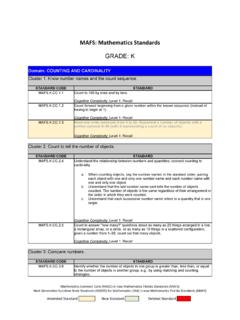
2 Number names and counting sequence Know number names and the count sequence. Cluster 1. Count to 100 by ones and by tens. 2. Count forward beginning from a given number within the known sequence (instead of having to begin at 1). 3. Write numbers from 0 to 20. Represent a number of objects with a written numeral 0-20 (with 0 representing a count of no objects). Cluster 1. Understand number words as representing a quantity. 2. Understand the concept of one and more . 3. Count forward using the 1-10 sequence. 4. Write or use an alternative pencil to write numbers 0-10. NC Extended CCSS Final 2 10/27/2011 Count to tell the number of objects. Count to tell how many / quantity Count to tell the number of objects. Cluster 4. Understand the relationship between numbers and quantities; connect counting to cardinality.
3 A. When counting objects, say the number names in the standard order, pairing each object with one and only one number name and each number name with one and only one object. b. Understand that the last number name said tells the number of objects counted. The number of objects is the same regardless of their arrangement or the order in which they were counted. c. Understand that each successive number name refers to a quantity that is one larger. 5. Count to answer how many? questions about as many as 20 things arranged in a line, a rectangular array, or a circle; or as many as 10 things in a scattered configuration; given a number from 1-20, count out that many objects. Cluster 5. Understand the relationship between numbers and quantities (0-10); connect counting to cardinality. a. When counting objects, indicate the number names in the standard order, pairing each object with one and only one number name and each number name with one and only one object.
4 B. Understand that the last number name said tells the number of objects counted. The number of objects is the same regardless of their arrangement or the order in which they were counted. c. Understand that each successive number name refers to a quantity that is one larger. 6. Count to answer how many? questions about as many as 10 things arranged in a line or a rectangular array; given a number from 1-10, count out that many objects or indicate the number of objects. Compare numbers. Compare numbers to determine more, less or equal Compare numbers. 6. Identify whether the number of objects in one group is greater than, less than, or equal to the number of objects in another group, , by using matching and counting strategies. 7. Compare two numbers between 1 and 10 presented as written numerals. 7. Identify whether the number of objects in one group is more, less, or equal to the number of objects in another group, , by using matching and counting strategies.
5 NC Extended CCSS Final 3 10/27/2011 Kindergarten Mathematics Measurement and Data Common core State standards Essence Extended Common core Describe and compare measurable attributes. Measureable attributes of length Describe and compare measurable attributes. Cluster 1. Describe measurable attributes of objects, such as length or weight. Describe several measurable attributes of a single object. 2. Directly compare two objects with a measurable attribute in Common , to see which object has more of / less of the attribute, and describe the difference. For example, directly compare the heights of two children and describe one child as taller/shorter. Cluster 1. Compare the length of two objects using direct comparison. 2. Use appropriate vocabulary to describe differences in length ( , longer/ shorter).
6 Concepts added at this grade to begin development of background knowledge for concepts developed in later grades. 3. Use the words, before/after, now/later, soon/never to refer to personal activities and events (time concepts). 4. Understand first-then schedule (time concepts). Classify objects and count the number of objects in each category. Sort objects by attribute and count how many in set. Sort objects and count the number of objects in each category. Cluster 3. Classify objects into given categories; count the numbers of objects in each category and sort the categories by count. Cluster 5. Identify objects as same or different. 6. Recognize similarities and differences between objects (attribute). 7. Sort objects according to attribute and count how many in sets (1-5 objects per set). NC Extended CCSS Final 4 10/27/2011 Kindergarten Mathematics Geometry Common core State standards Essence Extended Common core Identify and describe shapes (such as squares, circles, triangles, rectangles, hexagons, cubes, cones, cylinders, and spheres).
7 Identify shapes and describe positions Identify and describe shapes (squares and circles). Cluster 1. Describe objects in the environment using names of shapes, and describe the relative positions of these objects using terms such as above, below, beside, in front of, behind, and next to. 2. Correctly name shapes regardless of their orientations or overall size. 3. Identify shapes as two-dimensional (lying in a plane, flat ) or three-dimensional ( solid ). Cluster 1. Describe objects in the environment using names of shapes. 2. Describe the relative position of objects using terms such as in, on, out, under, off to locate objects. Analyze, compare, create, and compose shapes. Understand shapes can be different sizes Compare shapes. Cluster 4. Analyze and compare a variety of two- and three-dimensional shapes, in different sizes and orientations, using informal language to describe their similarities, differences, parts ( , number of sides and vertices/ corners ) and other attributes ( , having sides of equal length).
8 5. Model shapes in the world by building shapes from components ( , sticks and clay balls) and drawing shapes. 6. Compose simple shapes to form larger shapes. Cluster 3. Compare a variety of two-dimensional shapes, in different sizes to describe differences (big/little, small/medium/large). NC Extended CCSS Final 5 10/27/2011 1st Grade Mathematics Operations and Algebraic Thinking Common core State standards Essence Extended Common core Represent and solve problems involving addition and subtraction. Joining and separating can be used to make two sets have equal quantity. Solve problems involving joining and separating. Cluster 1. Use addition and subtraction within 20 to solve word problems involving situations of adding to, taking from, putting together, taking apart, and comparing, with unknowns in all positions, , by using objects, drawings, and equations with a symbol for the unknown number to represent the problem.
9 2. Solve word problems that call for addition of three whole numbers whose sum is less than or equal to 20, , by using objects, drawings, and equations with a symbol for the unknown number to represent the problem. Cluster 1. Use informal language (take away, give, add, more, same quantity) to describe the joining situations (putting together) and separating situations (breaking apart). 2. Use joining and separating to solve problems (to at least 10) using objects, representations and numbers using only two sets. 3. Describe equal sets as same quantity after counting objects (up to ten). 4. Use objects and representations to make two sets equal. NC Extended CCSS Final 6 10/27/2011 1st Grade Mathematics Number and Operations in Base Ten Common core State standards Essence Extended Common core Extend the counting sequence.
10 Continue to learn counting sequence and understand the magnitude of the number Extend the counting sequence. Cluster 1. Count to 120, starting at any number less than 120. In this range, read and write numerals and represent a number of objects with a written numeral. Cluster 1. Count forward using the 1-20 sequence. 2. Write or use an alternative pencil to write numbers 0-20. 3. Illustrate whole numbers to 20 using objects, representations and numbers. 4. Use number word (0-20) of last object counted in a set, to name the total number of objects in the set when asked, How many? (cardinality) 5. Use zero to indicate no objects when asked, How many? 6. Compare objects, representations and numbers (1-20) using words more and less . 7. Use a set of objects and separate set into smaller sets (number partners). 8. Understand a set has smaller quantities within the whole set (inclusion). 9. Illustrate the relationship between subsets and the whole (part-part-whole) using objects.