Transcription of NOT SO SCARY LIGHTING MATH - rsltg.com
1 Calculating Light NOT SO SCARY LIGHTING math . Measuring Light /. Light Metrics Hand Calculations Point-by-Point Lumen Method 1. Calculating Light The importance of LIGHTING math : Calculations can determine the light levels Calculations can determine the required quantity of fixtures Calculations can verify uniformity Methods to perform LIGHTING math : By Hand - calculates a quick . estimate of light levels levels, and verifies qty of fixtures By Computer - calculates a detailed . estimate of light levels, and verifies qty of fixtures 2. 1. Calculating Light Target Illuminance / Light Levels Who Defines Light Levels?
2 IES of North America Recommended Practices Defines light levels and quality of illumination by task and application Codes and Regulations The Owner Definitions: Task = the work performed Applications = the project type ( School, Commercial etc, 3. Target Illuminance / Ages Less than Standard Age Range Over 55. 400 ye yearss is 40-55 yyears old years old . old old . Can Can reduce increase the the light light levels levels up to up to 2/3! 1/3! Babies require 3 times more light than a 20 year old! 4. 2. Calculating Light IESNA Recommended Light Levels 5.)
3 IESNA Recommended Light Levels 6. 3. Calculating Light IESNA Recommended Light Levels IESNA Light Level recommendations are for foot- candles (FC, fc) at the work plane - 2'6 AFF (30 inches). They have limited significance to us when we interpret the actual environment. Such factors as LIGHTING walls, brightness accents, shadows, sparkle, and color have a greater influence on emotional reaction. IESNA's recommend light levels are for an age range of 40 55 years old 7. IESNA Recommended Light Levels A 3 fc A=. B = 5 fc C = 10 fc D = 30 fc E = 50 fc F = 100 fc G = 300-1000 fc 8.
4 4. Calculating Light Summary Horizontal Light Level (table 15). 9. Hand Methods to Calculate Light Mnfrs Guides Direct or Average Illumination from a Fixture or Lamp Recommended spacing or layout Point-by Point-by--Point Direct light level from a Fixture or Lamp reaching a specific point Candlepower info needed Lumen Method Average Light Level in a Room from a Fixture Lumen info needed (Can be used to determine quantity needed) 10. 5. Calculating Light Manufactures Guides: Beam Guides 11. Manufactures Guides: Printed Literature 12. 6. Calculating Light Manufactures Guides: Printed Literature 13.
5 Manufactures Guides: Printed Literature 14. 7. Calculating Light Manufactures Guides: Printed Literature 15. Manufactures Guides: On-Line Calculations 16. 8. Calculating Light Computer Calculation Example 17. Computer Calculation Example 9. Calculating Light Seeing Light Illuminance: We do Not See Light Arriving Light Measures how much light is present, the light level to perform a task arriving LIGHTING energy Examples: emergency light level on the floor), on the desk, desk on a book Measured in: Foot-Candles (US) and Lux (Metric). Light Luminance: We See Brightness of Surfaces Measures how easy something is to see, or how bright a surface is emitting or reflected light energy Examples: backlit signage signage, the moon moon, a glowing wall, the contrast on steps Measured in: Foot-Lamberts (US) or Candelas per meter squared (metric).
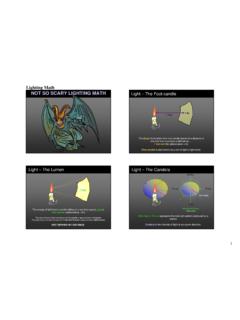
6 1 Foot-Lambert = Candelas/m2. 19. Light Metric The Foot-candle 1 foot 1 foot-candle Foot--candle is known as a unit of light - direct illumination Foot light level Derived from one candle placed at a distance of one foot from a surface is defined as a foot foot--candle (abbreviation = fc or FC). 20. 10. Calculating Light Light Metric The Lumen 12in 1 lm 12in The energy of light from a candle falling on a one foot square area is One Lumen (abbreviation = lm). The total amount of light energy coming out of the candle is approximately 13 lumens The total amount of light energy coming out of 100.
7 100--watt A. A--lamp is approximately 1650 lumens NOT DEFINED BY DISTANCE 21. Efficiency vs Efficacy Watts is the amount of energy used to Produce Light Light output from lamps and fixtures be measured in units of Lumens and Candelas Candelas. The ratio Lumens emitted by a lamp or fixture measures Efficiency and Efficacy 25% is lost Efficacy = Lumens/Watt Efficiency = Fixture Lumens/Lamp Lumens = 1650/100 = 1240/1650. = L/W = 75%. 22. 11. Calculating Light Light Metric The Candela 180 deg 270 deg 90 deg Candela 0 deg Distribution Curve Polar Chart Candle Power is the intensity value at any given direction.
8 (unit is Candela, abbreviated as cp). Distribution Curve represents the total light intensity pattern produced by a source 23. Light Measurement Measures the candlepower distribution of a particular lamp or luminaire. Information is generated in a -- Photometric report Integrating Sphere Gonio-Photometer The Spectro-Radiometer 24. 12. Calculating Light Photometry Reports Plot of candlepower values Summary of candlepower values in different planes Fixture Efficiency Lumen Summary Luminance summary Spacing criteria (SC) or Spacing/Mounting Height (S/MH) for uniformity Coefficient of Utilization Table Guides 25.
9 Hand Methods to Calculate Light Mnfrs Guides Direct or Average Illumination from a Fixture or Lamp Recommended spacing or layout Point-by Point-by--Point Direct light level from a Fixture or Lamp reaching a specific point Candlepower info needed Lumen Method Average Light Level in a Room from a Fixture Lumen info needed (Can be used to determine quantity needed) 26. 13. Calculating Light Point-by-Point: FC at a Point CIE Luminaire Types / Distributions Direct Semi-Direct General Diffuse (IES) Direct-Indirect Semi-Indirect Indirect 27. Photometry Reports: sample 1.
10 Open Downlight Downlight 28. 14. Calculating Light Photometry Reports: sample 2. Indirect Pendant Indirect Pendant 29. Photometry Reports: sample 3. Ceiling Fixture 30. 15. Calculating Light Point-by-Point: FC at a Point Asymmetrical Distribution Curve Rectangular Tubular Fluourescent fixture 90 deg Perpendicular Perpendicular . 90 degrees Candlepower Distribution 0 deg Parallel Rectangular Tubular Fluourescent fixture Candlepower Distribution 31. Point-by-Point: FC at a Point Candlepower distribution curves 90 deg provides intuitive p 80. information on how a 300.