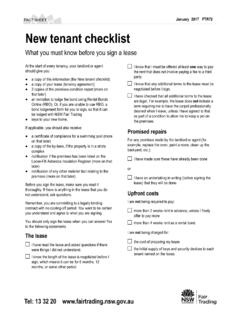
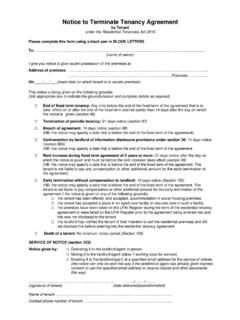
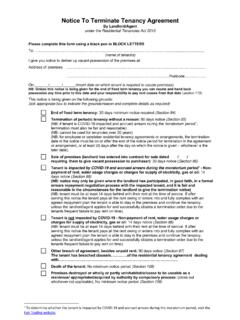
Transcription of NSW FAIR TRADING
1 NSW fair TRADING Real Estate Fraud Prevention Guidelines A division of the Department of Finance & Services Apr 2013 1 Real Estate Fraud Prevention Guidelines Contents 1. Introduction .. 2 2. Background .. 2 3. The Law .. 2 4. Commissioner s Guidance .. 3 5. Prescribed Documents .. 4 6. Confirming Identities of Vendors or Representatives .. 4 7. Possible Fraud Warning Signs .. 6 8. What Should be Done if Fraudulent Activity is Suspected? .. 6 9. Privacy Requirements for Personal Information .. 6 Attachment 1 Suggested Proof of Identity Checklist for Vendors (or appointed representative) State of New South Wales through NSW fair TRADING , 2013 A division of the Department of Finance & Services Apr 2013 2 1.
2 Introduction These Guidelines have been issued by the Commissioner for fair TRADING and are intended to help real estate agents verify the identification of vendors when dealing with clients in order to prevent real estate fraud. 2. Background Identity fraud and scams are increasingly prevalent throughout the community and the property industry is not immune to falling victim to such events. Two highly publicised incidents in September 2010 and March/April 2011 resulted in properties being sold in Western Australia without the knowledge and consent of the lawful property owners.
3 These two sales were undertaken by real estate agents after being contacted by criminals impersonating the true owners. The initial contact with the agent was made by telephone. The person impersonating the owner notified the agent of new contact details which then formed the basis of future contacts, a practice which should have placed the agent on alert. These two events highlight how easily a fraud can commence and emphasise that agents need to be on high alert at all times to ensure that fraudulent real estate transactions do not occur.
4 3. The Law Section 37 of the Property, Stock and Business Agents Act 2002 provides that the regulations may prescribe rules of conduct to be observed in the course of the carrying on of business or the exercise of functions under a licence or certificate of registration. Penalties apply for breaches of rules of conduct. The maximum penalty is 100 penalty units presently $11,000. In addition, disciplinary action can be taken under the Act which can lead to licence cancellation and disqualification. Rule of Conduct two in the Property, Stock and Business Agents Regulation 2003 requires agents to comply with the fiduciary obligations arising as an agent.
5 Rule of Conduct three requires that an agent must act honestly, fairly and professionally with all parties in a transaction. Rule of Conduct four requires that an agent must exercise reasonable skill, care and diligence. Rule of Conduct six requires that the agent must act in the client s best interest at all times unless it would be contrary to the Act or regulations under the Act or otherwise unlawful to do so. Section 191 of the Act provides that disciplinary action can be taken against the holder of a licence for inter-alia, carrying on business or exercising functions under the licence or certificate of registration having acted unlawfully, improperly, unfairly or incompetently.
6 Disciplinary action can A division of the Department of Finance & Services Apr 2013 3 lead to penalties ranging from a caution or reprimand, a monetary penalty, to cancellation of a licence and disqualification. Section 55 of the Property, Stock and Business Agents Act 2002 provides that an agent is not entitled to any commission or expenses from a person for or in connection with services performed by the licensee in the capacity of licensee for or on behalf of any person unless the services were performed pursuant to an agency agreement signed by or on behalf of the person and the licensee.
7 Section 63 of the Property, Stock and Business Agents Act 2002 prohibits a real estate agent from offering residential property for sale unless the required documents are all available for inspection at the real estate agent s registered office by a prospective purchaser or agent for a prospective purchaser at all times at which an offer to purchase the property may be made. Section 63 prescribes the situations when an agent is considered to offer residential property for sale, and sets out the required documents which must be available. These documents include a copy of the proposed contract for the sale of the property and the documents required by section 52A of the Conveyancing Act 1919.
8 4. Commissioner s Guidance The licensee in charge should have adequate written guidelines in place to ensure that all employees follow proper procedures and are aware of their responsibilities under the Act. In their procedures and in performing their duties an agent should conduct an identification check. Agents could use the attached Proof of Identity Checklist for Vendors or appointed representatives (see attachment 1) or a similar document to show that the client has satisfactorily proven that they own the property or legally represent the true owner.
9 DOCUMENTS SHOULD BE RETAINED IN THE SALES FILE FOR INSPECTION IF REQUIRED 5. Prescribed Documents The prescribed documents which must be included with the contract for the sale of the property are listed in Schedule 1 of the Conveyancing (Sale of Land) Regulation 2010. These documents include a property certificate. A property certificate is a title search from Land and Property Information relating to the property which is to be sold. The certificate describes the land using the lot and deposited plan. The first schedule on the property search sets out the full name of the current owner of the property.
10 The second schedule sets out any notifications, including details of any mortgagee, or any caveats on the property. A division of the Department of Finance & Services Apr 2013 4 6. Confirming Identities of Vendors or Representatives Agents should use the following guidelines when selling a property to confirm the identity of vendors (or appointed representative) in order to prevent real estate fraud. 1. When selling a property, confirm that dealings are with the true owner(s) of the property [ the registered proprietors or their properly appointed representative].