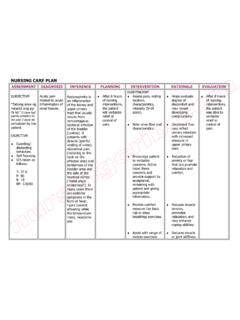
Transcription of NURSING CARE PLAN
1 NURSING care plan ASSESSMENT DIAGNOSIS INFERENCE PLANNING INTERVENTION RATIONALE EVALUATION Subjective: Hindi ako makatulog dahil sa ubo ko as verbalized by the patient. Objective: Fatigue. Dyspnea. V/S taken as follows: T: P: 90 R: 22 BP: 110/80 Actvity intolerance related to exhaustion associated with interruption in usual sleep pattern because of discomfort, excessive coughing and dyspnea. Coughing is the body's way of removing foreign material or mucous from the lungs and throat. The two general classifications of cough are productive coughs (producing phlegm or mucous from the lungs) and nonproductive coughs (dry and not producing any mucous or phlegm). Coughs are also divided into acute (less than 3 weeks' duration) After 4 hours of NURSING interventions, the patient will demonstrate a measurable increase in tolerance in activity with absence of dyspnea and excessive fatigue. Independent: Evaluate patient s response to activity.
2 Provide a quiet environment and limit visitors during acute phase. Elevate head and encourage frequent position changes, deep breathing and effective coughing. Encourage adequate rest balanced with moderate activity. Promote adequate nutritional intake. Establishes patient s capabilities or needs and facilitates choice of interventions Reduces stress and excess stimulation, promoting rest. These measures promotes maximal inspiration, enhance expectoration of secretions to improve ventilation. Facilitates healing process and enhances natural resistance. After 4 hours of NURSING interventions, the patient was able to demonstrate a measurable increase in tolerance in activity with absence of dyspnea and excessive fatigue. and chronic (more than three weeks' duration). Acute cough is most often caused by the common viral upper respiratory tract infection. Chronic cough may be caused by a variety of underlying diseases including asthma, cystic fibrosis, allergies, GERD and chronic post nasal drip.
3 Force fluids to at least 3000 ml per day and offer warm, rather than cold fluids. Collaborative: Administer medications as prescribe: mucolytics or expectorants. Fluids especially warm liquids aid in mobilization and expectoration of secretions. Aids in reduction of bronchospasm and mobilization of secretions.