Transcription of NURSING CARE PLAN Sleep
1 1180 UNIT X / Promoting Physiologic Healthsleep or nonrestorative Sleep associated with menopausal symp-toms often benefit by the prescription of 10 mg of zolpidem, a lowdose that was documented to be both safe and efficacious in thispopulation. Hypnotics are not appropriate if clients have anysymptoms suggestive of Sleep -related breathing disorders, or de-creased renal and/or hepatic 45 1 presents some of the common medications usedfor enhancing Sleep and the half-life of these medications.
2 Thehalf-life represents how long it takes for half of the medicationto be metabolized and eliminated by the body; hence, those withshorter half-lives are less likely to cause residual drowsiness af-ter administration, but may be less effective for the treatment ofsleep maintenance data collected during care and the desired outcomes de-veloped during the planning stage as a guide, the nurse judgeswhether client goals and outcomes have been achieved. Datacollection may include (a) observations of the duration of theclient s Sleep , (b) questions about how the client feels on awak-ening, or (c) observations of the client s level of alertness dur-ing the day.
3 Examples of client goals and related outcomes areshown in Identifying NURSING Diagnoses, Outcomes, and Inter-ventions earlier in this the desired outcomes are not achieved, the nurse and clientshould explore the reasons, which may include answers to thefollowing questions: Were etiologic factors correctly identified? Has the client s physical condition or medication therapychanged? Did the client comply with instructions about establishing aregular Sleep wake pattern? Did the client avoid ingesting caffeine?
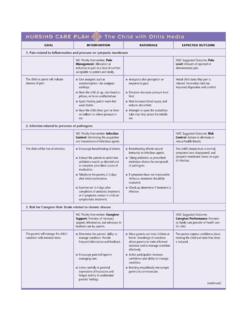
4 Did the client participate in stimulating daytime activities toavoid excessive daytime naps? Were all possible measures taken to provide a restful envi-ronment for the client? Were the comfort and relaxation measures effective? NURSING care PLANS leepASSESSMENT DATANURSING DIAGNOSISDESIRED OUTCOMES* NURSING AssessmentJack Harrison is a 36-year-old police officer assigned to a high-crime police precinct. One week ago he received a surface bulletwound to his arm. Today he arrives at the outpatient clinic to havethe wound redressed.
5 While speaking with the nurse, Mr. Harrisonmentions that he has recently been promoted to the rank of de-tective and has assumed new responsibilities. He states that sincehis promotion, he has experienced increasing difficulty fallingasleep and sometimes staying asleep. He expresses concern overthe danger of his occupation and his desire to do well in his newposition. He complains of waking up feeling tired and related to anxiety (as evidenced by difficultyfalling and remaining asleep,fatigue, and irritability) Sleep [0004] as evidenced by: Sleeps through the nightconsistently Feels rejuvenated after Sleep No dependence on sleepaidsPhysical ExaminationHeight: cm (6 2 )Weight: kg (189 lb)Temperature: C ( F)Pulse: 80 BPMR espirations: 18/minuteBlood pressure: 144/88 mm HgDiagnostic DataCBC within normal range, x-rayleft arm.
6 Evidence of superficialsoft tissue injuryTABLE 45 1 Selected Sedative-HypnoticMedications Used for InsomniaMEDICATIONHALF-LIFEC hloral hydrate (Noctec)Eszopiclone (Lunesta)Ethchlorvynol (Placidyl)Flurazepam (Dalmane)Glutethimide (Doriden)Lorazepam (Ativan)MelatoninTemazepam (Restoril)Triazolam (Halcion)Zaleplon (Sonata)Zolpidem (Ambien)7 10 hours6 hours10 20 hours47 100 hours1 12 hours10 20 hours1 hour9 15 hours1 hoursMediaLink Client with the Sleep Disorder care plan 11/8/06 6:24 PM Page 1180 CHAPTER 45 / Sleep 1181 Determine the client s Sleep and activity Mr.
7 Harrison to establish a bedtime routine to facilitatetransition from wakefulness to him to eliminate stressful situations before Mr. Harrison and significant others about factors ( ,physiologic, psychologic, lifestyle, frequent work shift changes, ex-cessively long work hours, and other environmental factors) thatcontribute to Sleep pattern with Mr. Harrison and his family comfort measures, Sleep -promoting techniques, and lifestyle changes that can contribute tooptimal bedtime food and beverage intake for items that facilitateor interfere with amount of Sleep an individual needs varies with lifestyle,health, and and routines induce comfort, relaxation, and interferes with a person s ability to relax, rest.
8 And of causative factors can enable the client to begin tocontrol factors that inhibit of factors that affect Sleep enables the client to im-plement changes in lifestyle and prebedtime and protein foods contain tryptophan, a precursor of sero-tonin, which is thought to induce and maintain Sleep . Stimulantsshould be avoided because they inhibit Enhancement [5380]Discuss specific situations or individuals that threaten Mr. Harrisonor his him to use coping responses that have been successful inthe is reduced when the reality of a situation is confronted in asafe environment.
9 Awareness of factors that cause intensificationof fears enhances of safety and security increase when an individual identi-fies previously successful ways of dealing with anxiety-provokingor fearful care plan SleepcontinuedNURSING INTERVENTIONS*/SELECTED ACTIVITIESRATIONALES leep Enhancement [1850]Outcome met. Mr. Harrison acknowledges his insomnia is a somatic expression of his anxiety regarding job promotion and fear of states that talking with the police department counselor has been helpful.
10 He is practicing relaxation techniques each night and sleepsan average of 7 hours a night. Mr. Harrison expresses a feeling of being rested upon an atmosphere to facilitate to understand Mr. Harrison s perspective of a stressful verbalization of feelings, perceptions, and the client s decision-making is an essential first step in the therapeutic is a feeling aroused by a vague, nonspecific threat. Identify-ing the client s perspective will facilitate planning for the best ap-proach to anxiety expression of feelings facilitates identification of specificemotions such as anger or helplessness, distorted perceptions,and unrealistic coping mechanisms are characterized by an inabilityto make decisions and Reduction [5820]APPLYING CRITICAL THINKING1.