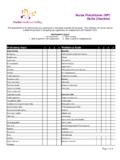
Transcription of NURSING SKILLS INVENTORY
1 NURSING SKILLS INVENTORY Student:_____ _____ To the Student: Purpose: This tool is provided to help keep a record of the SKILLS you have performed. It will aid in assessment and planning for each clinical rotation; promote increased skill acquisition, confidence and competence for the student nurse; and facilitate individualized teaching/learning throughout the clinical education process. 1) It is the student s responsibility to maintain this SKILLS checklist 2) Share skill list with clinical Faculty at the beginning and end of each clinical rotation. a) School faculty is to verify successful return demonstration of skill in learning lab. b) Student completes the SKILLS self-evaluation prior to the beginning of each clinical rotation. c) Student documents the date when the skill has been successfully demonstrated in the clinical setting; indicates skill level and initial as student. School Faculty: 1) Indicate(*) SKILLS appropriate for student level of process and per curriculum guidelines.
2 2) Document the date when the skill has been successfully demonstrated in a non- clinical setting ( SKILLS lab); and initial as faculty. Preceptor/RN staff personnel: 1) Familiarize the student with the location of available resources and references 2) Document the date when the skill has been successfully demonstrated in the clinical setting; and initial as preceptor. clinical Faculty: 1) Ensure that the student is familiar with the appropriate resources and references Record your signature with initials below: Signature Initials Facility Signature Initials Facility Perry, A. G., & Potter, P. A. (2006). clinical NURSING SKILLS & techniques (6t h ed.). St. Louis: Mosby. NURSING SKILLS INVENTORY Updated Student: _____ The student has correctly demonstrated the following NURSING SKILLS . Refer to clinical NURSING SKILLS and techniques foundations textbook for specific skill criteria.
3 NURSING SKILLS List Successfully completed return demonstration in simulated lab. Faculty initials/date Care of the Adult Client Successfully completed return demonstration in the clinical setting (I) Independent (A) Assisted Student and/or RN initials/date Care of the Pediatric Client Successfully completed return demonstration in the clinical setting (I) Independent (A) Assisted Student and/or RN initials/date Student Self-Assessment What level of confidence do you have with the following SKILLS ? Rate the SKILLS using this scale: L=Low M=Moderate H=High *=Have not previously performed this skill Supporting the Client Through the Health Care System Admitting, Transfer, and Discharge: Admitting Clients: Admission Health History Admission Assessment Transferring Clients (Interagency) Discharging Clients Communication: Establishing Therapeutic Communication Hand-off Communication: SBAR Recording and Reporting: Documenting in the Client Record Giving a Change-of Shift Report Incident Reporting Other: NURSING SKILLS List Return demonstration in simulated lab Care of the Adult Client Care of the Pediatric Client Student Self-Assessment Safety and Comfort Safety: Fall Prevention Seizure Precautions Applying Restraints: Vest Limb Mittens Comfort.
4 Removing Painful Stimuli Nonpharmacological Aids to Promote Comfort Pain Management Systems: Pain Assessment: Pain Scale/Other Patient-Controlled Analgesia: Set-up Monitoring/Maintaining Discontinuing Epidural Analgesia: Set-up Monitoring/Maintaining Discontinuing Other: Hygiene Bathing and Skin Care: Bathing a Client Providing Perineal/Foley Catheter Care Brushing Teeth Performing Mouth Care for the Unconscious or Debilitated Client NURSING SKILLS List Return demonstration in simulated lab Care of the Adult Client Care of the Pediatric Client Student Self-Assessment Cleaning Dentures Shampooing Hair of a Bedridden Client Shaving a Client Performing Nail and Foot Care Care of the Client s Environment: Making an Unoccupied Bed Making an Occupied Bed Pressure Ulcer Care: Risk Assessment and Prevention Strategies Treatment of Pressure Ulcers Care of Eye and Ear Prostheses: Taking Care of Contact Lenses Taking Care of an In-the-Ear Hearing Aid Other: Vital Signs and Physical Assessment Vital Signs: Measuring Body Temperature Assessing Apical Pulse Assessing Radial Pulse Assessing Peripheral Pulses Utilization of a Doppler Assessing Arterial Blood Pressure: Manual Blood Pressure Upper Extremity Lower Extremity Automatic/Dynamap NURSING SKILLS List Return demonstration in simulated lab Care of the Adult Client Care of the Pediatric Client Student Self-Assessment Assessing Respirations Measuring Oxygen Saturation (Pulse Ox) Physical Examination and Health Assessment.
5 Performing a General Physical Assessment Assessing the Neurological S y s t e m Assessing the EENT (Eyes, Ears, Nose, Throat) Assessing the Respiratory System Assessing the Cardiovascular / Circulatory System Assessing Gastrointestinal S y s t e m Assessing the Musculoskeletal S y s t e m Assessing the Integumentary S y s t e m Assessing the Reproductive System Other: Oxygenation Oxygen Therapy: Applying a Nasal Cannula Applying an Oxygen Mask Administering Oxygen Therapy to a Client with an Artificial Airway Using Incentive Spirometry Care of the Client on Mechanical Ventilation Measuring Peak Expiratory Flow Rates Performing Chest Physiotherapy: Performing Postural Drainage Performing Percussion, Vibration, and Rib Shaking NURSING SKILLS List Return demonstration in simulated lab Care of the Adult Client Care of the Pediatric Client Student Self-Assessment Airway Maintenance: Performing Oral Pharyngeal (Yankauer) Suctioning Performing Nasal Pharyngeal and Nasal Tracheal Suctioning Performing Endotracheal or Tracheostomy Tube Suctioning Performing Endotracheal or Tracheostomy Tube Suctioning Using a Closed System (In-L i n e ) Catheter Performing Endotracheal Tube Care Performing Tracheostomy Care Inflating the Cuff on an Endotracheal or Tracheostomy Tube Closed Chest Drainage Systems: Caring for Clients with Chest Tube Connected to Disposable Drainage S y s t e m Removing Chest Tubes Postoperative Autotransfusion Emergency Measures for Life Support Performing Cardiopulmonary Resuscitation (CPR) Other.
6 Medications Preparing For Medication Administration: Administration of Medication Utilizing 2 patient Identifiers Five Rights of Drug Administration: 6th Right-Documentation Identify Guidelines for Safe Administration of Medications: Function Class/Chemical Class Action Indications and Uses Why this client is receiving this Medication NURSING SKILLS List Return demonstration in simulated lab Care of the Adult Client Care of the Pediatric Client Student Self-Assessment Dosage and Route Contraindications Precautions Drug/Lab Interactions Drug Compatibilities NURSING Considerations Identify Aseptic Techniques Used in Preparing and Administering Medications Demonstrate Appropriate Drug Calculations and Confirmation with 2 RN s Utilization and Documentation on the Medication Administration Record Oral and Topical Medications.
7 Administering Oral Medications Administering Medications by Nasogastric Tube / G-Tube / J-Tube Administering Medications to the Skin Administering Eye Medications Administering Ear Drops Administering Ear Irrigations Administering Nasal Instillations Using Metered-Dose Inhalers Administering Vaginal Instillations Administering Rectal Suppositories Parenteral Medications: Administering Insulin Preparing Injections from Ampules and Vials Mixing Medications from Two Vials Administering Intradermal Injections Administering Subcutaneous Injections Administering Intramuscular Injections NURSING SKILLS List Return demonstration in simulated lab Care of the Adult Client Care of the Pediatric Client Student Self-Assessment Adding Medications to Intravenous Fluid Containers Administering Intravenous Medications by Intermittent Infusion Sets Administering Medications by Intravenous Bolus/Push Other: Fluid Balance Intravenous and Vascular Access Therapy.
8 Initiating (Setting-up) Intravenous Therapy Includes Appropriate Marking/Dating/Labeling Inserting a Peripheral Intravenous Catheter Regulating Intravenous Flow Rate Changing Intravenous Solutions Changing Infusion Tubing Includes Appropriate Marking/Dating/Labeling Changing a Peripheral Intravenous Dressing Discontinuing Peripheral Intravenous Access Administration of Infusions Utilizing a Central Venous Catheter Obtaining a Blood Sample from a Central Venous Catheter Obtaining a Central Venous Pressure (CVP) Reading Changing a Central Venous Catheter Dressing Discontinuing a Central Venous Catheter Blood Therapy: Initiating (Setting-up) Blood Transfusion Set Observe Initiation of Blood Therapy Note* Blood must be checked at Bedside by 2 RN s NURSING SKILLS List Return demonstration in simulated lab Care of the Adult Client Care of the Pediatric Client Student Self-Assessment Monitoring for Transfusion Reactions Assisting with Autologous Blood Transfusion Postoperative Autotransfusion Other: Nutrition Oral Nutrition: Performing Nutritional Assessment Assisting the Adult Client with Oral Nutrition Aspiration Precautions Enteral Nutrition: Intubating the Client with a Small-Bore Nasogastric or Nasointestinal Feeding Tube Verifying Tube Placement for a L a r g e-Bore Feeding Tube Initiating (Setting-up) Enteral Feedings Maintaining/Monitoring Enteral Feedings Continuous Bolus/Gravity Gastrostomy Tube Site Care Parenteral Nutrition.
9 Caring for the Client Receiving Central Parenteral Nutrition Caring for the Client Receiving Lipids Medication/Nutrition Pumps I V Infusion Pump Enteral Feeding Pump Other: NURSING SKILLS List Return demonstration in simulated lab Care of the Adult Client Care of the Pediatric Client Student Self-Assessment Elimination Urinary Elimination: Measuring and Recording Intake and Output Assisting a Client to use a Urinal Inserting a Straight Catheter (Male) Inserting a Straight Catheter (Female) Inserting an Indwelling Catheter (Male) Inserting an Indwelling Catheter (Female) Care of the Indwelling Catheter Discontinuing an Indwelling Catheter Performing an Intermittent Catheter Irrigation Continuous Bladder Irrigation Applying a Condom Catheter Care of a Suprapubic Catheter Performing a Bladder Scan Bowel Elimination: Assisting a Client to Use a Bedpan Insertion of rectal tubes Removing a Fecal Impaction Digitally (Bowel Program) Administering an Enema: Large Volume Small Volume Ostomy Care: Pouching an Enterostomy Peristomal Skin Care Emptying/Rinsing a Colostomy/Ileostomy Irrigating a Colostomy Other: NURSING SKILLS List Return demonstration in simulated lab Care of the Adult Client Care of the Pediatric Client Student Self-Assessment Posture, Mobility, and Ambulation Body Alignment and Mechanics: Maintaining Body Alignment Performing Safe and Efficient Lifting Techniques Transfer and Positioning: Using Safe and Effective Transfer Techniques Use of a Hoyer Lift Use of a Slide Board Use of a Transfer Belt Moving and Positioning Clients in Bed Exercise and Ambulation.
10 Performing Range-of-Motion Exercises Performing Isometric Exercises Applying Elastic (Anti-Embolic) Stockings Application and Maintenance of Sequential Compression Devices (SCD s) Application and Maintenance of Arterio-Venous Impulse System (AVI s) Changing Client s Position to Minimize Occurance of Orthostatic Hypotension Assisting with Ambulation Utilization of a Gait Belt Assistance of the Client with Crutches Assistance of the Client with a Walker Assistance of the Client with a Wheelchair Orthopedic Measures Application and Care of the Client with a Continuous Passive Motion (CPM) Device Application and Care of the Client with Buck s Traction Maintenance of an Orthopedic Cold Therapy Device (Cryo Cuff) NURSING SKILLS List Return demonstration in simulated lab Care of the Adult Client Care of the Pediatric Client Student Self-Assessment Care of the Client with External Fixator/Pin Care Specialty Beds and Support Surfaces Care of the Client on a Specialty Bed/Support Surface Other: Prevention of Infection Medical Asepsis: Hand Hygiene Standard Precautions Appropriate Use of Personal Protective Equipment Appropriate Use/Disposal of Safety Devices/Needles/Sharps Appropriate Disposal of Linen Appropriate Disposal of Trash/Waste Caring for Clients under Isolation Precautions: Airborne Droplet Contact Sterile Technique: Preparing a Sterile Field Open Gloving Other: Care of the Surgical Client Preoperative and Postoperative Care.