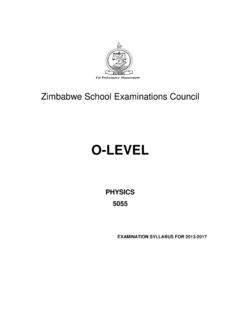
Transcription of O- LEVEL PHYSICS SYLLABUS
1 ZIMBABWEMINISTRY OF PRIMARY AND SECONDARY EDUCATIONO- LEVEL PHYSICS SYLLABUSFORMS 3 - 42015 - 2022 Curriculum Development and Technical Box MP 133 Mount PleasantHarare All Rights Reserved2015O LEVEL PHYSICS SYLLABUS Forms 3 - 4 ACKNOWLEDGEMENTSThe Ministry of Primary and Secondary Education wishes to acknowledge the following for their valued contribution in the production of this SYLLABUS : Panellists for O LEVEL PHYSICS SYLLABUS . Zimbabwe School Examinations Council (ZIMSEC). Government departments. Ministry of Higher and Tertiary Education, Science and Technology Development. United Nations Children s Fund (UNICEF). United Nations Educational Scientific and Cultural Organisation (UNESCO). iO LEVEL PHYSICS SYLLABUS Forms 3 - 4iiCONTENTSACKNOWLEDGEMENTS ..iCONTENTS .. PREAMBLE .. PRESENTATION OF THE SYLLABUS .. AIMS .. OBJECTIVES .. METHODOLOGY AND TIME ALLOCATION .. SCOPE AND SEQUENCE CHART ..3 FORM 3 ..8 FORM OF LEVEL PHYSICS SYLLABUS Forms 3 - Introduction This SYLLABUS is designed to put greater emphasis on the understanding and application of physical concepts and principles.
2 It make learners identify, investigate and solve problems in a sustainable manner. This two - year learning phase will see learners being assessed through continuous assessment and national examination. The O LEVEL PHYSICS SYLLABUS is designed to inclusively cater for all categories of learners. RationaleModern day economies, Zimbabwe included, are driven by technology and PHYSICS concepts form part of the basis. The study of PHYSICS enables learners to be creative and innovative in industry and society can promote the application of PHYSICS in industrial processes for value addition is well known. The learning of PHYSICS concepts promotes value creation, addition and beneficiation of natural resources and harness available opportunities for Summary of Content O LEVEL PHYSICS SYLLABUS will cover theory and practical activities in the following areas: Newtonian Mechanics, Dynamics, Waves, Electricity and Electromagnetism, Thermal PHYSICS and Modern PHYSICS . AssumptionsIt is assumed that: the learner has successfully completed Form 1 and 2 Science SYLLABUS .
3 Science clubs are existing and operational in schools. use of ICT for research and presentation is known by learners. use of measuring instruments such as rulers, balances, second-hand clocks, voltmeters, ammeters and thermometers is known by learners. safety measures are available and Cross- Cutting ThemesThis phase will develop an appreciation of: Inclusivity Environmental issues Indigenous knowledge system Financial literacy Enterprise Education Gender HIV and Life skills Child Protection. Team work Food security Safety health issues Disaster risk PRESENTATION OF THE SYLLABUSThe Ordinary LEVEL PHYSICS SYLLABUS is a single docu-ment covering Forms 3 - 4. It contains the Preamble, Aims, SYLLABUS Objectives, SYLLABUS Topics, Methodology and Time Allocation, Scope and Sequence, Competency Matrix and Assessment. The Scope and Sequence chart shows the progression of topics from Forms 3 - 4, while the SYLLABUS matrix gives details of the content to be AIMSThe aims are create opportunities for learners to acquire research, experimental and practical skills and attitudes in PHYSICS .
4 Enable learners to acquire basic principles of PHYSICS for application in life and as a basis for further studies in PHYSICS and related recognise the usefulness and limitations of the scientific method in the study of inculcate in learners the desire to apply Phys-ics for the benefit of society as guided by the principles of Unhu/Ubuntu and recognising the detrimental effects of misapplication of inculcate in learners the appreciation of the usefulness of ICT in the study and application of LEVEL PHYSICS SYLLABUS Forms 3 - develop, in learners the appreciation of the use of PHYSICS in value creation, addition and beneficiation in mining and other inculcate in learners the regard for safety and protection of the environment in the study of develop in learners an appreciation of gender, HIV and AIDS OBJECTIVES Learners should be able follow instructions in practical work in order to manipulate record observations and analyse data to confirm or establish demonstrate knowledge about physical phenomena, facts, laws, definitions and con-cepts of measure and express physical quantities in SI units to a given LEVEL of accuracy and solve problems using generate and transform information in PHYSICS , from one form to another for presen-tation, interpretation and problem design a practical solution through a PHYSICS project to solve a real life use ICT to simulate PHYSICS phenomena.
5 Present and analyse PHYSICS apply safety measures in all practical explain and apply procedures in PHYSICS to protect the METHODOLOGY AND TIME ALLOCATION Suggested MethodsIt is envisaged that teaching and learning programmes based on this PHYSICS SYLLABUS could feature a wide variety of learning experiences designed to promote acquisition of scientific expertise and understanding, and to develop values and attitudes relevant to science and life. Teachers are encouraged to use a combination of appropriate strategies to effectively and equitably engage and challenge their learners through: Planned experiments Problem solving based learning Individual and group work Educational tours Project based learning Design based learning Learning by discovery E-learning such as simulation Resource person(s) Ortho-didactic principles, such as visual tactile, simulation and self-activity, will be applied when need arises to cater for diverse needs of learners.
6 Safety precautions must always be AllocationA minimum of 8 periods of 35 minutes each in a week should be allocated as double periods for adequate cov-erage of the TOPICS1. Measurement and Physical Quantities2. Kinematics3. Forces4. Machines5. Mechanical Structures6. Work, Energy and Power7. Thermal PHYSICS 8. Internal Combustion Engines9. Waves10. Optics11. Electricity12. Magnetism13. Electromagnetism14. Electronics15. Atomic and Nuclear PhysicsO LEVEL PHYSICS SYLLABUS Forms 3 - SCOPE AND SEQUENCE CHART 2 SCOPE AND SEQUENCE CHART TOPIC FORM 3 FORM 4 MEASUREMENT AND PHYSICAL QUANTITIES Measurements Measurement of physical quantities. Derived quantities Use of units Definition of voltage, resistance and current Experiments to measure voltage, current and determine resistance for ohmic conductors Scalars and vectors Definitions and examples Resultant of coplanar vectors using graphical method Applications KINEMATICS Speed, velocity, distance, displacement and acceleration Definitions of terms Equations of linear motion and application Graphs of motion Drawing and interpretation of graphs Motion under gravity Definition of free fall Calculations and applications FORCES Effect of force on materials Types of forces Interpretation of force extension-graphs Application of forces on beams, trusses and mechanical large structures Effect of force on motion Definitions of weight.
7 Momentum and inertia State and apply Newton s laws of motion Circular motion Friction and circular motion Effects of friction Methods of friction Centripetal acceleration and force Turning effects of a force Moments of a force Turning effect of a force Principles of moments O LEVEL PHYSICS SYLLABUS Forms 3 - 44 3 Application of moments Centre of mass/centre of gravity Definitions of terms Determination of centre of mas Stability Pressure Definition Calculations Pressure in fluids and applications MACHINES Definition Experiments involving inclined planes, levers and pulleys Simple machines Definitions Experiments involving: - inclined plane - levers - pulleys - calculation of velocity ratio. Mechanical advantage and efficiency. MECHANICAL STRUCTURES Mechanical structures Beams, trusses, joining materials and large structures WORK, ENERGY AND POWER Work Definition Calculation of work done Energy Definition Types and sources of energy Energy conversion Law of conservation and conversion of energy Calculations involving energy O LEVEL PHYSICS SYLLABUS Forms 3 - 45 4 Power Definition Calculations involving power.
8 THERMAL PHYSICS Kinetic theory of matter Definition of matter States of matter and their physical properties Thermal properties Simple experiments to demonstrate thermal properties Calculation of heat capacity and latent heat Measurement of temperature Heat transfer Modes and mechanisms of heat transfer and their applications Experiments on modes of heat transfer INTERNAL COMBUSTION ENGINES Describe the operations of a four stroke engine Explain the role of the carburettor State the advantage of multiple cylinders in an engine Compare the operations of a diesel and petrol engine WAVES Types of waves Definition and classification of waves Wave properties Experiments to demonstrate wave properties and characteristics Sound Production and sound waves Experiments to determine speed of sound Electromagnetic waves Electromagnetic spectrum Application of electromagnetic waves OPTICS Application of waves: light Laws of reflection Experiments using plane mirror Ray diagrams Laws of refraction Experiments to demonstrate refraction Snell s law and application Experiments on dispersion of light ELECTRICITY O LEVEL PHYSICS SYLLABUS Forms 3 - 46 5 Electrostatics Charging Interaction between charges Field lines Application of electrostatics Safety and hazards Primary and secondary cells Definition of terms Power sources Measurement of electrical entities Ohm s law and resistance Safety Current electricity Definition of terms Electric circuits Electric components Constructing simple circuits Electricity in the home Wiring of three pin plugs Use of two pin plugs Safety precautions MAGNETISM Magnetic properties Properties and interaction Application ELECTROMAGNETISM Magnetic effects of an electric current Field patterns Hand rules Force on current carrying conductor in magnetic
9 Field Factors Hand rules applications O LEVEL PHYSICS SYLLABUS Forms 3 - 47 6 Electromagnetic induction generator principle Lenz s law Applications Transformers Transformer principle Efficiency AC transmission and power loses ELECTRONICS components Carbon resistors and colour coding Reed switch Logic gates Circuit symbols Construction of truth tables ATOMIC AND NUCLEAR PHYSICS Atomic model Description of an atomic model Isotopes Radioactivity Definition Types of radioactive emission and their characteristics Use storage handling and impact of radioactive emission O LEVEL PHYSICS SYLLABUS Forms 3 - COMPETENCY MATRIXFORM 3 TOPICOBJECTIVESL earners should be able to:UNIT CONTENT (Skills, attitudes and knowledge)SUGGESTED LEARNING ACTIVITIES AND NOTESSUGGESTED MEASUREMENTS AND PHYSICAL Measurements measure physical quantities; read an instrument scale to the nearest fraction of a division determine density of regular and irregular objects express quantities in terms of units; Derive other units from base units Length, area, volume, mass, time, temperature.
10 Liquids, regular, irregular objects. units. Newton, joule watt, volt and others. Experiments on measur-ing length, time, mass. Determining area and volume. Determining density experimentally for liquids, regular and irregular ob-jects. Relating density to flota-tion and sinking. Deriving units from base units. A ruler, Vernier callipers, thermometer, balance stop-watch, micro meter screw gauge, measuring cylinder, force meterO LEVEL PHYSICS SYLLABUS Forms 3 - 49 FORM 3 8 TOPIC OBJECTIVES Learners should be able to: UNIT CONTENT(Skills, attitudes and knowledge) SUGGESTED LEARNING ACTIVITIES AND NOTES SUGGESTED RESOURCES KINEMATICS Speed, Velocity and Acceleration define displacement, speed, velocity and acceleration Displacement, speed, velocity and acceleration. Using of ticker tape timer experiment or any other method. Ticker tape timer and tape Electronic speed detector Graphs of motion plot, draw and interpret graphs of motion Distance time graph Determining velocity using distance time graph.