Transcription of OFFICIAL, EFFECTIVE DATE 11/04/2021
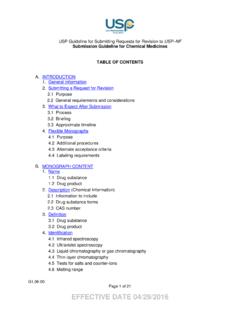
1 USP Guideline for Submitting Requests for Revision to USP NF Submission Guideline for Excipients Page 1 of 26 EFFECTIVE DATE 04/29/2016 TABLE OF CONTENTS A. INTRODUCTION 1. General Information 2. Submitting a Request for Revision Purpose General requirements and considerations Format Specific tests 3. What to Expect After Submission Process Briefing Approximate timeline B. MONOGRAPH CONTENT 1. Name 2. Description (Chemical Information) Structure Molecular formula Molecular weight CAS number Chemical names 3.
2 Definition 4. Identification Infrared spectroscopy Ultraviolet spectroscopy Liquid chromatography or gas chromatography Thin-layer chromatography Identification of specific salts Other 5. Assay General requirements LC and GC procedures Titration 6. Other Components USP Guideline for Submitting Requests for Revision to USP NF Submission Guideline for Excipients Page 2 of 26 EFFECTIVE DATE 04/29/2016 7. Impurities Organic impurities Inorganic impurities Residual solvents Other impurities 8. Specific Tests pH <791> Loss on Drying <731> and Water Determination <921> Microbial limit test Antimicrobial agent test Bacterial endotoxins Melting Range or Temperature <741> Degree of polymerization 9.
3 Additional Requirements Packaging and storage Labeling Other requirements Reference Standards 10. Formulas C. CO-PROCESSED EXCIPIENTS D. OTHER INFORMATION 1. Description and Solubility 2. Excipient Functional Category 3. Reagents 4. Chromatographic Columns E. CHECKLIST FOR SUBMITTING REQUESTS FOR REVISION TO THE USP NF FOR NEW AND EXISTING EXCIPIENT MONOGRAPHS USP Guideline for Submitting Requests for Revision to USP NF Submission Guideline for Excipients Page 3 of 26 EFFECTIVE DATE 04/29/2016A. INTRODUCTION 1. General Information Sponsors should be familiar with the General Information for All Submissions at the beginning of this Guideline.
4 Sponsors also should be familiar with the General Notices and Requirements (General Notices) section of USP NF, which provides the basic assumptions, definitions, and default conditions for the interpretation and application of USP NF standards. References to relevant general chapters in USP NF are provided by title and chapter number throughout this document as needed. Pharmaceutical excipients are substances other than the active pharmaceutical ingredient (API) that are intentionally included in an approved drug delivery system or a finished drug product.
5 For example, excipients can do the following: Aid in the processing of the drug delivery system during its manufacture Protect, support, or enhance the stability, bioavailability, or acceptability of the product to patients Assist in product identification Enhance any attribute of the overall safety Assist in the effectiveness and/or delivery of the drug Assist in maintaining the integrity of the drug product during storage Although listed as inactive ingredients by the Food and Drug Administration (FDA), excipients generally have well-defined functions in a drug product.
6 As with active ingredients, they may be small molecule or complex and may vary in terms of degree of characterization. Excipients may be available in multiple grades that can be natural, synthetic, or semi-synthetic in origin; animal derived, plant derived, biotechnology derived (recombinant), and/or mineral derived; and solid, semi solid, liquid, or gas. In contrast to active ingredients, minor components of an excipient can have a significant impact on its pharmaceutical performance. Depending on the intended use, an excipient in one drug product may be an active ingredient in another drug product.
7 These excipients are often referred to as atypical actives or dual-active excipients. USP Guideline for Submitting Requests for Revision to USP NF Submission Guideline for Excipients Page 4 of 26 EFFECTIVE DATE 04/29/2016 2. Submitting a Request for Revision Purpose. The purpose of the Request for Revision (RFR) generally is: To create a new monograph for a new excipient. To revise or update an existing monograph. Note that every revision must be meaningful, add value to the public standard, and contribute to the public health. General requirements and considerations Follow the attached Checklist for Submitting Requests for Revision to the USP NF for New and Existing Excipients Monographs (Checklist).
8 USP is actively engaged in updating official USP NF monographs that utilize outdated technology, have safety/environmental concerns, or are missing procedures for key aspects such as identification, assay, and impurities. Introduction of new techniques will be considered on a case-by-case basis. It is preferable to start with the development of a general chapter describing the technique before referencing the technique in a monograph. Please contact the liaison(s) responsible for general chapter development to suggest a new chapter. Inclusion of co-processed excipients in NF was deemed appropriate because these excipients possess certain physical characteristics that are different from or altered from their corresponding simple physical admixtures.
9 Co-processed excipients should follow proposed criteria established to define when USP would consider advancing a prospective new monograph for a co-processed excipient into NF. These criteria were developed to differentiate multi-component co-processed excipients from the more commonly encountered excipients that have been the norm in NF. Due to the complex processes used to manufacture multi-component excipients, their proprietary nature, and the lack of comprehensive understanding of these types of excipients, the Excipients Expert Committee proposes to limit the current criteria to solid co-processed An RFR for a co-processed excipient monograph should consider the criteria appearing below in section C.
10 Co-processed Excipients. 1 Stimuli to the Revision Process: USP Responses to Comments on Stimuli Article: Co-processed Excipients, PF 37(3) [May June 2011]. USP Guideline for Submitting Requests for Revision to USP NF Submission Guideline for Excipients Page 5 of 26 EFFECTIVE DATE 04/29 Format. An RFR for an NF excipient monograph justifies the specification and typically includes the following sections (not every excipient monograph will contain every section): Name (title) Description (structure, molecular weight, CAS number) Definition Identification Assay Other components Impurities Specific tests Additional requirements o Packaging and storage o Labeling o Reference Standards An NF monograph is stability indicating when taken as a whole.