Transcription of OFFSHORE TECHNOLOGY REPORT 2001/088 - …
1 HSEH ealth & SafetyExecutiveBeyond lifetime criteria foroffshore cranesPrepared byBAE Systems (Land and Sea Systems) Ltdfor the Health and Safety ExecutiveOFFSHORE TECHNOLOGY REPORT2001/088 HSEH ealth & SafetyExecutiveBeyond lifetime criteria foroffshore cranesBAE Systems (Land and Sea Systems) Ltd1 Atlantic QuayBroomielawGlasgowG2 8 JEUnited KingdomHSE BOOKSii Crown copyright 2002 Applications for reproduction should be made in writing to:Copyright Unit, Her Majesty s Stationery Office,St Clements House, 2-16 Colegate, Norwich NR3 1 BQFirst published 2002 ISBN 0 7176 2326 2 All rights reserved. No part of this publication may bereproduced, stored in a retrieval system, or transmittedin any form or by any means (electronic, mechanical,photocopying, recording or otherwise) without the priorwritten permission of the copyright REPORT is made available by the Health and SafetyExecutive as part of a series of reports of work which hasbeen supported by funds provided by the the Executive, nor the contractors concernedassume any liability for the reports nor do theynecessarily reflect the views or policy of the Contents EXECUTIVE SUMMARY ABBREVIATIONS 1 introduction Background Objectives of this Guide Scope and Extent of Guidance Structure of Guide 2 OFFSHORE SAFETY CASE (CRANES)
2 introduction Guidance on the Contents of Crane Safety Cases Incomplete Records Safety Categorisation of Cranes Crane Reviews Substantiation of Crane Categorisation Substantiation Required Scope of Crane Reviews Load Conditions Maintenance and Operating History Control Procedures Structural and Mechanical Integrity Protection Criteria for the Review Structural Ageing and Degradation Review of Dropped Load Incidents Operating Rules QRA in the Life of an Installation Risk Assessment Interfaces with Other Plant/Systems Comparison Against Modern Standards iv 3 OIL AND GAS PRODUCTION REGIMES General Normally manned installation Normally unmanned installation remote controlled Applicable Aspects of the Production Regimes 4 DESIGN, MANUFACTURE & TESTING STANDARDS General Crane Duties and Performance Duties Performance Design Codes Relevant Legislation Design Parameters 5 TESTING AND INSPECTIONS General Testing and Inspection Procedures 6 AGEING AND DEGRADATION introduction Ageing and Degradation Condition Monitoring Frequency Domain Information Lube Oil Analysis Thermography Corrosion Detection Applicable Aspects of Crane Ageing and Degradation 7 CONTROLS AND PROCEDURES General Applicable Aspects of Management Controls v 8 REVIEW OF STEP CHANGE INITIATIVES 9 HUMAN FACTORS 10 REFERENCES Appendix A Pedestal Crane Essential Features Appendix B Principal Recommended Safety Systems Appendix C HSE Inspectors Checklists Appendix D Generic Safety Case Elements Printed and published by the Health and Safety ExecutiveC30 1/98viviii
3 Executive Summary The OFFSHORE oil and gas industry has been operating in the North Sea for the past 30 years, with the consequence that many of the early platforms are approaching the end of their design life. However, the economics of the OFFSHORE industry are such that there is a drive by Duty Holder s to maximise their assets by extending their use. This REPORT presents a review of current regulatory requirements and best practice to enable checklists to be produced to assist HSE (OSD) inspectors when reviewing/auditing a duty holder s safety case justifying the continued operation of a pedestal crane once it has gone beyond its design life. The approach considered the contents of the duty holder s crane safety case submission, and how they would be affected by beyond design life issues. The REPORT included the appraisal of the ongoing cross industry Step Change Initiatives to improve safety management performance on platforms that are below the industry average.
4 Printed and published by the Health and Safety ExecutiveC30 1/98viii List of Abbreviations ACoP Approved Code of Practice ALARP As Low As Reasonably Practicable API American Petroleum Institute BOP Blow-out Protection BS British Standard CBA Cost Benefit Analysis CCPS Center for Chemical Process Safety COSHH Control of Substances Hazardous to Health Regulations 1994 FMECA Failure Modes, Effects and Criticality Analysis FoS Factor of Safety GOP Gross Overload Protection HAZID Hazard Identification HSC Health and Safety Commission HSE Health and Safety Executive LOLER Lifting Operations and Lifting Equipment Regulations NDT Non-Destructive Testing OIM OFFSHORE Installation Manager OREDA OFFSHORE Reliability Database OSD OFFSHORE Safety Division PSF Performance Shaping Factors ixxPUWER Provision and Use of Work Equipment Regulations QRA Quantitative Risk Assessment SHE Safety, Health and Environmental SLI Safe Load Indicator SMS Safety Management System SWL Safe Working Load UK United Kingdom UKOOA UK OFFSHORE Operators Association WOAD World-Wide OFFSHORE Accident Databank 1-1 1 introduction Background The OFFSHORE oil and gas industry has been operating in the North Sea for the past 30 years, with the consequence that the early platforms are approaching the theoretical end of their design life.
5 However, due to economical considerations there is a drive by Duty Holder s ( OFFSHORE operators) to maximise their assets by extending the platform useful production life. In addition to extending the useful life of existing infrastructure, benefits are also achieved by deferring decisions about platform decommissioning. The cost of decommissioning can be substantial, and are in themselves an incentive for operators to find new uses to extend the lives of platforms providing the costs involved in doing so are not prohibitive. The current legislation requires Duty Holder s/owners to carry out periodic and systematic review and reassessment of safety cases for their installations. This safety case as it is known covers all topside equipment and systems on the installation including cranes and their operation. During operation of the crane, there is a potential for various crane failures such as uncontrolled movements, dropped loads, boom/structural collapse, etc.
6 , which might directly, or indirectly via damage to other equipment, lead to an increase in the risk of personnel injury and/or a major hazard occurring ( fire/explosion). The object of this REPORT is to provide guidance to HSE inspectors to identify the additional safety case aspects that require to be addressed when considering cranes that are being proposed to operate beyond their intended design life. In addition to the above, the OFFSHORE industry has also been involved with reducing manning levels on OFFSHORE platforms for the last two decades. This is made possible by the advances in TECHNOLOGY , monitoring and surveillance techniques that have been introduced over that time. The various oil and gas production regimes that have emerged during this period have resulted in platforms being operated as either: 1-2 Normally manned installation; i) with minimum manning commensurate with, and supported by, enhanced condition monitoring and surveillance or, ii) some short production periods with platform mothballed, or partially mothballed, when not in production Normally unmanned installation remote controlled and visited at regular intervals.
7 Objectives of this Guide The intent of any safety case submission must be to demonstrate compliance with HSE Safety Principles as defined in the relevant HSE Regulations. The objective of this guide is to assist HSE (OSD) OFFSHORE inspectors when assessing the life limiting factors claimed by a Duty Holder/operator in their safety case submission to extend the life of a OFFSHORE pedestal crane. This guidance provides information on: (a) procedures, factual information and schedules that should be reviewed when assessing safety cases and auditing Duty Holder s and their contractors (b) items and aspects which should be addressed OFFSHORE (c) targeted questions for inspectors to raise both at safety case stage and at subsequent OFFSHORE inspections/audits. Scope and Extent of Guidance This guidance document will cover OFFSHORE fixed pedestal cranes and their connections to the supporting structure, and identifies potential failure mechanisms that could limit the life of these cranes.
8 The identified aspects and requirements regarding crane life extension are collated as follows; (a) Generic safety critical elements and unattended risk criteria of OFFSHORE pedestal cranes which require to be considered by the Duty Holder, together with the likely mitigating arguments and standards they may claim in their QRA for continued operation of the crane, are discussed and guidance provided. (Appendix D) (b) Prescriptive aspects are entered directly into the checklist contained in Appendix A. (c) Where questions are postulated on goal-setting aspects, they are presented in Appendix C formulated as an aide memoir for inspectors to note. (d) Ageing aspects that are judged to be a potential problem area, and their likely consequential outcomes, are summarised to guide the inspectors. (Section 6 and Appendix D) 1-3 (e) Targeted questions are provided for inspectors to raise both at the Safety Case stage and at subsequent OFFSHORE inspections, to ensure that the operational and failure history of the crane(s) is verified by an acceptable process.
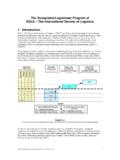
9 (Appendix C) (f) Procedures, information and schedules to be reviewed when assessing a Duty Holder s submission for crane life extension, to ensure that an acceptable process verifies its current condition. (Appendix C) (g) Items and aspects that should be carried out during OFFSHORE and inspections are also included. (Appendix C) (h) Appraisal of the various OFFSHORE industry STEP CHANGE initiatives concerning pedestal crane life extension is included. (Section 8) Structure of Guide Figure below illustrates the arrangement of the material in this guide. This guide is divided into two main parts; the front sections of the document that discuss, in general terms, the various issues affecting operation beyond the design life of cranes, and the checklists contained in the Appendices that could be used as part of an audit check specific to beyond the design life issues. Any crane that has reached the end of its design life will require a safety justification for operation beyond its design life, with the validity of the justification demonstrated in the appropriate areas of the Safety Case, and the application of the justification implemented in the various control and procedures applied to the crane.
10 Sections 1, 3 and 4 give general overviews and introduce the subject matter. The typical content of a safety case submission is discussed in Section 2, with further related topics discussed/expanded in Sections 5 and 6. Management Procedures and controls relating to the implementation of the claims made in the Safety Case are covered in Section 5 and 7. Section 8 reviews the cross industry STEP CHANGE initiative, while Section 9 covers the minor issues raised by human factors considerations. References are given in Section 10. As far as possible, this guide is based on public domain sources and all the references are either openly published or expected to be published in the near future. 1-4 Figure - Structure of the Guide introduction introduction (Section 1) Oil and Gas Production Regimes (Section 3) Crane, Design, Manufacture, Testing Standards (Section 4) SAFETY CASE (The demonstration) OFFSHORE Safety Case (Section 2) Testing and Inspections (Section 5) Ageing and Degradation (Section 6) MANAGEMENT CONTROLS (The implementation) Testing and Inspections (Section 5) Controls and Procedures (Section 7) APPENDICES Appendix A Pedestal Crane Essential Features Appendix B Principal Recommended Safety Systems Appendix C HSE Inspectors Checklists Appendix D Generic Safety Case Elements REVIEW OF STEP CHANGE INITIATIVES (Section 8) HUMAN FACTORS (Section 9) 1-5 The essentials of the discussions in the front sections of this REPORT are presented in a number of appendices.