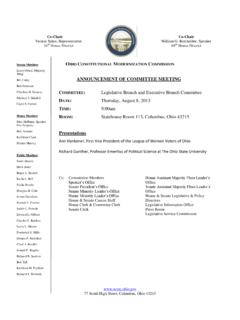
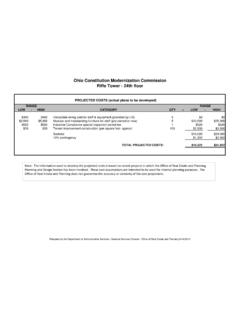
Transcription of OHIO CONSTITUTIONAL MODERNIZATION …
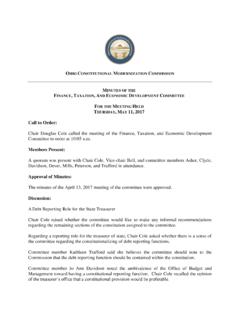
1 OHIO CONSTITUTIONAL MODERNIZATION COMMISSION MINUTES OF THE JUDICIAL BRANCH AND ADMINISTRATION OF JUSTICE COMMITTEE FOR THE MEETING HELD THURSDAY, DECEMBER 10, 2015 Call to Order: Chair Janet Abaray called the meeting of the Judicial Branch and Administration of Justice Committee to order at 2:40 Members Present: A quorum was present with Chair Abaray and committee members jacobson , Kurfess, Mulvihill, Obhof, Saphire, Skindell, and Wagoner in attendance. Approval of Minutes: The minutes of the July 9, 2015 meeting of the committee were approved as amended.
2 Presentation: Chair Abaray then turned the committee s attention to the ongoing consideration of the issue of the use of grand juries in Ohio, as provided in Article I, Section 10. She introduced two members of the Ohio Prosecuting Attorneys Association, Michael T. Gmoser, prosecuting attorney for Butler County; and Morris J. Murray, prosecuting attorney for Defiance County, who were present to provide their perspective on the use of grand juries in criminal prosecutions. The Grand Jury Process Michael T.
3 Gmoser Prosecuting Attorney Butler County, Ohio Morris J. Murray Prosecuting Attorney Defiance County, Ohio 2 Mr. Gmoser spoke first, indicating that 98 percent of felony prosecutions in the criminal division of his office begin with a grand jury indictment, as opposed to a bill of information. He remarked that law is an evolutionary institution, but there are some aspects of law that should be a constant. He said the grand jury process should be a constant, and is provided for under federal law in the United States Constitution.
4 He added that the grand jury process is an Ohio institution that has changed very little over the years because it is based on the principle that no person shall be held to answer for a serious crime without a grand jury indictment, and that the process requires secrecy. Mr. Gmoser acknowledged that whenever there is an issue that demands transparency, the institutions that demand secrecy come under attack and that is only natural. But, he said, transparency is not a good thing when it comes to charging someone as opposed to trying someone.
5 He cautioned the committee that it could do damage if it acts in favor of transparency, because the secrecy in the grand jury process benefits the guilty as well as the innocent. Mr. Gmoser said he first wanted to emphasize that prosecutors do not, in the main, indict innocent people if they can avoid it. He said prosecutors have to be accountable to the public and do not want to try cases they cannot win. He said, unlike the popular saying, there is nothing to be gained by indicting a ham sandwich, adding that might be true as an exception to the rule, but we should not change the whole system because of it.
6 He said secrecy prevents the innocent person from being maligned and abused based on improper charges. He said prosecutors have an interest in protecting suspects from the condemnation of public disclosure. He remarked that the other function he finds essential to the operation of his office is the use of the grand jury as a tool to obtain information in a private, secret way. He said prosecutors use the grand jury for investigatory purposes, so that, if the process becomes transparent, it will prevent opportunities for disclosure of crime.
7 He explained the end result of a grand jury proceeding is a charging instrument that results in a court proceeding in which the defendant has all the protections afforded a criminal defendant. At the time a criminal charge is brought, the accused has a right to the evidence, but he said this does not mean the evidence should be given to the defense before or during grand jury proceedings. Mr. Gmoser concluded his presentation by asking the committee to protect a vital institution of our state by making no modifications that will eliminate the confidential nature of the grand jury process.
8 Chair Abaray explained that an issue the committee has been asked to address, which was raised by communications from Sen. Sandra Williams and Ohio Supreme Court Chief Justice Maureen O Connor, is whether there are any changes or recommendations that would help the public gain confidence in the grand jury system. She said, when things are done in secret, that requires trust, and if trust is eroded, that has a negative effect. She asked Mr. Gmoser whether he had any suggestions for ways to improve the process, beginning, specifically with a practice used in other states, such as Pennsylvania and New York.
9 Chair Abaray described that, in those states, grand jury proceedings are recorded by a court reporter and then, at the end of the proceeding, are reviewed by a judge who signs off that the process was properly done. Chair Abaray wondered whether Mr. Gmoser is familiar with this practice and what his opinion is of it. 3 Mr. Gmoser responded that prosecutors are against that practice. He said this kind of oversight, particularly a method that uses a commission to review the proceedings, can create problems because if a controversy arises the public then wants to fire the commission.
10 He said, regardless, the successful operation of the system always depends on the quality of the prosecutor, calling prosecutors the most ethically-oriented people we have in our society dealing with criminal law. He said, as prosecutor, he is able to identify problems and knows how the system should work. He added having another layer of oversight would complicate speedy trial requirements. He said oversight would be impossible in the larger counties, maybe possible in smaller counties, but in little communities everyone knows everyone s business anyway.