Transcription of ommon Ground between NDD and IDDSI
1 Created by USTIRG; Last revised July 2021 Common Ground between NDD and IDDSI The National dysphagia Diet (NDD) of 2002 is being replaced by the International dysphagia Diet Standardisation Initiative ( IDDSI ) Framework, founded in 2013. This document explores the development of IDDSI framework and the identification of the diet levels. IDDSI is the only professionally recognized and supported diet framework as of October 2021. Comparing the NDD to the IDDSI Framework NDD IDDSI Framework Generalized, subjective, undefined Specific, objective measures of food/liquid Limited evaluation tools for modified food and liquid consistencies Standardized testing methods and tools for evaluation of modified food and liquid consistencies 1. Both NDD and IDDSI are based on modifying food and drink textures for people with chewing and/or swallowing difficulties ( , dysphagia ). 2. The intention of the NDD was always to evolve and be revised pending new research and best practice. A systematic review (Steele et al.)
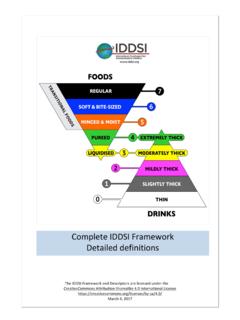
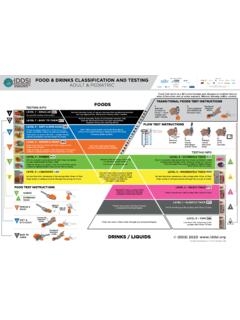
2 , 2015, dysphagia , 30(1): 2-26) found an urgent need to develop a global standardized terminology and definitions to describe texture modified foods and thickened liquids used for individuals with dysphagia of all ages, in all care settings, and all cultures. 3. NDD and IDDSI have some similar content. The final IDDSI framework consists of a continuum of 8 levels (0-7). Liquids and foods are tested using the IDDSI Testing Methods. 4. The NDD labels for drinks easily transition to the IDDSI labels. IDDSI created clearer labels and added more descriptions to the diet levels to assure food and drink safety. a. This labeling system has shown to facilitate education, allow accurate identification, and improve communication. For example, IDDSI identifies Thin Drinks as 0, White, Thin. The 3 descriptors to identify IDDSI diet levels are: Number, Color, and Label Created by USTIRG; Last revised July 2021 Comparing the NDD and IDDSI levels Created by USTIRG; Last revised July 2021 Comparing the NDD Levels to the IDDSI Food Levels NDD, Level 1 Pureed IDDSI , Pureed, Level 4 The name and texture definition for puree in both NDD and IDDSI are similar.
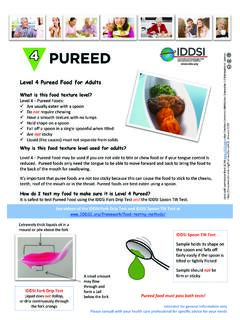
3 IDDSI lists additional descriptions and provides the Spoon Tilt Test as an objective testing method to assure safety of a pureed food product. NDD, Level 2 Mechanically Altered IDDSI , Minced & Moist, Level 5 The NDD name of Mechanically Altered was hard to interpret and the description stated, moist, minced, cohesive, and easily mashed. The IDDSI name of Minced & Moist is what NDD intended and is more descriptive of what food consistency the kitchens should produce. IDDSI provides testing suggestions for exact sizes of food pieces consistent with a safe swallow based on research in children and adults. Added moisture is a must to make this level moist, cohesive, and not crumbly! NDD, Level 3 dysphagia Advanced IDDSI , Soft & Bite Sized, Level 6 The NDD description stated, bite-sized, soft," moist," and not sticky." However, bite size guidelines were larger than the typical diameter of an airway. The IDDSI name of Soft & Bite Sized is more descriptive of what food consistency the kitchens should produce.
4 IDDSI provides testing suggestions based on the diameter of the average child and adult trachea for improved safety and prevention of choking. OR NDD, Level 3 dysphagia Advanced IDDSI , Easy to Chew, Level 7 IDDSI s Easy to Chew, Level 7 is a sub-level of Regular, Level 7. Softer foods provided on the Easy to Chew, Level 7 that may align closely to NDD Level 3 or with your least restrictive texture modified diet. Easy to Chew, Level 7 has no particle size restrictions, so this level does not reduce a choking risk like Soft & Bite-sized, Level 6. The safety and suitability of breads & mixed consistencies is assessed on an individual basis. For information on how to implement IDDSI in your facility, review the How to Ease IDDSI Implementation document. Visit the IDDSI United States and Territories page for this, and more NDD to IDDSI , documents. Created by USTIRG; Last revised July 2021 How to Ease IDDSI Implementation The National dysphagia Diet (NDD) of 2002 is being replaced by the International dysphagia Diet Standardisation Initiative ( IDDSI ) Framework, founded in 2013.
5 IDDSI is the only professionally recognized and supported diet framework as of October 2021. This document explores the implementation of IDDSI framework from your facility s previously established dysphagia diet. 1. Team up with the dietitian, the speech-language pathologist, the certified dietary manager, a chef, and other related members of your team for collaborative initiation of IDDSI . a. Review the Complete IDDSI Framework Detailed Definitions document. b. Review the IDDSI Framework Testing Methods document to learn more about how the IDDSI levels are determined for foods and drinks in your setting. c. Review the Implementation Guides on the IDDSI global webpage. A helpful document is the Master Guide: Cross-Sector, though other documents are also available and may need to be customized for your facility. 2. Before transitioning from NDD to IDDSI , ask your team: a. How does the facility define the current texture modified diets being used? b. Which of our current diet levels align best with each IDDSI level?
6 (Mapping) c. What are the food and drink items that currently meet IDDSI standards when I use the IDDSI Testing methods? d. What items require new or adjusted recipes to produce consistent and safe food/drinks that align with the IDDSI Framework? 3. Map your facility s NDD diets or other diet labels with the IDDSI Levels. All levels may not be appropriate for all settings. Each organization determines the levels they will adopt. Review all related documentation to understand the framework and testing methods. Created by USTIRG; Last revised July 2021 Mapping 101: Compare NDD (or your diet level names) to IDDSI Framework The process of changing over to IDDSI from your old diets is called mapping or using a crosswalk diagram (see mapping images below). Use this document to map your facility s NDD diets or other diet labels with the IDDSI Levels. Keep in mind that NDD levels loosely translate to IDDSI levels. IDDSI s levels are confirmed and classified using several testing methods.
7 1. Determine where your facility s food and drink names fall in the Current NDD Food Textures column. 2. Review the IDDSI Framework & Detailed Definitions. Align your old NDD diet names to the new IDDSI Levels by considering the Description/Characteristics of each level. 3. Confirm your IDDSI levels by incorporating IDDSI testing methods. IDDSI s testing methods use easy-to-access tools, such as spoons, forks, fingers, and chopsticks. 4. See the IDDSI Framework s Physiological Rationale for each level when considering a specific individual s abilities. Created by USTIRG; Last revised July 2021 Drink Levels from NDD and IDDSI NDD IDDSI Levels Food Levels from NDD and IDDSI NDD IDDSI Levels Created by USTIRG; Last revised July 2021 Tips for NDD to IDDSI Mapping National dysphagia Diet (NDD) classifications are similar to IDDSI with these levels. IDDSI s levels have more refined measurements for safety and product consistency. The IDDSI testing methods should be conducted for accurate measures and safe swallowing.
8 O Thin, Level 0 is all regular drinks o Mildly Thick, Level 2 is similar to NDD nectar o Moderately Thick, Level 3 is similar to NDD honey o Extremely Thick, Level 4 is similar to NDD pudding o Pureed, Level 4 may be similar to your current NDD puree. Two levels share the same IDDSI description and testing methods for both drinks and foods: o Moderately Thick, Level 3 drink equals Liquidised, Level 3 food. o Extremely Thick, Level 4 drink equals Puree, Level 3. Easy to Chew, Level 7 often aligns well with NDD level 3 ( dysphagia Advanced) or YOUR least restrictive texture modified diet. Use the IDDSI testing methods to confirm and adjust the recipe, as needed. Streamline efforts by testing current recipes for Minced & Moist, Level 5 and Soft & Bite-Sized, Level 6 at the same time. o Identify adjustments need for current recipes to achieve both levels 5 and 6. o Re-test and confirm adjusted or new recipes for IDDSI levels 5 and 6. Slightly Thick, Level 1 is a new liquid viscosity that describes liquids that flow at a slightly slower rate.
9 This describes drinks that are thickened but able to flow through a bottle nipple for infants and is also relevant for individuals who may require only a slight slowing down of liquid flow and do not need their drinks as thick as a mildly thick/nectar thick consistency. Watch for new products being developed! For information on how to implement IDDSI in your facility, review the IDDSI s Focus on Safety with Mixed Consistency Foods & Bread document. Visit the IDDSI United States and Territories page for this, and more NDD to IDDSI , documents.