Transcription of Operating & Maintenance Instructions - BASCO
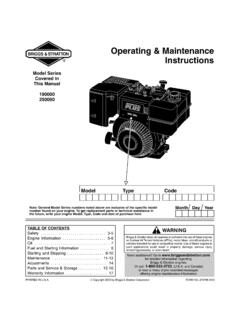
1 Operating & Maintenance Instructions Model Series Covered in This Manual 190000. 280000. Model Type Code Note: General Model Series number noted above is inclusive of the specific model Month Day Year number found on your engine. To get replacement parts or technical assistance in the future, write your engine Model, Type, Code and date of purchase here. TABLE OF CONTENTS. Safety .. 3-5. WARNING. Engine Information .. 5-6 Briggs & Stratton does not approve or authorize the use of these engines on 3-wheel All Terrain Vehicles (ATVs), motor Oil .. 7 bikes, fun/recreational go-karts, aircraft products or vehicles intended for use in competitive events. Use of these engines in Fuel and Starting Information .. 8 such applications could result in property damage, serious Starting and Stopping .. 9-10 injury (including paralysis), or even death.
2 Maintenance .. 11-13. Need assistance? Go to Parts and Service & Storage .. 14 for detailed information regarding Briggs & Stratton engines. Warranty Information .. 15 Or call, 1-800-233-3723, ( and Canada). to hear a menu of pre-recorded messages offering engine Maintenance information. PRINTED IN Copyright 2004 by Briggs & Stratton Corporation FORM NO. 274787-7/04. Document: - page 1 (Black). Screen angle and frequency: , THE POWER THAT WORKS FOR YOU . Look For Relevant Emissions Durability Period and Air Index Information On Your Engine Emissions Label Engines that are certified to meet the California Air Resources Board (CARB) Tier 2 Emission Standards must display information regarding the Emissions Durability Period and the Air Index. Briggs & Stratton makes this information available to the consumer on our emission labels.
3 The engine emission label will indicate certification information. The Emissions Durability Period describes the number of hours of actual running time for which the engine is certified to be emissions compliant, assuming proper Maintenance in accordance with the Operating &. Maintenance Instructions . The following categories are used: Moderate: Engine is certified to be emission compliant for 125 hours of actual engine running time. Intermediate: Engine is certified to be emission compliant for 250 hours of actual engine running time. Extended: Engine is certified to be emission compliant for 500 hours of actual engine running time. For example, a typical walk-behind lawn mower is used 20 to 25 hours per year. Therefore, the Emissions Durability Period of an engine with an intermediate rating would equate to 10 to 12 years. The Air Index is a calculated number describing the relative level of emissions for a specific engine family.
4 The lower the Air Index, the cleaner the engine. This information is displayed in graphical form on the emissions label. After July 1, 2000, Look For Emissions Compliance Period On Engine Emissions Compliance Label After July 1, 2000 certain Briggs & Stratton engines will be certified to meet the United States Environmental Protection Agency (USEPA) Phase 2 emission standards. For Phase 2 certified engines, the Emissions Compliance Period referred to on the Emissions Compliance label indicates the number of Operating hours for which the engine has been shown to meet Federal emission requirements. For engines less than 225 cc displacement, Category C = 125 hours, B = 250 hours and A = 500 hours. For engines of 225 cc or more, Category C = 250 hours, B = 500 hours and A = 1000 hours. The displacement of Model Series 190000 engines is 319 cc.
5 The displacement of Model Series 280000 engines is 465 cc.. 2. Document: - page 2 (Black). Screen angle and frequency: , 274787. BEFORE Operating ENGINE. Read entire Operating & Maintenance Instructions AND. the Instructions for the equipment this engine powers.*. Failure to follow Instructions could result in serious injury or death. THE Operating & Maintenance Instructions . CONTAIN SAFETY INFORMATION TO. Make you aware of hazards associated with engines Inform you of the risk of injury associated with those hazards, and Tell you how to avoid or reduce the risk of injury. The safety alert symbol ( ). is used to identify safety HAZARD SYMBOLS AND MEANINGS. information about hazards that can result in personal injury. A signal word (DANGER, WARNING, or CAUTION) is used with the alert symbol to indicate the likelihood and the potential severity of injury.
6 In addition, a hazard symbol Fire Moving Parts may be used to represent the type of hazard. DANGER indicates a hazard which, if not avoided, will result in death or serious injury. Shock Explosion WARNING indicates a hazard which, if not avoided, could result in death or serious injury. Toxic Fumes Hot Surface CAUTION indicates a hazard which, if not avoided, might result in minor or moderate injury. CAUTION, when used without the alert symbol, Kickback indicates a situation that could result in damage to the engine. WARNING. The engine exhaust from this prod- uct contains chemicals known to the State of California to cause cancer, birth defects, or other reproductive harm. * Briggs & Stratton does not necessarily know what equipment this engine will power. For that reason, you should carefully read and understand the Operating Instructions for the equipment on which your engine is placed.
7 3. Document: - page 3 (Black). Screen angle and frequency: , SAFETY. WARNING WARNING. Gasoline and its vapors are extremely Starting engine creates sparking. flammable and explosive. Sparking can ignite nearby flammable Fire or explosion can cause severe burns gases. or death. Explosion and fire could result. WHEN ADDING FUEL If there is natural or LP gas leakage in area, do not Turn engine OFF and let engine cool at least 2 start engine. minutes before removing gas cap. Do not use pressurized starting fluids because Fill fuel tank outdoors or in well-ventilated area. vapors are flammable. Do not overfill fuel tank. Fill tank to approximately 1-1/2 inches below top of neck to allow for fuel expansion. Keep gasoline away from sparks, open flames, pilot lights, heat, and other ignition sources. Check fuel lines, tank, cap, and fittings frequently WARNING.
8 For cracks or leaks. Replace if necessary. Rapid retraction of starter cord (kickback) will WHEN STARTING ENGINE pull hand and arm toward engine faster than Make sure spark plug, muffler, fuel cap and air you can let go. cleaner are in place. Broken bones, fractures, bruises or sprains Do not crank engine with spark plug removed. could result. If fuel spills, wait until it evaporates before starting engine. When starting engine, pull cord slowly until If engine floods, set choke to OPEN/RUN position, resistance is felt, then pull rapidly. place throttle in FAST and crank until engine starts. Remove all external equipment/engine loads before starting engine. WHEN Operating EQUIPMENT Direct coupled equipment components such as, but not limited to, blades, impellors, pulleys, Do not tip engine or equipment at angle which sprockets, etc.
9 , must be securely attached. causes gasoline to spill. Do not choke carburetor to stop engine. WHEN TRANSPORTING EQUIPMENT. Transport with fuel tank EMPTY or with fuel shut-off WARNING. valve OFF. Rotating parts can contact or entangle WHEN STORING GASOLINE OR EQUIPMENT hands, feet, hair, clothing, or accessories. WITH FUEL IN TANK Traumatic amputation or severe laceration Store away from furnaces, stoves, water heaters or can result. other appliances that have pilot light or other Operate equipment with guards in place. ignition source because they can ignite gasoline vapors. Keep hands and feet away from rotating parts. Tie up long hair and remove jewelry. Do not wear loose-fitting clothing, dangling drawstrings or items that could become caught. 4. Document: - page 4 (Black). Screen angle and frequency: , SAFETY. WARNING WARNING.
10 Engines give off carbon monoxide, an odorless, colorless, poison gas. Unintentional sparking can result in fire or electric shock. Breathing carbon monoxide can cause nausea, fainting or death. Unintentional start-up can result in en- Start and run engine outdoors. tanglement, traumatic amputation, or lac- Do not start or run engine in enclosed area, even if eration. doors or windows are open. BEFORE PERFORMING ADJUSTMENTS OR. WARNING REPAIRS. Disconnect spark plug wire and keep it away from Running engines produce heat. Engine spark plug. parts, especially muffler, become extremely Disconnect battery at negative terminal (only hot. engines with electric start). Severe thermal burns can occur on contact. WHEN TESTING FOR SPARK. Combustible debris, such as leaves, grass, brush, etc. can catch fire. Use approved spark plug tester.