Transcription of Operating & Maintenance Instructions - bsintek.basco.com
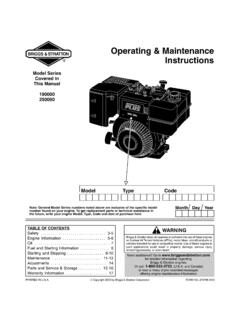
1 Model SeriesCovered inThis Manual90000 Operating & MaintenanceInstructionsModelTypeCodeMont h DayYearNote: General Model Series numbers noted above are inclusive of the specific modelnumber found on your engine . To get replacement parts or technical assistance inthe future, write your engine Model, Type, Code and date of purchase and Service & &Strattondoes notapproveorauthorizethe useof theseengineson 3-wheel All Terrain Vehicles (ATVs), motor bikes, aircraft products orvehicles intended for use in competitive events. Use of these engines insuch applications could result in property damage, serious injury(including paralysis), or even assistance? Go detailed information regardingBriggs & Stratton call,1-800-233-3723, ( and Canada)to hear a menu of pre-recorded messagesoffering engine Maintenance IN Copyright 2004 by Briggs & Stratton CorporationFORM NO.
2 275909-1/042 The Power That Works For You. After July 1, 2000, Look For Emissions Compliance Period OnEngine Emissions Compliance LabelAfter July 1, 2000 certain Briggs & Stratton engines will be certified to meet the United States Environmental ProtectionAgency (USEPA) Phase 2 emission standards. For Phase 2 certified engines, the Emissions Compliance Period referredto on the Emissions Compliance label indicates the number of Operating hours for which the engine has been shown tomeet Federal emission requirements. For engines less than 225 cc displacement, Category C = 125 hours, B = 250 hoursand A = 500 hours. For engines of 225 cc or more, Category C = 250 hours, B = 500 hours and A = 1000 displacement of Model Series 90000 engine is 148 is a generic representationof the emission label typicallyfound on a certified Operating engine Read entire Operating & Maintenance Instructions ANDthe Instructions for the equipment this engine powers.
3 * Failure to follow Instructions could result in serious injuryor Operating & Maintenance INSTRUCTIONSCONTAIN SAFETY INFORMATION TO Make you aware of hazards associated with engines Inform you of the risk of injury associated with those hazards, and Tell you how to avoid or reduce the risk of safety alert symbol()is used to identify safetyinformation about hazards that can result in personal signal word (DANGER, WARNING, or CAUTION) isused with the alert symbol to indicate the likelihood and thepotential severity of injury. In addition, a hazard symbolmay be used to represent the type of a hazard which, if notavoided,will result in death or serious a hazard which, if notavoided,could result in death or serious a hazard which, if notavoided,might result in minor or ,whenusedwithoutthealertsymbol,indicates a situation thatcould result in damageto the engine exhaust from this prod-uct contains chemicals known to theState of California to cause cancer,birth defects, or other SYMBOLS AND MEANINGSE xplosionToxic FumesMoving PartsShockHot SurfaceKickbackFireTHE INTERNATIONAL SYMBOLS USEDON THE engine ORIN THIS MANUAL INCLUDE:On OffFuel ShutoffRead Owner sManualStopFuelChokeSafety AlertOil*Briggs & Stratton does not necessarily know what equipment this engine will power.
4 For that reason, you should carefully readand understand the Operating Instructions for the equipment on which your engine is and its vapors are extremelyflammable and explosioncancause severeburnsor ADDING FUEL Turn engine OFF and let engine cool at least 2minutes before removing gas cap. Fill fuel tank outdoors or in well-ventilated area. Do not overfill fuel tank. Fill tank to approximately1-1/2 inches below top of neck to allow for fuelexpansion. keep gasoline away from sparks, open flames,pilot lights, heat, and other ignition sources. Check fuel lines, tank, cap, and fittings frequentlyfor cracks or leaks. Replace if STARTING engine Make sure spark plug, muffler, fuel cap and aircleaner are in place. Do not crank engine with spark plug removed. If fuel spills, wait until it evaporates before startingengine. If engine floods, set choke to OPEN/RUN position,place throttle in FAST and crank until engine Operating EQUIPMENT Do not tip engine or equipment at angle whichcauses gasoline to spill.
5 Do not choke carburetor to stop TRANSPORTING EQUIPMENT Transport withfuel tank EMPTY or with fuel shut-offvalve STORING GASOLINE OR EQUIPMENTWITH FUEL IN TANK Storeaway from furnaces, stoves, water heaters orother appliances that have pilot light or otherignition source because they can ignite engine creates can ignite nearby and fire could If there is natural or LP gas leakage in area, do notstart engine . Do not use pressurized starting fluids becausevapors are retraction of starter cord (kickback) willpull hand and arm toward engine faster thanyou can let bones, fractures, bruises or sprainscould result. When starting engine , pull cord slowly untilresistance is felt, then pull rapidly. Remove all external equipment/ engine loadsbefore starting engine . Direct coupled equipment components such as,but not limited to, blades, impellors, pulleys,sprockets, etc.
6 , must be securely parts can contact or entanglehands, feet, hair, clothing, or amputation or severe lacerationcan result. Operate equipment with guards in place. keep hands and feet away from rotating parts. Tie up long hair and remove jewelry. Do not wear loose-fitting clothing, danglingdrawstrings or items that could become give off carbon monoxide, anodorless, colorless, poison carbon monoxide can causenausea, fainting or Start and run engine outdoors. Do not start or run engine in enclosed area, even ifdoors or windows are engines produce heat. Engineparts, especially muffler, burns canoccur debris, such as leaves, grass,brush, etc. can catch fire. Allow muffler, engine cylinder and fins to coolbefore touching. Remove accumulated combustibles from mufflerarea and cylinder area. Install and maintain in working order a sparkarrester beforeusingequipment onforest-covered,grass-covered, brush-covered unimproved state of California requires this (Section 4442of the California Public Resources Code).
7 Otherstates may have similar laws. Federal laws applyon federal sparking can result in fire orelectric start-up can result in en-tanglement, traumatic amputation, or PERFORMING ADJUSTMENTS ORREPAIRS Disconnect spark plug wire and keep it away fromspark plug. Disconnect battery at negative terminal (onlyengines with electric start).WHEN TESTING FOR SPARK Use approved spark plug tester. Do not check for spark with spark plug INFORMATIONTECHNICAL INFORMATIONPOWER RATINGS:The power ratings for an individual enginemodelareinitiallydevelopedbystarti ngwithSAE(SocietyofAuto-motive Engineers) code J1940 (Small engine Power & TorqueRating Procedure) (Revision 2002-05). Given both the wide arrayofproductsonwhichourenginesareplace d,andthevarietyofen-vironmental issues applicable to Operating the equipment, it maybe that the engine you have purchased will not develop the ratedhorsepowerwhenusedinapieceof powerequipment (actual on-site power).
8 This difference is due to a varietyof factorsincluding,but not limited to, the following: differences in altitude, tempera-ture, barometric pressure, humidity, fuel, engine lubrication, maxi-mumgovernedenginespeed,individualen ginetoenginevariabil-ity, design of the particular piece of power equipment, the mannerin which the engine is operated, engine run-in to reduce frictionand clean out of combustion chambers, adjustmentsto thevalvesand carburetor, and other factors. The power ratings may also beadjusted based on comparisons to other similar engines utilizedinsimilarapplications,andwillthe reforenotnecessarily matchthevalues derived using the foregoing Handle for Rewind Drain control Tank plug / Spark plug xx Switch Wire (if equipped) fill Switch13141512 GENERAL INFORMATIONENGINE MODELT hisisasinglecylinder,L-head, lowemis-sions SERIES 90000 Bore2-9/16 in.
9 ( mm)..Stroke1-3/4 in. ( mm).. cu. in. ( cc)..TUNE-UP SPECIFICATIONSA rmature air -- in. ( -- mm)..Spark plug in. ( mm)..Valve clearance with valve springs installed and piston 1/4 in. (6 mm)past top dead center (check when engine is cold). See RepairManual P/N -- in. ( -- mm).. -- in. ( -- mm)..For practical operation, the horsepower loading should not exceed85% of rated horsepower. engine power will decrease 3-1/2% foreach 1,000 feet (300 meters) above sea level and 1% for each 10 F( C) above 77 F(25 C). engine will operate satisfactorily at anangle up to 15 .7 OIL275909 CAUTION:This engine is shipped from Briggs &Strattonwithout oil. Check oil level before startingengine. If you start the engine without oil, the enginewill be damaged beyond repair and will not becovered under :If this engine is equipped with gear reduction, gearreduction case must be filled with oil prior to Operating en-gine.
10 See gear reduction oil filling Instructions on page CAPACITYThe engine holds approximately 2/3 qt (21 ozs; liter).TYPE OF OIL TO USE Use a high quality detergent oil classified For ServiceSF, SG, SH, SJ or higher, suchas Briggs & Stratton30,Part Number 100005 (20 oz) or 100028 (48 oz). Do not use special additives. Choose a viscosity according to the table :Synthetic oil meeting ILSAC GF-2, APIcertification mark and API service symbol(shown at left) with SJ/CF ENERGY CON-SERVING or higher, is an acceptable oil at of synthetic oil does notalter required oil change intervals. F-20020406080100 C-30-20-10010203040 STARTING TEMPERATURE RANGE ANTICIPATED BEFORE NEXT OIL CHANGE**32*CAUTION:Air cooled engines run hotter thanautomotive engines. The use of non-syntheticmulti-viscosity oils (5W-30, 10W-30, etc.) intemperatures above 40 F(4 C) will result in higherthan normal oil consumption.