Transcription of Opioid Conversion Ratios - Guide to Practice 2013
1 Opioid Conversion Ratios - Guide to Practice 2013 Released 1st October 2013 2013. The EMR PCC grants permission to reproduce parts of this publication for clinical and educational use only, provided that the Eastern Metropolitan Region Palliative Care Consortium is acknowledged. Requests to reproduce this document, for purposes other than those stated above, should be addressed to: Consortium Manager Eastern Metropolitan Region Palliative Care Consortium PO Box 2110 Rangeview 3132 Victoria Australia Eastern Metropolitan Region Palliative Care Consortium (Victoria) Opioid Conversion Guidelines 2013 2013.
2 Page 2 of 12 TABLE OF CONTENTS Instructions for use 3 Disclaimer 3 General Notes 3 Oral morphine to other oral opioids 4 Oral opioids to parental opioids 4 Parenteral morphine to other parental opioids 5 Transdermal buprenorphine to oral morphine
3 5 Transdermal fentanyl to morphine 6 Parenteral fentanyl to transdermal fentanyl 6 Transdermal and intranasal fentanyl _____ 7 Methadone 8 References 9 Summary Chart 11- 12
4 Eastern Metropolitan Region Palliative Care Consortium (Victoria) Opioid Conversion Guidelines 2013 2013. Page 3 of 12 INSTRUCTIONS FOR USE Printing: It is highly recommended these guidelines are printed in colour, to aid ease of use. The access point for the current electronic version of these guidelines is at Eastern Metropolitan Region Palliative Care Consortium or Centre for Palliative Care DISCLAIMER The information in this document is to be used as a guideline only. It is the responsibility of the user to ensure information contained in this document is used correctly. These guidelines reflect current palliative care Practice in the eastern metropolitan region and available literature at the time of the guideline release.
5 The current electronic version of the document available at should always be referred to. All medication doses derived from these guidelines should be checked and prescribed by a medical doctor with appropriate experience before administering. Medication doses should be modified in response to the patient/client s clinical situation and status, including previous exposure to opioids and concurrent medications. Adhere to all legislation and professional requirements including organisational policies and procedures regarding Opioid medications and their administration. All patients should be monitored closely until stable when commencing, adjusting dosage and/or switching Opioid medications. GENERAL NOTES (1,2,3) The guidelines are applicable to chronic pain for palliative care patients It is recommended that opioids be converted to the equianalgesic oral morphine as the first step Calculate the equianalgesic starting dose of the new Opioid using the guidelines Apply a dose reduction of 25% to 50% to the equianalgesic starting dose to allow for cross-tolerance A dose reduction closer to 50% is appropriate if the patient is elderly or medically frail Also consider o dose and duration of previous Opioid treatment o current pain severity o patient s ethnicity, for example, oxycodone may be metabolised differently by Caucasian.
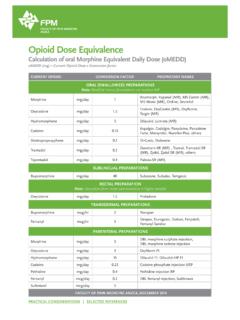
6 Asian and North African groups due to genetic polymorphism o renal and hepatic function o occurrence of adverse effects o direction of switch of Opioid Provide supplemental Opioid analgesia (breakthrough medication) during the titration process of 1/10th to 1/6th of the total daily Opioid dose Frequently monitor for patient response and individual dose titration Eastern Metropolitan Region Palliative Care Consortium (Victoria) Opioid Conversion Guidelines 2013 2013. Page 4 of 12 ORAL MORPHINE TO OTHER ORAL OPIOIDS Oral to Oral Conversion Ratio Comments Reference Morphine to Tramadol 1:10 Oral Morphine 10mg = Oral Tramadol 100mg Tramadol has a limited role in managing moderate-severe pain in palliative care 3,4 Morphine to Codeine 1:10 Oral Morphine 6mg = Oral Codeine 60mg 4,5 Morphine to Methadone CONSULTANT REQUIRED.
7 See methadone Conversion on p8 for more information. Morphine to Oxycodone :1 Oral Morphine 15mg = Oral Oxycodone 10mg The oxycodone component of Targin should be considered in conversions 3,6 Morphine to Hydromorphone 5:1 Oral Morphine 5mg = Oral Hydromorphone 1mg 3,6 ORAL OPIOIDS TO PARENTERAL OPIOIDS same drug to same drug Oral Parenteral Conversion Ratio Calculation Comments Reference Morphine Morphine 2 to 3:1 Oral Morphine 30mg = Subcutaneous Morphine 10 to 15mg 3 Oxycodone Oxycodone 2:1 Oral Oxycodone 10mg = Subcutaneous Oxycodone 5mg 3 Hydromorphone Hydromorphone 3:1 Oral Hydromorphone 15mg = Subcutaneous Hydromorphone 5mg CCG Methadone Methadone 2:1 Oral Methadone 20mg = Subcutaneous Methadone10 mg Consultation with a palliative care service or pain clinic advised 3 Tramadol Tramadol.
8 1 Oral Tramadol 120mg = Parenteral Tramadol 100mg Tramadol has a limited role in managing moderate to severe pain in palliative care 4,7 Eastern Metropolitan Region Palliative Care Consortium (Victoria) Opioid Conversion Guidelines 2013 2013. Page 5 of 12 PARENTERAL MORPHINE TO OTHER PARENTERAL OPIOIDS Parenteral Parenteral Conversion Ratio Calculation Comments Reference Morphine Fentanyl 100:1 Morphine 10,000micrograms (10mg) = Fentanyl 100 micrograms 6 Morphine Hydromorphone 5:1 Morphine 10mg = Hydromorphone 2mg 3,8 Morphine Tramadol 1:10 Morphine 10mg = Tramadol 100mg Tramadol has a limited role in managing moderate to severe pain in palliative care 3,4 Morphine Oxycodone 1:1 Morphine 10mg = Oxycodone 10mg 3 TRANSDERMAL BUPRENORPHINE TO ORAL MORPHINE Patch Strength Delivery Rate Oral Morphine Dose Reference Buprenorphine 5 mg/7 days 120 micrograms/24 hours 5 micrograms/hour 9 to 12 mg/24 hours Conversion ratio 1:75 (6) and 1.
9 100 (3) Buprenorphine10 mg/7 days 240 micrograms/24 hours 10 micrograms/hour 18 to 24 mg/24 hours Conversion ratio 1:75 (6) and 1:100 (3) Buprenorphine 20 mg/7 days 480 micrograms/24 hours 20 micrograms/hour 36 to 48 mg/24 hours Conversion ratio 1:75 (6) and 1:100 (3) Conversion CALCULATION TRANSDERMAL BUPRENORPHINE TO ORAL MORPHINE 5 mg patch = 5 micrograms buprenorphine per hour 5 mcg x 24 = 120 micrograms over 24 hours 120mcg buprenorphine x 75 ( Conversion ) = 9000mcg or 9mg oral morphine 120mcg buprenorphine x 100 ( Conversion ) = 12000mcg or 12mg oral morphine Eastern Metropolitan Region Palliative Care Consortium (Victoria) Opioid Conversion Guidelines 2013 2013.
10 Page 6 of 12 TRANSDERMAL FENTANYL TO MORPHINE Patch Strength Dose Oral Morphine equivalent (mg/24 hours) Parenteral Morphine equivalent (mg/24 hours) Breakthrough immediate release Oral Morphine (mg) 1/6th of daily dose Reference Fentanyl Patch 12 microgram/hour 288mcg/24 hours <44mg < 15mg 5mg 3,9,10 Fentanyl Patch 25 microgram/hour 600mcg/24 hours 45 to 89mg 15 to 30mg to15mg 3,9,10 Fentanyl Patch 50 microgram/hour 1200mcg/24 hours 90 to 149mg 30 to 50mg 15 to 25mg 3,9,10 Fentanyl Patch 75 microgram/hour 1800 mcg/24 hours 150 to 209mg 50 to 70mg 25 to 35mg 3,9,10 Fentanyl Patch 100 microgram/hour 2400 mcg/24 hours 210 to 269mg 70 to 90mg 35 to 45mg 3,9,10 Conversion CALCULATION TRANSDERMAL FENTANYL TO ORAL MORPHINE 25 micrograms/hour fentanyl patch 25 mcg / hour x 24 = 600 mcg / 24 hours 600mcg x 100 ( Conversion ) = 60000 micrograms morphine = 60 mg oral morphine CONVERTING TO TRANSDERMAL FENTANYL (3,11) From To Transdermal Fentanyl* 4 hour immediate release (IR)