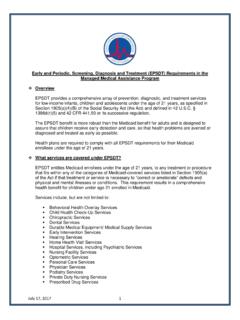
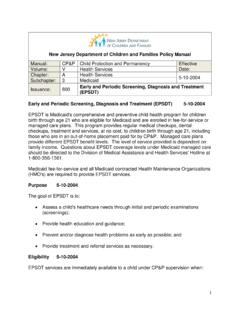
Transcription of Options and Considerations When Accessing …
1 Options and Considerations When Accessing Medicaid early periodic screening Diagnosis and Treatment (EPSDT) for Part C Services 2010 IDEA ITCA 5/20/2010 2 | Page Table of Contents Purpose and Anticipated Outcome of this 3 Approaches to Medicaid Utilization .. 3 Finding Common Ground with Your State Medicaid 5 Essential Elements of Readiness to Facilitate the Dialogue with Medicaid .. 6 Political Will and Competing 7 Exploring a Part C Medicaid EPSDT State Plan Procedures to Define Operational Detail .. 9 Qualified 13 Reimbursement/Rate 15 State Medicaid 19 In 20 Contributing Authors and Editors Credit: This document has been modified from a much longer document developed for the State of Virginia and is being provided for ITCA members through the generosity of Mary Ann Discenza, Part C Coordinator for Virginia.
2 ITCA would like to express its appreciation to Susan Mackey Andrews, consultant and original author, for her work in providing guidance to states as they navigate the Medicaid maze, especially in early periodic screening Diagnosis and Treatment (EPSDT) services in order to maximize state s investment in providing quality services to Medicaid eligible children and their families. ITCA would also like to express its thanks to Tammy Whitlock, Specialized Services Manager, Virginia Department of Medical Assistance Services and contributing author, for her hard work and commitment to ensuring that Virginia s children and families receive all necessary services in order to develop to their fullest potential.
3 A special thanks to Maryann Discenza, Virginia s Part C Coordinator, for her foresight and determination to ensure that Virginia s children with disabilities receive quality early intervention services for which they are entitled and for being a good steward of federal and state public funds and her willingness to share this paper with her Part C colleagues. Finally, ITCA would like to thank Anne Taylor, Technical Assistance Specialist in finance at the National early Childhood Technical Assistance Center (NECTAC) for her insight and timely recognition of the need for a concise compilation of information related to the use of EPSDT as a source of reimbursement for Part C services.
4 3 | Page The challenges of implementing and maintaining valuable Part C services through a blended funding mechanism have escalated for Part C administrators and stakeholders in the current economic recession. Budget reductions, realignments and curtailments compound proportionally for the Part C system, which is reliant upon a variety of partner resources and fund sources. This paper is intended for Part C administrators and stakeholders as they contemplate Medicaid EPSDT as a source of reimbursement for any or all of the Part C services within their state. States may be using Medicaid to fund Part C services to some degree but now face a reduction or loss of these funds due to competing needs and challenges within the state.
5 More states who may not be Accessing Medicaid funds realize that this is a potential resource, particularly in light of growing enrollments and declining resources from other partners. This paper provides specific guidance to state Part C leaders including ways of finding common ground with your state Medicaid agency, identifying the essential elements of readiness to facilitate the dialogue, and providing some procedures to define operational details of a new partnership, or creating the opportunity to change your current Medicaid partnership. The majority of state Part C systems utilize Medicaid as a partner in funding services to enrolled infants, toddlers and their families.
6 The degree to which these partnerships exist varies substantially, and ranges from formal, Part C cultivated initiatives to other arrangements which are informal and largely depend upon provider capacity and knowledge. The latter typically piggy-back upon existing methods of reimbursement and are not constructed specifically for the Part C target population. The variety of ways states access Medicaid for early identification and the Purpose and Anticipated Outcome of this Document Approaches to Medicaid Utilization 4 | Page provision of services and supports for very young children and their families include the following: Outreach/Enrollment Partnerships that recognize the system s ability to collect documentation to support enrollment into Medicaid.
7 early periodic screening , Diagnosis and Treatment (EPSDT) Targeted Case Management (TCM) Medicaid State Plan services, particularly physical, occupational, and speech/language therapies Development of a State Plan Amendment for uncovered services, such as special instruction/developmental therapy, social work services, family therapy etc. Waivers including 1915(c) Home and Community Based Waivers targeted to a specific population(s) and/or service(s). The intent of waiver services is to reduce the frequency of institutionalism, promote self-determination and to permit a state to provide targeted programs for individuals based on need which often reflects services not otherwise available under Medicaid to the population.
8 Katie Beckett/TEFRA (Tax Equity and Financial Responsibility Act of 1988) which permits states to enroll children with disabilities who live at home and need extensive care but who would not otherwise qualify for Medicaid due to their family income and resources Managed Care Initiatives Medicaid Administrative Claiming (MAC) to include system activities at the state and local levels required to assure the delivery of quality services to children and families. Title V and State Rehabilitation Agency Interagency Agreements that represent the unique Federal requirement for state Medicaid agencies to partner with sister agencies in the planning and delivery of services to targeted populations, such as child with special health care needs (CSHCN), pregnant women, low birth-weight babies, children with sensory losses, etc.
9 5 | Page Rarely do states utilize only one avenue to access Medicaid to support programs and services to very young children and their families. Most states report multiple avenues such as Administrative Claiming, TCM and some type of direct service reimbursement. When making these decisions, the state s structure should be considered. For example, a state with a significant managed care system within its Medicaid program will operate differently than a state without a significant managed care system. In planning system improvements related to Medicaid financing for early childhood and family supports and services, there are multiple issues to be considered before initiating exploratory or formal discussions.
10 In order to ensure that all resources are effectively utilized, supports and services to eligible children and families should: Be cultivated or improved in terms of accessibility and utilization for families, including Considerations related to travel to homes and community settings, the nature of pediatric-oriented practitioners (or medical treatment model), and the importance of families as key participants in service planning, delivery and evaluation; Match or conform to the population to be served- specifically issues related to pediatric trained personnel and variations of service delivery models appropriate to the target population; Be consistent with the method or desired approach(es) to providing services consistent with evidence-based practices and the requirement for individualized family service plans developed by multidisciplinary teams.