Transcription of Oracle Enterprise Session Border Controller and …
1 Oracle Enterprise Session Border Controller and CUCM with TELUS Enterprise IP Trunking R2 for Dedicated and Registration Connection Technical Application Note 2 Disclaimer The following is intended to outline our general product direction. It is intended for information purposes only, and may not be incorporated into any contract. It is not a commitment to deliver any material, code, or functionality, and should not be relied upon in making purchasing decisions. The development, release, and timing of any features or functionality described for Oracle s products remains at the sole discretion of Oracle . 3 Table of Contents INTENDED AUDIENCE .. 4 DOCUMENT OVERVIEW .. 4 INTRODUCTION .. 5 CONFIGURING THE Oracle Enterprise Session Border Controller .. 6 IN SCOPE ..6 OUT OF SCOPE ..6 WHAT WILL YOU NEED.
2 6 CONFIGURING THE E-SBC ..7 CISCO UNIFIED COMMUNICATION MANAGER CONFIGURATION: .. 12 TEST PLAN .. 17 TROUBLESHOOTING TOOLS .. 32 APPENDIX A .. 33 FULL E-SBC CONFIGURATION .. 33 APPENDIX B .. 36 4 Intended Audience This document is intended for use by Oracle personnel, third party Systems Integrators, and end users of the Oracle Enterprise Session Border Controller (E-SBC). It assumes that the reader is familiar with basic operations of the Oracle Enterprise Session Border Controller Acme Packet 4600 / Acme Packet 3820. Document Overview Cisco Call Manager offers the ability to connect to Internet telephony service providers (ITSP) using an IP-based SIP trunk. This reduces the cost and complexity of extending an Enterprise s telephony system outside its network borders. Oracle Enterprise Session Border Controllers (E-SBCs) play an important role in SIP trunking as they are used by many ITSPs and some enterprises as part of their SIP trunking infrastructure.
3 This application note has been prepared as a means of ensuring that SIP trunking between Cisco Call Manager, Oracle E-SBCs and TELUS IP Trunking services are configured in the optimal manner. 5 Introduction Audience This is a technical document intended for telecommunications engineers with the purpose of configuring the Oracle Enterprise Session Border Controller and CUCM. There will be steps that require navigating the Command Line Interface (ACLI). Understanding the basic concepts of TCP/UDP, IP/Routing, SIP/RTP, TLS and SRTP are also necessary to complete the configuration and for troubleshooting, if necessary. Requirements Fully installed and configured Cisco Call Manager Oracle Enterprise Session Border Controller running m1. Note: the configuration running on the E-SBC is backward/forward compatible with any release in the stream.
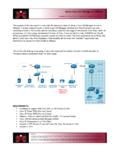
4 TELUS IP trunk based customers with dedicated data connectivity to TELUS. Architecture The following reference architecture shows a logical view of the connectivity between CUCM, E-SBC and the TELUS trunk. 12 ABC3 DEF45 JKL6 MNOGHI78 TUV9 WXYZPQRS*0 OPER#?+-7961 SERIESCISCO IP PHONEC isco IP PhonesPSTNVG204 XMPoESPDDPLXSTATSYSTMODE1 CONSOLEC atalyst 3560 SERIES PoE-1213579112468101212 ABC3 DEF45 JKL6 MNOGHI78 TUV9 WXYZPQRS*0 OPER#?+-7961 SERIESCISCO IP PHONE12 ABC3 DEF45 JKL6 MNOGHI78 TUV9 WXYZPQRS*0 OPER#?+-7961 SERIESCISCO IP PHONEVG 224 Cisco SwitchOracle Telus SIP Trunk R2 FAXT elus Vancouver LabVoLTET elus SIP ProviderCUCM 11 CUC 11 CUCM SUB 11 BVoipNGHP 6 Configuring the Oracle Enterprise Session Border Controller In this section we describe the steps for configuring an Oracle Enterprise Session Border Controller , formally known as an Acme Packet Net-Net Enterprise Session Director, for use with CUCM Server in a SIP trunking scenario.
5 In Scope The following guide configuring the Oracle E-SBC assumes that this is a newly deployed device dedicated to a single customer. If a service provider currently has the E-SBC deployed then please refer to the ACLI Configuration Guide on for a better understanding of the Command Line Interface (CLI). Note that Oracle offers several models of E-SBC. This document covers the setup for the E-SBC platform running or later. If instructions are needed for other Oracle E-SBC models, please contact your Oracle representative. Out of Scope Configuration of Network management including SNMP and RADIUS What will you need Hypervisor with console connectivity through the hypervisor Terminal emulation application such as PuTTY or HyperTerm Passwords for the User and Super user modes on the Oracle E-SBC IP address to be assigned to management interface (Wancom0) of the E-SBC - the Wancom0 management interface must be connected and configured to a management network separate from the service interfaces.
6 Otherwise the E-SBC is subject to ARP overlap issues, loss of system access when the network is down, and compromising DDoS protection. Oracle does not support E-SBC configurations with management and media/service interfaces on the same subnet. IP address of CUCM external facing NIC IP addresses to be used for the E-SBC internal and external facing ports (Service Interfaces) IP address of the next hop gateway in the service provider network 7 | P a g e Configuring the E-SBC Once the Oracle SBC is racked and the power cable connected, you are ready to set up physical network connectivity. Plug the slot 0 port 0 (s0p0) interface into your outside (TELUS next-hop facing) network and the slot 1 port 0 (s1p0) interface into your inside (CUCM server-facing) network. Once connected, you are ready to power on and perform the following steps.
7 All commands are in bold, such as configure terminal; parameters in bold red such as SBC1 are parameters which are specific to an individual deployment. Note: The ACLI is case sensitive. Establish the serial connection and logging in the SBC Confirm the SBC is powered off and connect one end of a straight-through Ethernet cable to the front console port (which is active by default) on the SBC and the other end to console adapter that ships with the SBC, connect the console adapter (a DB-9 adapter) to the DB-9 port on a workstation, running a terminal emulator application such as PuTTY. Start the terminal emulation application using the following settings: Baud Rate=115200 Data Bits=8 Parity=None Stop Bits=1 Flow Control=None Power on the SBC and confirm that you see the following output from the bootup sequence.
8 8 | P a g e Enter the following commands to login to the E-SBC and move to the configuration mode. Note that the default E-SBC password is acme and the default super user password is packet . Password: acme SBC1> enable Password: packet SBC1# configure terminal SBC1 (configure)# You are now in the global configuration mode. Initial Configuration Assigning the management Interface an IP address To assign an IP address, one has to configure the bootparams on the E-SBC by going to SBC1#configure terminal --- >bootparams Once you type bootparam you have to use carriage return key to navigate down A reboot is required if changes are made to the existing bootparams SBC1#(configure)bootparam '.' = clear field; '-' = go to previous field; q = quit boot device : eth0 processor number : 0 host name : acmesystem file name : / --- >location where the software is loaded on the SBC inet on ethernet (e) : :ffffff80 --- > This is the ip address of the management interface of the SBC, type the IP address and mask in hex inet on backplane (b) : host inet (h) : gateway inet (g) : -> gateway address here user (u) : vxftp ftp password (pw) (blank = use rsh) : vxftp flags (f) : target name (tn) : SBC1 -> ACLI prompt name & HA peer name startup script (s) : other (o) : Configuring the E-SBC The following section walks you through configuring the Oracle E-SBC.
9 It is outside the scope of this document to include all of the configuration elements as it will differ in every deployment. Header manipulation rule required for TELUS The header manipulation rule towardstrunk deletes the Require:100rel header from all SIP messaging which is going towards the TELUS trunk. The sip-feature 100rel is added to the config for SIP PRACK interworking, and 100rel-interworking is added as OPTIONS on the trunk and core side sip-interface. 9 | P a g e sip-manipulation name towardstrunk header-rule name DelReq header-name Require action delete match-value 100rel sip-feature name 100rel realm Peer support-mode-inbound Pass require-mode-inbound Pass proxy-require-mode-inbound Pass support-mode-outbound Pass require-mode-outbound Pass proxy-require-mode-outbound Pass last-modified-by
10 Last-modified-date 2016-05-05 17:18:13 Webserver Configuration A webserver is available on all Enterprise versions of Oracle E-SBCs. The Webserver can be used to provide tracing, configuration and dashboard info. For tracing info, 2 parts must be configured. The webserver must be enabled. Tracing filters must be applied. web-server-config state enabled inactivity-timeout 5 http-state enabled http-port 80 https-state disabled https-port 443 tls-profile sip-monitoring match-any-filter disabled state enabled short- Session -duration 0 monitoring-filters * trigger-window 30 10 | P a g e TELUS Trunk Authentication TELUS offers two types of connections.