Transcription of Organizing and Providing Feedback - …
1 1 Organizing and Providing Feedback Once your couples have completed the PREPARE/ENRICH assessment online, their reports will be available in your account (when you log in with your Facilitator ID and password). Click on the Manage Couples button after you have logged in and you will see that you can view or print the reports in the language they were completed. If the assessment was completed in English, you will have the option to view or print the report in a second language of your choice. If the assessment was completed in a second language, you will also have the option to view or print the report in English.
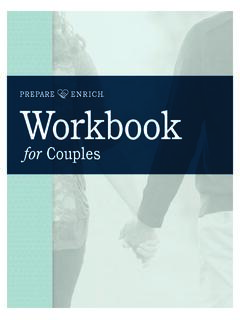
2 The Facilitator Report is intended only for you, the certified PREPARE/ENRICH facilitator. The Couple Report may be given to your couple if you choose to do so. It provides summaries of the SCOPE Personality scales, Personal Stress Profile, Relationship Dynamics, Summary of Strengths and Growth Areas, and Couple and Family Maps. It does not provide scores for the Core Scales. Facilitator s Feedback Guide- Provides examples of how you may organize 4-8 Feedback sessions with your couples The Workbook for Couples contain 24 exercises your couples can complete either in Feedback sessions with you or as homework.
3 The Facilitator Report lists the names of the exercises that correspond to various content areas. Ideally, each individual will have a copy of the Workbook for Couples to refer to during the Feedback process. The Workbook for Couples can be downloaded from the website in PDF format; if you would like bound copies of Couple Workbooks, they can be ordered at printing costs on the P/E website. Feedback can be customized Like the assessment component of PREPARE/ENRICH, the Feedback component can also be customized. While the assessment is customized to the stage and structure of the relationship, Feedback can be customized based on assessment results, number of anticipated Feedback sessions, and Facilitator skills and preferences.
4 PREPARE/ENRICH offers a very structured Feedback approach. Some Facilitators take advantage of this structure and use many of the couple exercises. Other Facilitators use some of the couple exercises, while also utilizing their own counseling skills and/or other resources in their Feedback . There are other Facilitators who may not use any of the Feedback resources available, as they use PREPARE/ENRICH as part of their clinical profile and to determine therapy goals. Goals of the Feedback Process The Feedback process accompanying the PREPARE/ENRICH assessment is intended to accomplish several goals: 1.
5 To help couples explore their Relationship Strength and Growth Areas. The Sharing Strength and Growth Areas exercise helps couples reflect on, and share with their partner, areas they believe to be strengths and areas they believe to be growth areas. 2 2. To help couples learn and practice communication skills. The specific skills emphasized in the communication exercises are assertiveness and active listening. 3. To help couples resolve conflicts. Couples learn conflict resolution skills by practicing a Ten-Step Model. 4. To help couples discuss their relationship and families-of-origin as assessed by the Couple and Family Map.
6 Couples are introduced to the concepts of closeness and flexibility contained in the Couple and Family Map and can explore impact on their relationship. 5. To help couples better understand their personality similarities and differences. The Feedback process is intended to help couples understand and accept one another s personality style, maximizing their ability to work together as a team. 6. To help couples identify and cope with major stressors in their lives. Couples identify stress and strategize ways and prioritize, manage, and apply resources to cope. 7. To help couples develop a financial budget and set financial goals.
7 Most couples agree that a budget would be useful, but few take the time to establish a workable budget that will help them reach their short and long term financial goals. 8. To help couples develop and share their personal, couple and family goals. Goal-setting facilitates closeness as couples progress together toward shared goals. Reviewing the Facilitator Report Carefully Review the Facilitator Report before meeting with your couple. You can expect to spend one hour reviewing the Facilitator Report and Organizing your materials before your first session. This time will decrease as you use the Inventories with more couples and establish a process.
8 Review the Feedback exercises in the Workbook for Couples and determine which exercises you will use with your couple. Exercises can be selected based on your couple s strength and growth areas, and should typically include several of the Core Exercises. Customizations Make note of the inventory Customizations for your couple based on their relationship stage and background. This section is found right before the Table of Contents. Background Information Review Background Information for similarities and differences and take note of any potential issues. 3 Couple Typology / Strengths and Growth Areas Review couple relationship type and Strength and Growth Areas.
9 Note: The Couple Typology is statistical analysis run with 9 of the core scales that exist across all relationship stages (dating, engaged, and married) showing relational patterns. For more info on research on the couple typology, see the Research tab on the P/E website. Overall Satisfaction / Idealistic Distortion Review each person s overall satisfaction and Idealistic Distortion, noting any differences. Relationship Dynamics Review Relationship Dynamics to better understand each partner s relational tendencies ( , self-confidence and assertiveness) and interaction patterns.
10 ( , partner dominance and avoidance). For more information on Relationship Dynamics, review the chapter in the CD Manual. The Communication exercises in the Workbook for Couples will help you teach assertiveness. Commitment Review each partner s responses to the commitment questions regarding how they feel about their own and their partner s level of commitment. Some Facilitators will invite their couple to reflect on how commitment may affect their relationship (satisfaction, health, security, etc). For analysis on Commitment and the Couple Typology, see Research section of the P/E website.