Transcription of OURSOLARSYSTEM
1 National Aeronautics and Space AdministrationNational Aeronautics and Space Solar SystemOur Star The SunMercuryVenusEarthEarth s MoonMarsAsteroidsMeteors and Meteorites Moons of the Solar SystemJupiterGalilean Moons of JupiterSaturnMoons of SaturnUranusNeptunePluto and CharonCometsKuiper Belt and Oort CloudWhat Is a planet ?Educational ProductEducatorsGrades K 12+LS-2013-07-003-HQ JPL 400-1489 07/13 NASA EDUCATIONAL RESOURCESThe NASA portal ( ) is the gateway for information about content, programs, and services offered for the general public and the education community. NASA s goal is to improve interactions for students, educators, and families with NASA and its education resources.
2 NASA s education home page ( ; click on For Educators ) serves as the portal for information about edu-cational programs and services offered by NASA. A directory of information provides details and points of contact for all of NASA s educational efforts, NASA field center offices, and points of presence within each state. A wide variety of NASA educational materials, video clips, and links to other NASA educational websites can be found using the NASA education materials finder at EarthSpace portal ( ) is a national clearinghouse for higher information space and Earth sciences, with resources for undergraduate education in plan-etary science and solar and space physics.
3 NASA multimedia ( ) features International Space Station coverage, live special events, interactive educational live shows, electronic field trips, aviation and space news, and historical NASA footage. Links to a variety of NASA resources can be found here, such as the NASA image of the day, videos, audio and video podcasts, and interactive features. NASA s Solar System Exploration website features formal and informal educational materials visit and click on Education. Educator Resource Center Network (ERCN) NASA s Educator Resource Center (ERC) network helps edu-cators learn about NASA educational resources and provides NASA materials.
4 Regional Educator Resource Centers offer access to NASA edu-cational materials for educators. NASA has formed partnerships with universities, museums, and other educational institutions to serve as Regional ERCs in many may wish to visit an individual NASA field center s ERC website for details on materials, resources, directions, hours of operation, and other information. Go to and click on For Educators to locate the Regional Wavelength ( ) is a digital col-lection of Earth and space science resources for educators of all levels, from elementary to college, to out-of-school programs. The resources were developed through funding from the NASA Science Mission Directorate and have been peer-reviewed by educators and JPL 400-1489A 07/13 National Aeronautics and Space AdministrationNational Aeronautics and Space AdministrationMercuryVenusEarthMarsJupit erSaturnUranusNeptuneOur Solar have gazed at the heavens and tried to understand the cosmos for thousands of years.
5 Ancient civilizations placed great emphasis on careful astronomical observations. Early Greek astronomers were among the first to leave a written re-cord of their attempts to explain the cosmos. For them, the uni-verse was Earth, the Sun, the Moon, the stars, and five glowing points of light that moved among the stars. The Greeks named the five points of light called planetes, or wanderers after their gods. The Romans later translated the names into Latin Mercury, Venus, Mars, Jupiter, and Saturn and these are the names astronomers use today. Planetary features are named by the International Astronomical Union, founded in 1919.
6 For more information about the names of planets, moons, and features, consult the Gazetteer of Planetary Nomenclature website at observers believed that the Sun and all the other ce-lestial bodies revolved around Earth. Astronomers gradually realized that the Earth-centered model did not account for the motions of the planets. In the early 17th century, Galileo Gali-lei s discoveries using the recently invented telescope strongly supported the concept of a solar system in which all the plan-ets, including Earth, revolve around a central star the Sun. Planetary moons, the rings of Saturn, and more planets were eventually discovered: uranus (in 1781) and Neptune (1846).
7 The largest known asteroid, Ceres, was discovered between Mars and Jupiter in 1801. Originally classified as a planet , Ceres is now designated a dwarf planet (but retains its asteroid label), along with Pluto, which was discovered in 1930; Eris, found in 2003; Haumea, found in 2004; and Makemake, found in 2005. There may be hundreds of dwarf planets in Pluto s realm. Our solar system formed about billion years ago. The four planets closest to the Sun Mercury, Venus, Earth, and Mars are called the terrestrial planets because they have solid, rocky surfaces. Two of the outer planets beyond the orbit of Mars Jupiter and Saturn are known as gas giants; the more distant uranus and Neptune are called ice giants.
8 Earth s atmosphere is primarily nitrogen and oxygen. Mer-cury has a very tenuous atmosphere, while Venus has a thick atmosphere of mainly carbon dioxide. Mars carbon dioxide atmosphere is extremely thin. Jupiter and Saturn are composed mostly of hydrogen and helium, while uranus and Neptune are composed mostly of water, ammonia, and methane, with icy mantles around their cores. The Voyager 1 and 2 spacecraft visited the gas giants, and Voyager 2 flew by and imaged the ice giants. Ceres and the outer dwarf planets Pluto, Eris, Hau-mea, and Makemake have similar compositions and are solid with icy surfaces.
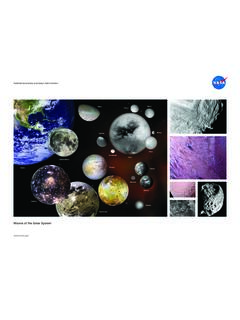
9 NASA spacecraft are en route to two of the dwarf planets the Dawn mission visits Ceres in 2015 and the New Horizons mission reaches Pluto in that same year. Neither Ceres nor Pluto has been previously visited by any spacecraft. Moons, rings, and magnetic fields characterize the planets. There are 146 known planetary moons, with at least 27 moons awaiting official recognition. (Three of the dwarf planets have moons: Pluto has five, Eris has one, and Haumea has two.) The planetary moons are not all alike. One (Saturn s Titan) has a thick atmosphere; another has active volcanoes (Jupiter s Io). New moons are frequently discovered, so moon counts can change.
10 Rings are an intriguing planetary feature. From 1659 to 1979, Saturn was thought to be the only planet with rings. NASA s Voyager missions to the outer planets showed that Jupiter, uranus , and Neptune also have ring systems. Most of the planets have magnetic fields that extend into space and form a magnetosphere around each planet . These magneto-spheres rotate with the planet , sweeping charged particles with them. How big is our solar system? To think about the large distances, we use a cosmic ruler based on the astronomical unit (AU). One AU is the distance from Earth to the Sun, which is about 150 mil-lion kilometers or 93 million miles.