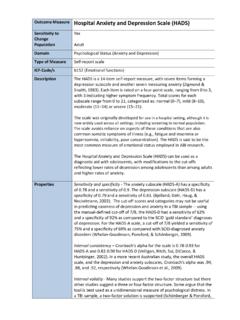
Transcription of Outcome Measure Delis-Kaplan Executive Function System (D ...
1 Outcome Measure Delis-Kaplan Executive Function System (D-KEFS): Verbal Fluency Sensitivity to Yes Change Population Paediatrics Domain Neuropsychological Impairment Type of Measure Objective assessment ICF-Code/s B164. Description With nine new stand-alone tests, the D-KEFS provides a comprehensive assessment of higher-level thinking and cognitive flexibility key components of Executive functioning believed to be mediated primarily by the frontal lobe. The tests, administered as a complete set to both children and adults in 90 minutes, or individually in varying time frames, assess vital Executive functions such as flexibility of thinking, inhibition, problem solving, planning, impulse control, concept formation, abstract thinking, and creativity in both verbal and spatial modalities.
2 Use D-KEFS results to: Assess the integrity of the frontal System of the brain Determine how deficits in abstract, creative thinking may impact upon an individual's daily life Plan coping strategies and rehabilitation programmes tailored to each patient's profile of Executive - Function strengths and weaknesses. D-KEFS is the first set of standardised tests to evaluate higher-level cognitive functions in individuals as young as 8 years old. While IQ and basic achievement tests are vital for assessing certain domains of cognitive abilities, they do not provide information about what are arguably a child's most important cognitive abilities, the capacity to engage in creative, abstract thinking. D-KEFS allows you to identify and then address Executive Function deficits in children who perform well on IQ and achievement tests.
3 D-KEFS is individually administered, and its game-like format is designed to be interesting and engaging for examinees, encouraging optimal performance without providing right/wrong feedback that can create frustration in some children and adults. Two forms are available: Standard Record Forms include all nine D- KEFS tests, with alternate versions for three of the tests that are most susceptible to practice effects; D-KEFS Sorting, Verbal Fluency and 20. Questions Tests. The D-KEFS Verbal Fluency Test (VF) is comprised of three testing conditions: Letter Fluency, Category Fluency, and Category Switching. The VF measures multiple aspects of verbal behavioural productivity and cognitive flexibility. It evaluates effectiveness of novel and semantic search strategies, and assesses flexibility in the implementation of semantic search strategies.
4 The process approach enables further evaluation of self-monitoring of information search , as well as difficulties related to initiation and sustaining effort. There are three conditions in the VF in which the examinee must say as many words as they can by letter, category, and category switching prompts. 1. The examinee says words beginning with a specified letter as quickly as possible;. 2. The examinee is asked to say words belonging to a designated semantic category; and 3. The examinee must alternate between saying words from two different; semantic categories. Alternate forms with normative data are provided for the D-KEFS. Verbal Fluency Test. Properties Ages: 8 to 89 years Description: The D-KEFS VF is an Executive Function test with three conditions: phonemic fluency (child must name words beginning with a certain letter), semantic fluency (child must name words that fall into certain categories), and semantic switching.
5 There are alternate forms for verbal fluency. It assesses fluent productivity in the verbal domain. Administration: The D-KEFS is individually administered in a game-like format. The Verbal Fluency Test is one of nine subtests which in their entirety take 90 minutes to complete. Scoring: Raw scores are converted to scaled scores (M=10, SD=3). Administration Comments: Can be given to children ages 8 to 19. Test is to be used only by individuals with a doctorate in psychology, education, or related field. Administrator must be comfortable scoring and timing simultaneously. Psychometric Properties: D-KEFS is correlated with the Wechsler Abbreviated Scale of Intelligence (WASI) and the California Verbal Learning Test-Second Edition (CVLT-II), providing information concerning the role of intellectual ability and memory on D-KEFS performance.
6 Reliability The psychometric properties of internal consistency, stability coefficients and alternate-form reliability related to the D-KEFS. instruments are presented in the Technical manual which accompanies the D-KEFS kit. These measures of reliability provide the basis for deriving the standard error of measurement and confidence intervals for the test. The applicability of specific reliability methodologies varied across D-KEFS tests depending on the nature and procedures of the task. The studies completed with the different age groups showed that the reliability of the different subtests was largely within the moderate to high range. Validity The nine tests comprising the D-KEFS are either relatively new or modifications of long-standing clinical or experimental tests.
7 The validity of D-KEFS instruments that are modified tests ( , the Stroop procedure, Trail Making Test, verbal and design fluency tests, tower tasks, the 20-questions procedure and proverb interpretations) has been demonstrated in numerous neuropsychological studies conducted over the past 50 years or more. Evidence of the validity of these procedures has been provided in terms of the sensitivity of the tests to Measure important areas of higher-level Executive functions. Validity studies presented in the Technical manual report correlation studies including: intercorrelations of measures within individual D- KEFS tests correlations between measures of different D-KEFS tests correlations of the D-KEFS with other cognitive tests including California Verbal Learning Test Second Edition (Delis, Kaplan, Kramer & Ober, 2000) and the Wisconsin Card Sorting Test (Heaton, Chelune, Talley, Kay & Curtiss, 1993).
8 A clinical pilot study is also discussed in the Technical manual. This was carried out to assess the D-KEFS profiles associated with Alzheimer's disease and Huntington's disease. Findings from this preliminary study suggested that dissociation in Executive Function profiles across different types of patients can be captured by the D-KEFS achievement and process measures. Advantages The D-KEFS VF was selected because verbal fluency has been shown to be sensitive to TBI severity and to focal left frontal lesions and because all of the D-KEFS tests were standardised on normative data for 1,750 typically developing children. The integration of verbal fluency with semantic fluency and the switching condition also potentially enhances the usefulness of the D-KEFS VF as a Measure of Executive Function .
9 McCauley et al. 2012. Disadvantages Some researchers have criticised the limited clinical data presented in the original publication manual ( , Schmidt, 2003). **Schmidt, M. (2003). Hit or miss? Insight into Executive functions (Test Review). Journal of the International Neuropsychological Society, 9, 962 964. Additional Some researchers have criticised the limited clinical data presented in the Information original publication manual ( , Schmidt, 2003). In response, Delis, Kramer, Kaplan and Holdnack (2004) pointed out that much of the test development and validity data for the D-KEFS had appeared in the mainstream neuropsychology literature rather than the test manual itself, where it was available for peer review and open to scientific critique.
10 The new D-KEFS Examiner's manual includes a review of this research reported by Delis et al (2004) and more recent papers that have cited the use of the D-KEFS. The evidence from these studies further argues for the clinical utility of the D-KEFS. Reviewers Vicki Anderson Cathy Catroppa References Delis, D., Kaplan, E., and Kramar, J. (2001). Delis-Kaplan Executive Function System . Pearson Assessment: San Antonio, TX. Delis, D. C., Kaplan, E., Kramer, J., & Ober, B. A. (2000). California Verbal Learning Test-Second Edition (CVLT-II). San Antonio, TX: The Psychological Corporation. Delis, , Kramer, , Kaplan, E. & Holdnack, J. (2004). Reliability and validity of the Delis- Kaplan Executive Function System : An Update. Journal of the International Neuropsychological Society, 10, 301-303.