Transcription of Overview: NFPA 70E 2021 changes
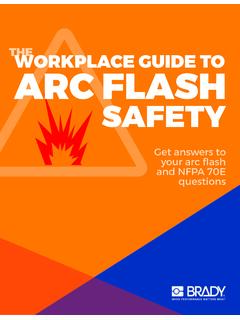
1 With the recent NFPA 70E changes in effect, you need to make sure you're compliant with regulatory requirements so you can keep your team safe. Our experts took a deep dive into the updates to compile the key changes that have the biggest impact on the work you do every : NFPA 70E 2021 changesRelevant changes by section110 Relocated the requirement to de-energize from Article to Article 110 for a logical progression through the requirements. This prioritizes and emphasizes de-energizing as a requirement of an Electrical Safety Program. (National Fire Protection Association, ) Relocated lockout/tagout general principles from (A) to Article 110. (National Fire Protection Association, ) , from former Sections and (A), as the requirement is part of an electrical safety program.
2 (National Fire Protection Association, ) (K)New subsection requires electrical safety programs to include a policy on establishing an electrically safe work condition. (National Fire Protection Association, ) (L)New subsection clarifies that the lockout or tagout program must be either part of the electrical safety program or must reference the lockout or tagout program. (National Fire Protection Association, ) (G)This table can be used with the incident energy analysis method for selecting arc flash PPE. The table used to be in Annex H in 2015, but due to incorrect use of PPE, so it was moved to the required text. (National Fire Protection Association, ) section clarifies that the electrical safety is predicated on all the equipment being used in accordance with the instructions provided by the manufacturer.
3 (National Fire Protection Association, ) (C)(3)Requirements of a lockout device revised to align with OSHA (b)(2)(iii)(E). (National Fire Protection Association, ) , , sections and to accommodate the relocation of information from former (A) to Focused Article 130 on requirements related to work involving electrical hazards . (National Fire Protection Association, )Table (C)Revised table to include initial CB and switch operation and after-maintenance because each has a higher likelihood of an arc flash event. Removed normal operating conditions from the table because it is redundant with (A)(4). Changed voltage testing to electrical testing to accommodate other testing tasks. (National Fire Protection Association, )Table (C)(7)(a)New table provides maximum use voltages for rubber insulating gloves and provides ready access to users of this standard and for the proper application of (C)(7)(a).
4 (National Fire Protection Association, )Table (C)(15)(c)Revised glove requirements and Table Note (D) to correlate with Table (G). Added table footnote that permits the use of footwear that has been tested to demonstrate no ignition, melting, or dripping at the estimated incident energy exposure. (National Fire Protection Association, ) (D)(1)Simplified the language regarding the requirement to use insulated tools and equipment. Simplified the language regarding the use of barriers. Simplified and changed the applicable boundary from the limited approach boundary to the restricted approach boundary to clarify the difference between the use of barriers per (D) and barricades per (E). (National Fire Protection Association, ) (D)(1)(f)Retitled Barriers and the language regarding the use of barriers is simplified and the applicable boundary is changed from the limited approach boundary to the restricted approach boundary to clarify the difference between the use of barriers per (D) and barricades per (E).
5 (D)(1)(g) and (D)(1)(h) are revised to require the rubber insulating equipment and the plastic guard equipment to be rated for the voltage. (National Fire Protection Association, )Modified definitions An information note was added to the term, "electrically safe work condition," to clarify that this is not is a written procedure, but rather, a state in which all electrical conductors or circuit parts that a worker might come in contact with must be de-energized in order for it to be considered safe for the period of time that work is being completed An information note was added to the term, "fault current, available," to clarify that available fault current varies by location in the circuit The word "exposed" was added to the definition of the term shock hazard to indicate that parts must be exposed to be a hazardQ&AsYou asked and we re answering!
6 Find answers to some of the more frequently asked NFPA 70E questions here:What is the biggest change from 2018 to 2021?Chapter 1 has been reorganized to emphasize the employer's responsibility to create an electrically safe work condition and emphasize that doing energized work with PPE should be a last does NFPA 70E 2021 go into effect?NFPA 70E is not technically a code, so adoption depends on the Authority Having Jurisdiction (AHJ). It is generally accepted that January 1 of the listed year is when it takes flash data reviews should not exceed 5 years. How extensive should these reviews be? Any and all changes should be discovered in the review. The utility company should also be contacted to ensure fault current is still the same.
7 If absolutely no changes have been made, then the review will be simple. Learn more about Arc Flash Assessment a typical industrial machine require an arc flash label?If there is a potential for the equipment control panel to require examination, adjustment, servicing or maintenance while energized, then it shall be marked with a label. An assessment is should be included on an arc flash label?Learn more about what should appear on an arc flash label at should be trained?Electrical safety training should be given to all employees who face a risk of electric a safety champion be a qualified person to train employees?Yes. We perform train-the-trainer for our clients. The training delivered to your employees has to meet your standards and requirements for what you feel they need to be safe.
8 Learn more about Arc Flash is the definition of a qualified person?One who has demonstrated skills and knowledge related to the construction and operation of electrical equipment and installations and has received safety training to identify the hazards and reduce the associated an employee with no electrical certification open a panel board to shut on-off shop lights? Operation of a circuit breaker (CB) or a switch for the first time after installation or completion of maintenance of the equipment is a task that increases the likelihood of an arc flash incident. Any employee performing this task should be qualified to do so. However, after the CB is switched for the first time and in proper working order, an arc flash incident is not likely to occur.
9 Since there are no exposed energized-electrical parts or components and this task does not increase the exposure to an arc flash hazard, this is not considered energized work and is not a task restricted to qualified workers. 2021 Brady Worldwide Inc. ALL RIGHTS RESERVEDUSA Customer Service: 1-888-272-3946 Customer Service: 1-800-263-6179 Customer Service: 1-800-262-7777 Inside Sales: 1-800-262-7777 ext 177 to learn about our Arc Flash 70E is a registered trademark of the National Fire Protection AssociationWhat are common arc flash hazards , and at what level of voltage should arc flash be a concern?Any time there are exposed/energized conductors or circuit parts there is an arc flash and shock hazard.
10 OSHA and NFPA 70E both define 50V as the threshold where a risk exists. In order to open the cover of an electrical panel, does the power need to be turned off and an arc flash suit worn? Per Table (C), opening hinged door(s) or cover(s) or removal of bolted covers (to expose bare,energized electrical conductors and circuit parts) increases the likelihood of arc flash occurrence and requires the use of additional protective measures (PPE). Arc rated PPE exists on a continuum and is determined during the assessment process. This could include arc rated shirt, pants, face shield, leather gloves or a heavy-duty arc-rated suit. Is the lowest PPE category now Category 1 ? If the PPE Categories Method is used, then yes, Category 0 no longer exists and this should be increased to Category 1.