Transcription of Overview of DSM-5 Changes
1 Overview of DSM-5 Changes Christopher K. Varley, MD Disclosure to Audience No one involved in the planning or presentation of this activity has any relevant financial relationships with a commercial interest to disclose The following are North Star Behavioral Health s Content Controllers: Christopher K. Varley, MD - Presenter Dr. Andy Mayo, CEO Dr. Ruth Dukoff, System Medical Director Laura McKenzie, QIRM Director Denise Gleason, CME Coordinator Evelyn Alsup, Education Resource Manager Medical Staff: Dr. Phillip Neuberger Dr. Arom Evans Dr. Manuel Rodriguez Dr. Elizabeth Baisi Dr. David Hjellen Dr. Judith Bautista Dr. Jill Abram Education Committee: Sabrina Ben, HRD Carla MacGregor, DRTC Administrator Ron Meier, PRTC Clinical Director Melanie Nelson, DOSS Brandy Proctor, DON Sarah Skeel, PRTC Administrator Business Development Department: Elke Villegas, Director of Business Development Lindsey Fletcher, Clinical Community Liaison Becky Bitzer, Clinical Community Liaison Alice Walter, Clinical Community Liaison Sarah Twaddle, Clinical Community Liaison DSM-5 Revisions DSM-IV s organizational structure failed to reflect shared features or symptoms of related disorders and diagnostic groups (like psychotic disorders with bipolar disorders, or internalizing (depressive, anxiety, somatic) and externalizing (impulse control, conduct, substance use) disorders.)
2 DSM-5 restructuring better reflects these interrelationships, within and across diagnostic chapters DSM-5 Revisions DSM-IV does not adequately address the lifespan perspective, including variations of symptom presentations across the developmental trajectory, or cultural perspectives DSM-5 s chapter structure, criteria revisions, and text outline actively address age and development as part of diagnosis and classification Culture is similarly discussed more explicitly to bring greater attention to cultural variations in symptom presentations DSM-5 Revisions DSM-5 represents an opportunity to better integrate neuroscience and the wealth of findings from neuroimaging, genetics, cognitive research, and the like, that have emerged over the past several decades all of which are vital to diagnosis and treatment development DSM-5 will be more amenable to updates in psychiatry and neuroscience, making it a living document and less susceptible to becoming outdated than its predecessors DSM-5 Revisions The multiaxial system in DSM-IV is not required to make a mental disorder diagnosis and has not been universally used DSM-5 has moved to a nonaxial documentation of diagnosis (formerly Axes I, II, and III), with separate notations for important psychosocial and contextual factors (formerly Axis IV) and disability (formerly Axis V) This approach is consistent with established WHO and ICD guidance to consider the individual s functional status separately from his or her diagnoses or symptom status Elimination of Multi-Axial Diagnosis Axis IV - psychosocial and environmental factors - are now covered through an expanded set of V codes.
3 V codes allow clinicians to indicate other conditions that may be a focus of clinical attention or affect diagnosis, course, prognosis or treatment of a mental disorder Axis V - CGAS and GAF - are replaced by separate measures of symptoms severity and disability for individual disorders. An eventual change to the World Health Organization Disability Assessment Schedule (WHO DAS ) is anticipated for measurement of disability, however it is not yet recommended for use by APA until it has been studied further. Clustering of Chapters Neurodevelopmental Disorders Emotional (Internalizing) Disorders Somatic Disorders Externalizing Disorders Neurocognitive Disorders Personality Disorders DSM-5 Chapters Neurodevelopmental Disorders Schizophrenia Spectrum and Other Psychotic Disorders Bipolar and Related Disorders Depressive Disorders Anxiety Disorders Obsessive-Compulsive and Related Disorders Trauma-and Stressor-Related Disorders Dissociative Disorders Somatic Symptom Disorders Feeding and Eating Disorders DSM-5 Chapters (continued) Elimination Disorders Sleep-Wake Disorders Sexual Dysfunctions Gender Dysphoria Disruptive, Impulse Control and Conduct Disorders Substance Use and Addictive Disorders Neurocognitive Disorders Personality Disorders Paraphilic Disorders Other Disorders Changes in Terminology Not Otherwise Specified (NOS) has been used as a catch-all for patients who didn t fit into the more specific categories.
4 NOS language is eliminated in DSM-5 . There will now be an option for designating Not Elsewhere Classified (NEC) which will typically include a list of specifiers as to why the patient s clinical condition doesn t meet a more specific disorder. The phrase general medical condition is replaced in DSM-5 with another medical condition where relevant across all disorders. These classification Changes will help providers with the transition to ICD-10 in October 2014. DSM-5 includes the ICD-10 diagnoses in parentheses. Highlights: Neurodevelopmental Disorders Intellectual Disability (Intellectual Developmental Disorder) Diagnostic criteria for intellectual disability (intellectual developmental disorder) emphasize the need for an assessment of both cognitive capacity (IQ) and adaptive functioning. Severity is determined by adaptive functioning rather than IQ score. Despite the name change, the deficits in cognitive capacity beginning in the developmental period, with the accompanying diagnostic criteria, are considered to constitute a mental disorder.
5 No longer use of term mental retardation. Criteria: Neurodevelopmental Disorders Intellectual Disability (Intellectual Developmental Disorder) A. Deficits in intellectual functions, such as reasoning, problem solving, planning, abstract thinking, judgment, academic learning, and learning from experience, confirmed by both clinical assessment and individualized, standardized intelligence testing. B. Deficits in adaptive functioning that result in failure to meet developmental and socio-cultural standards for personal independence and social responsibility. Without ongoing support, the adaptive deficits limit functioning in one or more activities of daily life, such as communication, social participation, and independent living, across multiple environments, such as home, school, work, and community. C. Onset of intellectual and adaptive deficits during the developmental period. Specify severity (based on adaptive function, not IQ): Mild, Moderate, Severe, Profound Criteria: Neurodevelopmental Disorders Global Developmental Delay Diagnosed reserved for individuals under 5 when clinical severity level cannot be reliably assessed.
6 Diagnosed when an individual fails to meet expected developmental milestones in several areas of intellectual functioning, and applies to individuals who are unable to undergo systematic assessments of intellectual functioning, including children who are too young to participate in standardized testing. Requires reassessment after a period of time. Unspecified Intellectual Disability Diagnosed in individuals over 5 when assessment of the degree of intellectual disability by means of locally available procedures is difficult or impossible because of associated sensory or physical impairments, as in blindness or prelingual deafness; locomotor disability; or presence of severe problem behaviors or co-occurring mental disorder. Should only be used in exceptional circumstances and requires reassessment after a period of time. Criteria: Neurodevelopmental Disorders Communication Disorders The DSM-5 communication disorders include new and revised conditions: language Disorder (which combines DSM-IV expressive and mixed receptive-expressive language disorders) Speech Sound Disorder (a new name for phonological disorder) Childhood-Onset Fluency Disorder (a new name for stuttering) Social (pragmatic) Communication Disorder, a new condition for persistent difficulties in the social uses of verbal and nonverbal communication (ASD is an obligate rule-out).
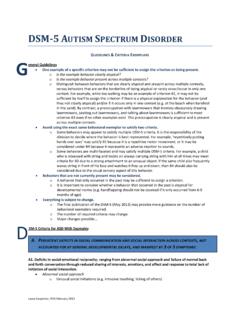
7 DSM-5 : Autistic Disorder Asperger s Disorder PDD-NOS CDD autism Spectrum Disorder 3 become 2 Deficits in social communication and social interaction Restricted, repetitive patterns of behavior, interests, or activities impairment in Social Interaction Qualitative impairment in communication Restricted repetitive and stereotyped patterns of behavior, interests, and activities A. Persistent deficits in social communication and social interaction across multiple contexts, manifested by the following, currently or by history (examples are illustrative not exhaustive; see text): 1. Deficits in social-emotional reciprocity; ranging, for example, from abnormal social approach and failure of normal back-and-forth conversation; to reduced sharing of interests, emotions, or affect; to failure to initiate or respond to social interactions. 2. Deficits in nonverbal communicative behaviors used for social interaction, ranging, for example, from poorly integrated verbal and nonverbal communication; to abnormalities in eye contact and body language or deficits in understanding and use of gestures; to a total lack of facial expressions and nonverbal communication.
8 3. Deficits in developing, maintaining, and understanding relationships, ranging, for example, from difficulties adjusting behavior to suit various social contexts; to difficulties in sharing imaginative play or in making friends, to absence of interest in peers. B. Restricted, repetitive patterns of behavior, interests, or activities, as manifested by at least two of the following, currently or by history (examples are illustrative, not exhaustive; see text): 1. Stereotyped or repetitive motor movements, use of objects, or speech ( , simple motor stereotypies, lining up toys or flipping objects, echolalia, idiosyncratic phrases). 2. Insistence on sameness, inflexible adherence to routines, or ritualized patterns of verbal or nonverbal behavior ( , extreme distress at small Changes , difficulties with transitions, rigid thinking patterns, greeting rituals need to take same route or eat same food every day). 3. Highly restricted, fixated interests that are abnormal in intensity or focus ( , strong attachment to or preoccupation with unusual objects, excessively circumscribed or perseverative interests).
9 4. Hyper- or hypo-reactivity to sensory input or unusual interest in sensory aspects of the environment ( , apparent indifference to pain/temperature, adverse response to specific sounds or textures, excessive smelling or touching of objects, visual fascination with lights or movement). C. Symptoms must be present in the early developmental period (but may not become fully manifest until social demands exceed limited capacities; or may be masked by learned strategies in later life). D. Symptoms cause clinically significant impairment in social, occupational, or other important areas of current functioning. E. These disturbances are not better explained by intellectual disability (intellectual developmental disorder) or global developmental delay. Intellectual disability and autism spectrum disorder frequently co-occur; to make comorbid diagnoses of autism spectrum disorder and intellectual disability, social communication should be below that expected for general developmental level.
10 Note: Individuals with a well-established DSM-IV TR diagnosis of Autistic disorder, Asperger s disorder, or Pervasive Developmental Disorder Not Otherwise Specified should be given the diagnosis of autism Spectrum Disorder. autism Spectrum Disorder: Specifiers With/without accompanying intellectual impairment . With/without accompanying language impairment . Associated with a known medical or genetic condition or environmental factor. Associated with another neurodevelopmental, mental, or behavioral disorder. With catatonia. autism Spectrum Disorder: Severity Severity is based on social communication impairments and restricted, repetitive patterns of behavior (see Table 2 in text). Severity Level Social Communication Restricted, repetitive behaviors Level 3 Severe deficits in verbal and nonverbal social communication skills cause severe impairments in functioning; very limited initiation of social interactions and minimal response to social overtures from others.