Transcription of Palliative Care Competence Framework
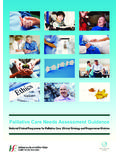
1 1 Palliative care Competence FrameworkMEDICINE NURSING MIDWIFERY HEALTH care ASSISTANTS SOCIAL WORK SPEECH AND LANGUAGE THERAPY DIETETICS / CLINICAL NUTRITIONOCCUPATIONAL THERAPYPHYSIOTHERAPYPHARMACYPSYCHOLOGYCH APLAINCY/PASTORAL CARE233 Palliative care Competence Framework2014 This report should be cited as follows:Ryan K, Connolly M, Charnley K, Ainscough A, Crinion J, Hayden C, Keegan O, Larkin P, Lynch M, McEvoy D, McQuillan R, O Donoghue L, O Hanlon M, Reaper-Reynolds S, Regan J, Rowe D, Wynne M; Palliative care Competence Framework Steering Group. (2014). Palliative care Competence Framework . Dublin: Health Service ExecutiveOrPalliative care Competence Framework Steering Group. (2014). Palliative care Competence Framework . Dublin: Health Service Executive45 Published by:Health Service Executive, DublinISBN 978-1-906218-79-9 Health Service Executive 2014.
2 Palliative care Competence work is licensed under the Creative Commons Attribution-Non International view a copy of this license, visit of of Steering Framework Development .. context of the Palliative care Competence of Competences for Palliative Specific care and Language As a society, perhaps the most sensitive measurement of our maturity is the manner in which we care for those who are facing the ultimate challenge the loss of life. (Report of the National Advisory Committee on Palliative care , 2001)The provision of high quality Palliative care is a central responsibility of the whole health care system. It is essential that health and social care workers possess the right competences to effectively meet the needs of people with life-limiting conditions as they are among the most vulnerable of populations served by our health service.
3 The development of the Palliative care Competence Framework is a valuable tool in supporting staff to achieve this goal and serves as a signal of the areas of performance that are valued by the Department of represent a dynamic combination of knowledge, understanding, skills and abilities. The purpose of continuing professional development is to foster competences and it is envisaged that the Framework will initially be used by individuals and managers to identify specific training needs. The Framework will also serve to focus dialogue when evaluating practice needs or demands. Furthermore, the development of the Framework affords a valuable opportunity to articulate and further our understanding of discipline-specific and inter-professional competences. This is particularly important as teamwork is an integral part of the philosophy of Palliative care .
4 Effective coordination and collaboration can occur only when each profession knows and uses the others expertise and capabilities in a patient-centred would like to thank all the individuals and representative professional organisations who gave so generously of their time and expertise in the development of this we work to meet the challenges posed by increasing demands for Palliative care associated with our ageing population and greater incidence of chronic illness, I encourage you to read and share this document with your Lynch Minister for Primary care , Social care (Disabilities & Older People) and Mental Health7 JOINT MESSAGEJ oint Message from the National Director of Clinical Strategy and Programmes and the Clinical Lead, National Clinical Programme for Palliative CareThe National Clinical Programme for Palliative care continues to make a significant contribution to improving the care for patients, their families and society as a whole by focusing on our most important resource, our development of the Palliative care Competence Framework highlights the ability of the National Clinical Programmes to bring key stakeholders and professions together to work collaboratively.
5 The Framework supports health care staff in all care settings to self assess, develop and maintain skills, knowledge and attributes required for the provision of Palliative care . This Framework will help to embed a culture within our services to ensure high quality safe services for patients. It also provides a template for our partners in education and professional development to support health care professionals by including Palliative care competences in education programmes at all Framework places a focus on the person with a life-limiting condition and their family. It helps in determining what health care staff can do to alleviate distress, pain and discomfort whether this is physical, emotional, spiritual or psychological. Applying the core and specific competences in practice, will help all health care staff (based in a hospital, hospice, GP practice, primary care centre or a community based setting) working with social care partners, to recognise their role in Palliative care and to develop their own quality National Clinical Programme for Palliative care and its partners will work with all stakeholders in order to ensure Palliative care is at the heart of our health care service.
6 We are grateful for the support and enthusiasm from all stakeholders to date and look forward to building on this to meet our objective of improving the quality of life of people with life-limiting ine Carroll, National Director, Clinical Strategy and ProgrammesDr. Karen Ryan, FRCPI Clinical Lead, National Clinical Programme for Palliative care 89In my role as Chairman of the Forum of Irish Postgraduate Medical Training Bodies I am very happy to both endorse and congratulate all those who have put together this Palliative care Competence Framework . The Forum was established in 2006 with the aim of enhancing the effectiveness of the training bodies in maintaining the highest standards of medical education and training. Since that time its remit has expanded beyond matters solely to do with education and training but also into areas of professionalism and service provision, specifically focusing on the development of clinical leadership; whilst recognising, at the same time, the importance of team working and the pivotal roles of all those health care disciplines that are our partners in providing all that is the very best for our patients.
7 Few topics in medicine extend so widely across so many health care disciplines and care settings as Palliative care . This kind of care is not simply about managing the physical symptoms of life threatening illness but extends necessarily into psychological, social, pastoral and spiritual support. Furthermore, the image and aspiration of the discipline of Palliative care has changed from one of, not simply managing terminal illness and soothing the symptoms of disease and disorders, to a more positive one of wellness. As in so many areas of medicine, change and knowledge is moving apace and it is difficult enough to keep abreast with one s own area of interest let alone what is available across other fields and what other skills can be brought to the table. It is in this context that this Palliative care Framework document sets out, so helpfully, the core competences as to the knowledge, attitudes and skills that should be required, not just by specialists and part-time practitioners, but by all health care workers who look after patients with life-threatening illnesses.
8 These competences are set out against six domains and across ten disciplines ranging from medicine and nursing to dietetics and nutrition and pharmacy. Providing this information under the umbrella of a single document will not only promote better, harmonious and standardised care but will, I have no doubt, significantly improve the quality of life of patients and their families across Ireland and who are faced with all the problems associated with such a life-threatening illness. Professor Frank Keane Chairman, Forum of Irish Postgraduate Medical Training Bodies The Nursing and Midwifery Board of Ireland (NMBI) welcome the development of the competency Framework document for Palliative care as a guide to ensure a common expectation of practice in all settings. Nursing and Midwifery Board of IrelandThe Office of Nursing and Midwifery Services Director is very pleased to endorse the Palliative care competency Framework .
9 The Nursing and midwifery profession acknowledge that professional Competence is far more complex than demonstrating behaviour aspirations or undertaking a task. Collaborative decision making with service users and their families in care planning and provision requires a level of knowledge and skills that engages with values, beliefs and attitudes to make competent and effective decisions. The continuum of contemporary Palliative care from early provision, concurrent with disease modifying treatments, to sole palliation recognises the increasing competency requirements on all health and social care providers. As partners in the advancement of the competences for nursing, midwifery and health care assistants we are confident of the potential of this Framework to enhance knowledge, skills and development in providing positive Palliative care outcomes for service users and their families.
10 Dr Michael ShannonOffice of Nursing and Midwifery Services Director I welcome the opportunity to support the publication of the Palliative care Competency Framework . This document will be an invaluable resource that will support standards of clinical practice in Palliative care and ultimately enhance the quality of patient care and experience. Additionally, it will assist education providers and influence curriculum development in the relevant therapy professions in the future. For clinicians and employers it will be a positive tool that will help identify professional development and training needs to ensure high standards of service delivery to patients with life-limiting conditions. It will also promote interprofessional understanding of the multidisciplinary and holistic Framework of Palliative care service delivery.