Transcription of PART 2: USING PHYSICAL AND CHEMICAL …
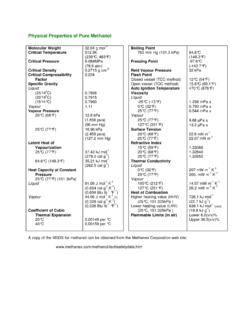
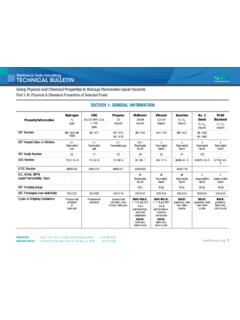
1 PART 2: USING PHYSICAL AND CHEMICAL PROPERTIES TO MANAGE FLAMMABLE LIQUID HAZARDS1 METHANOL SAFE HANDLING TECHNICAL BULLETINPART 2: USING PHYSICAL AND CHEMICAL PROPERTIES TO MANAGE FLAMMABLE LIQUID HAZARDS1 INTRODUCTIONThis is part two of the three-part Technical Bulleti n, which provides guidance for USING PHYSICAL , CHEMICAL , thermal, and electrical properti es to identi fy and control hazards of fl ammable liquids. Properti es and characteristi c parameters of eight fuels [hydrogen, compressed natural gas (CNG), propane, methanol, ethanol, gasoline, No. 2 diesel, and biodiesel] are listed in part 1B of the Technical Bulleti n2. This bulleti n compares various properti es for gasoline and and PHYSICAL properti es data may be diffi cult to locate and even more diffi cult to interpret and verify.
2 Flame speed is an example of this diffi culty. Some sources indicate the fl ame speed of methanol is greater than that for unleaded gasoline; others sources state the reverse. Sti ll others report that small additi ons of methanol increase the fl ame speed of gasoline. All may be correct, depending on the temperature, pressure, mixing, and stoichiometry at which combusti on occurs and how fl ame temperature is determined. Flame speeds of methanol and gasoline have similar values ( and feet per second [ft /s] for gasoline and methanol, respecti vely). Therefore, there may be overlap of fl ame speed parameters depending on whether measurements were made at lean, rich, or stoichiometric fuel/air rati os. Flame speed data used in this three-part bulleti n series are characteristi c of stoichiometric combusti on of a vapor at NTP (Normal Temperature = 68oF and Normal Pressure = psia or 760 mmHg).
3 Diff erences between the published values of fl ame speed for methanol and gasoline do not have a large eff ect on fi rst order esti mates for explosive overpressure and fi re radiant heat fl ux, and are not of major concern. The approximately tenfold diff erence between the fl ame speed of hydrogen ( 12 ft /s)3 and those of gasoline and methanol have a very large diff erence on overpressure and heat fl purpose of collecti ng and comparing data for diff erent fuels is to determine and compare the severity of potenti al consequences: fi res, explosions, and toxic plumes for parti cular circumstances. Consequence analysis4has been in widespread use for about 25 years, but remains an inexact mixture of science and art borne of experience. Results of modeling may be generally correct, but are typically inexact and non-specifi c.
4 Never-the-less, modeling results are highly useful in esti mati ng order-of-magnitude consequence severity5. PART 2: USING PHYSICAL AND CHEMICAL PROPERTIES TO MANAGE FLAMMABLE LIQUID HAZARDS2 Gasoline and methanol are NFPA class IB fl ammable liquids. Both are known to BLEVE in non-bulk and bulk transport containers, in pressure vessels, and storage tanks in roll-over situati ons. Vapors of both fuels form plumes and may accumulate in unventi lated areas, and both are considered to present an explosion hazard in confi ned spaces. Beyond this point, the behavior of gasoline and methanol begin to diverge. The vapor density and equilibrium of gasoline and methanol vapors show marked diff erences. Gasoline vapor is heavier than air, while methanol vapor is near neutral in buoyancy.
5 Gasoline has an equilibrium true vapor pressure (TVP) two to three ti mes greater than that of methanol. The fl ammability range of gasoline is to v/v % versus to 36 v/v % for methanol; fl ash point temperature of gasoline is minus (-) 45 oF versus 52 oF for methanol. Finally, the lower heati ng value of gasoline is over twice that of methanol; the mass burn rate of gasoline is over three ti mes that of methanol; minimum igniti on energy and stoichiometric fl ame velocity are approximately the same for comparing the hazardous characteristi cs of these vapors, it is apparent that gasoline vapor accumulates in low-lying areas and is capable of traveling long distances. Gasoline is also more easily ignited, ignites at lower concentrati ons, burns faster, and releases more radiant heat than methanol.
6 As a result, gasoline vapor is more likely to concentrate and explode. Gasoline fi res produce a much greater radiant heat fl ux hazard, and as much or more shock wave over pressure. The sum of these characteristi cs has caused gasoline to be replaced with methanol in high performance race cars where collision, tank rupture, fuel spillage, igniti on, fi re and explosion are expected to consequence severity must be determined beyond a fi rst order level, then users should verify that data contained in the Technical Bulleti n s Part 1-B PHYSICAL and CHEMICAL Properti es tables is appropriate for the desired level of precision in determining the radius of overpressure and radiant heat fl ux hazard zones. Second order consequences can be readily determined USING proprietary consequence modeling soft ware (a variety of soft ware packages can either be purchased or leased).
7 Each soft ware package uses parameter values and calculati on techniques, which are judged by the soft ware providers to be appropriate for the algorithms used in their parti cular model. Therefore, parameter values in the PHYSICAL and CHEMICAL Properti es tables in Part 1-B of this Technical Bulleti n may not correspond to the values used by third-party soft ware. In order to establish whether the soft ware is appropriate for your specifi c needs, it is recommended to compare soft ware modeling results to results of actual fi re and explosion incidents. Additi onally, it is good practi ce to confi rm soft ware modeling results with hand calculati ons to verify that results provided by the soft ware are reasonable. 6,7,8,9A word of cauti on regarding the use of CHEMICAL and PHYSICAL properti es parameters is appropriate.
8 Values of parameters presented in the PHYSICAL and CHEMICAL Properti es tables are determined in a laboratory environment, and therefore characterize a narrow range of standardized, controlled, and repeatable conditi ons. Test results for pure materials are not representati ve of fuel blends, contaminated materials, complicati ons associated with switch loading, and substance property parameters at elevated temperature and pressure. Values presented in the PHYSICAL and CHEMICAL Properti es tables may or may not typify your conditi ons of usage or process 2: USING PHYSICAL AND CHEMICAL PROPERTIES TO MANAGE FLAMMABLE LIQUID HAZARDS3 FLAMMABLE LIQUIDSICC, NFPA, and OSHA classify liquids as fl ammable or combusti ble. Each of these designati ons is divided into sub-classes based on values of selected PHYSICAL and CHEMICAL parameters.
9 These parameters indicate conditi ons at which vaporizati on, piloted igniti on, and combusti on are likely to occur. Liquids are assigned to classes based on the values of identi fi able and measurable properti es (boiling point temperature and fl ash point temperature); each fl ammability class contains materials whose properti es fall within a specifi ed range of values. For example, class IA fl ammable liquids have fl ash point temperatures below 73oF and boiling point temperatures below 100oF ( , n-pentane). Class IA substances have substanti al equilibrium vapor pressure at NTP, and are known to ignite in air at temperatures below normal ambient temperature in the presence of a suffi ciently energeti c igniti on source. Class IB fl ammable liquids are defi ned as having fl ash point temperatures less than 73oF and boiling point temperatures at or above 100oF ( , methanol, ethanol, and unleaded gasoline).
10 Class IC fl ammable liquids have fl ash point temperatures at or above 73 oF, and boiling point temperatures below 100oF ( , turpenti ne). Guidance provided in this Technical Bulleti n series focuses on IB fl ammable liquids. This fl ammability class contains three widely-used motor fuels which are transported, handled, and stored in large volumes by persons and organizati ons highly experienced in safe handling, as well as in small volumes by users who are less familiar with and practi ced in safe handling requirements and an extent, fi re hazards that characterize a parti cular fl ammability class are common to all of the materials within that class. Class IB fl ammable liquids include motor fuels, solvents, reactants, and feed stocks. Benzene, toluene, acetone and alcohols are examples of class IB solvents and feed stocks.