Transcription of “Part-time” Employment - Labour
1 1 part - time Employment Know More About Labour Legislation 2 Introduction Some employers engage part - time employees to meet operational needs. A number of families also employ part - time local domestic helpers to help them with housework. On the other hand, due to personal reasons such as further study and family commitments, some job-seekers prefer part - time work with fewer working hours. part - time Employment offers an alternative mode of Employment to both employers and employees. This leaflet provides useful information to them on part - time Employment . Protection under Labour Legislation Many people may think that part - time employees are not protected by Labour legislation. This is a misconception. In fact, Labour legislation does not differentiate between part - time and full- time employees. Employees, no matter whether they are designated as full- time or part - time , are protected by Labour legislation.
2 This leaflet briefly introduces the rights and protection enjoyed by part - time employees under the Employment Ordinance, Minimum Wage Ordinance, Employees Compensation Ordinance and mandatory provident fund schemes Ordinance. For further information, please refer to the relevant publicity leaflets, provisions of the law or contact the Labour Department or mandatory provident fund schemes authority . 3 Protection under the Employment Ordinance The Employment Ordinance is the main piece of legislation governing Employment conditions in Hong Kong. It lays down the minimum Employment standards. Employers and employees may enter into Employment terms more favourable than those provided in the Ordinance. Employees, except for those to whom the Employment Ordinance does not apply1, be they designated as full- time , part - time , casual or substitute employees, and irrespective of their working hours, are entitled to the following rights and benefits under the Ordinance: Wage payment protection Restriction on deductions from wages Statutory holidays Maternity protection (prohibition of assignment of heavy, hazardous or harmful work) Employment protection (unreasonable and unlawful dismissal) Provision of information on conditions of service by employers Protection against anti-union discrimination, etc Under the Employment Ordinance, an employee who has been employed continuously by the same employer for 4 weeks or more, with at least 18 hours worked in each week, is regarded as being employed under a continuous contract.
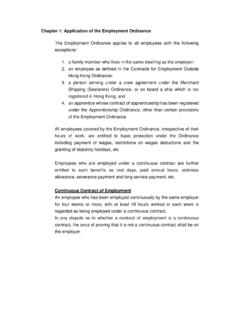
3 An employee, who is employed under a continuous contract and meets the qualifying conditions stated in the Employment Ordinance, is also entitled to the following rights and benefits in addition to those mentioned in the preceding paragraph: Rest days Pay for statutory holidays Annual leave with pay Sickness allowance Maternity protection (maternity leave, payment for maternity leave, protection of a pregnant employee against termination of Employment ) Paternity leave 1 Persons to whom the Employment Ordinance does not apply: A family member who lives in the same dwelling as the employer An employee as defined in the Contracts for Employment Outside Hong Kong Ordinance A person serving under a crew agreement under the Merchant Shipping (Seafarers) Ordinance, or on board a ship which is not registered in Hong Kong An apprentice whose contract of apprenticeship has been registered under the Apprenticeship Ordinance, other than certain provisions of the Employment Ordinance 4 Severance payment Long service payment Employment protection, etc For further information on the rights and benefits enjoyed by employees under the Employment Ordinance, please refer to the Labour Department s publication A Concise Guide to the Employment Ordinance , A Concise Guide to Paternity Leave under the Employment Ordinance and other related information.
4 Points-to-note On Switching from Full- time to part - time Employment Unless an employee has given prior consent or the employer can provide valid reasons2, his employer should not unilaterally change his Employment from full- time to part - time . Otherwise, the employee is entitled to lodge a claim for remedies against his employer on the ground of unreasonable variation of the terms of the Employment contract under the Employment Ordinance. If an employee is asked to switch to part - time Employment , he must carefully consider the new Employment terms, assess the pros and cons involved, including whether the new Employment contract is still regarded as a continuous contract under the Employment Ordinance. Enquiry: Labour Department Website: Hotline: 2717 1771 (the hotline is handled by 1823 ) 2 Valid reasons: the conduct of the employee the capability or qualifications of the employee for performing his work redundancy or other genuine operational requirements of the business statutory requirements ( it would be contrary to the law to allow an employee to continue to work in his original position or to continue with the original terms in his Employment contract) other substantial reasons 5 Protection under the Minimum Wage Ordinance Statutory Minimum Wage (SMW) is expressed as an hourly rate.
5 In essence, wages payable to an employee in respect of any wage period, when averaged over the total number of hours worked in the wage period, should be no less than the SMW rate. SMW applies to all employees, whether they are monthly-rated, weekly-rated, daily-rated, hourly-rated, piece-rated, permanent, casual, full- time , part - time or other employees, and regardless of whether or not they are employed under a continuous contract as defined in the Employment Ordinance, with the following exceptions: persons to whom the Employment Ordinance does not apply3 live-in domestic workers, irrespective of their sex, race or nationality specified student interns as well as work experience students during a period of exempt student Employment SMW applies to employees with disabilities and able-bodied employees alike. In order to strike an appropriate balance between providing wage protection to employees with disabilities and safeguarding their Employment opportunities, a special arrangement is also provided under the Minimum Wage Ordinance so that employees with disabilities whose productivity may be impaired by their disabilities are given the right to undergo productivity assessment to determine whether they should be remunerated at not lower than the SMW rate or at a rate commensurate with their productivity.
6 The right to invoke assessment is solely vested in the employees with disabilities, not their employers. For details of the Minimum Wage Ordinance and the special arrangement for employees with disabilities, please refer to the relevant leaflet and reference guidelines published by the Labour Department. Protection under the Employees Compensation Ordinance Under the Employees Compensation Ordinance, no employer shall employ any employee in any Employment unless there is in force a policy of insurance to cover 3 As for an apprentice whose contract of apprenticeship has been registered under the Apprenticeship Ordinance, while certain provisions of the Employment Ordinance apply to registered apprentices, SMW is not applicable 6 their liabilities both under the Ordinance and at common law for injuries at work in respect of all their employees, irrespective of the length of Employment contract or working hours, full- time or part - time , permanent or temporary Employment .
7 As required by the Employees Compensation Ordinance, an employer must notify the Commissioner for Labour of an accident met by his employee arising out of and in the course of Employment within 14 days (7 days in respect of fatal cases), and pay compensation to the employee. Major items of compensation under the Employees Compensation Ordinance may include: periodical payments, medical expenses and compensation for permanent total or partial incapacity, etc. If an employee dies as a result of an accident arising out of and in the course of Employment , his employer shall be liable to pay compensation for death to the eligible family members of the deceased employee and reimburse reasonable funeral and medical attendance expenses to persons who have paid such expenses. For information on the major provisions of the Employees Compensation Ordinance, please refer to the Labour Department s publication A Concise Guide to the Employees Compensation Ordinance.
8 Protection under the mandatory provident fund schemes Ordinance The mandatory provident fund schemes Ordinance provides that for any employee of age 18 or over to below 65 who is employed under a written or verbal Employment contract for a period of not less than 60 days irrespective of whether he is employed full- time or part - time and irrespective of his weekly working hours, his employer must enrol him in a mandatory provident fund (MPF) scheme and make contributions. For employees who are not employed under a continuous contract , as long as their employed period is not less than 60 days, they are still covered by the MPF System. The above 60-day rule does not apply to casual employees under the MPF System, short-term employees employed on a day-to-day basis or for a fixed period of less than 60 days in the catering industry or the construction industry.
9 Even if a casual employee is only employed for one day, his employer must still enrol him in an MPF scheme and make contributions. 7 For further information on MPF System, please refer to the leaflets MPF rights of part - time employees and MPF Industry schemes published by the mandatory provident fund schemes authority which can be downloaded from the website of the authority . Enquiry: mandatory provident fund schemes authority Website: Hotline: 2918 0102 8 Good People Management Practices Full- time and part - time employees alike are valuable assets of a company. Good people management practices help boost the morale, commitment and productivity of employees. Apart from meeting statutory requirements, employers are advised to adopt good Employment practices to care for their part - time employees. Improper human resource management policies and practices will result in high turnover, unnecessary Labour disputes and even increase in operational costs.
10 In the end, the employers will suffer. If employers show concerns over the needs of part - time employees, the employees will definitely contribute their best to the company in return. Recruitment Although an Employment contract can be made verbally or in writing, employers should, as far as possible, enter into written Employment contracts with their part - time employees. This will help avoid Labour disputes. (Employers may refer to the Labour Department s publication Using Written Employment Contracts and Proper Keeping of Wage and Employment Records for information on how a written Employment contract should be drawn up.) The Employment Ordinance provides minimum standards on Employment rights and benefits. To attract the most suitable candidates, many employers offer better and more competitive Employment terms.