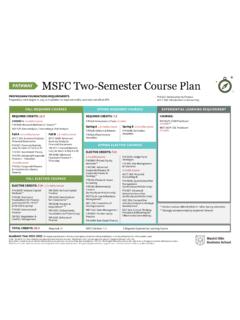
Transcription of PATHWAY MSFQ Three-Semester Course Plan
1 FALL 2 REQUIRED COURSESREQUIRED CREDITS: Recommendedsemester for Experiential Learning courseFall AFIN 500R: Topics in Quantitative Finance credits Fall BFIN 527: financial credits**MSFQ Three-Semester Course Plan PATHWAYPREPROGRAM FOUNDATIONS REQUIREMENTSP reparatory work begins in July, is in addition to required credits, and does not affect 510: Introduction to FinanceACCT 560: Introduction to AccountingACCT 562: financial Accounting II Intermediate AccountingAcademic Year 2021-2022 The degree requirements in this document apply to students entering Washington University during the 2021 2022 academic year. Under the flat tuition rate, students may take up to 18 credits per semester. Additional credits must be approved and are charged at the per credit rate. Every effort is made to ensure that the information is accurate and correct as of the date of publication (5/7/21). Washington University reserves the right to make changes at any time without prior notice.
2 Therefore, this curriculum document may change from time to time without notice. The governing document at any given time is thethen-current version, as published 1 REQUIRED COURSESREQUIRED CREDITS: 560F: Professional Business Communication creditsDAT 537: Data Analysis, Forecasting & Risk Analysis 3 creditsDAT 561: Introduction to Python & Data Science 3 credits Fall AFIN 524: Options & creditsFIN 532: Investment creditsFIN 538: Stochastic Foundations for creditsFall BFIN 524B: Derivative Securities creditsFIN 527: financial credits**FIN 532B: Data Analysis for Investments creditsMGT 537: Invest in Your Career0 creditSPRING REQUIRED COURSESREQUIRED CREDITS: 500Q: Quantitative Risk Management 3 creditsFIN 537: Advanced Derivative Securities 3 creditsSpring AFIN 525: Fixed Income Securities creditsFIN 534: Advanced Corporate Finance I Valuation creditsFIN 539: Mathematical Finance creditsSpring B FIN 534B: Advanced Corporate Finance II creditsFIN 552.
3 Fixed Income Derivatives creditFALL OR SPRING RECOMMENDED ELECTIVE COURSESELECTIVE CREDITS: DAT 560G: Database Design & SQL credits*DAT 500S: Machine Learning for Prediction of Business Outcomes 3 credits*CSE 502N: Data Structures & Algorithms 3 credits*CSE 514A: Data Mining 3 credits*CSE 511A: Intro to AI3 credits*EXPERIENTIAL LEARNING REQUIREMENTCOMPLETE1 Course : MGT 551E: Internship, Business, & Application creditsFIN 500K: financial Consulting Project 3 creditsFIN 556: Quantitative Finance Projects 3 creditsMGT 501V: Applied Problem Solving for Orgs credits* Elective courses offered either in Fall or Spring semesters** FIN 527: financial Markets can be taken in Fall 1 or Fall 2,or replaced by FIN 521: financial Intermediation in Fall 2, if CREDITS:39 Required: Elective: Quantitative Finance Courses Summer Online Foundations Workshops FIN 510 Introduction to Finance The main topics to be covered in this Course are (1) principles of investments, (2) financial analysis of corporate projects, (3) cost of capital, and (4) capital structure and financing policies.
4 The objective of the company is assumed to be shareholder value maximization. Shareholder value is created by earning more than the cost of capital. The cost of capital is an opportunity cost what investors could expect to earn on comparable investments in the financial markets. To understand the cost of capital, we need to understand the viewpoint of investors. Furthermore, to understand whether a project earns more than the cost of capital, we need to know how to estimate and discount project cash flows. So, the first three topics are closely connected. The main question in the fourth topic is whether we can create shareholder value through the financial structure of the firm. For example, we will ask whether we can lower the cost of capital by financing with debt instead of equity, or vice versa. ACCT 560 Introduction to Accounting In this Course , we will study the three fundamental financial accounting issues, including (1) recognition, (2) measurement/valuation, and (3) classification/disclosure and consider how business transactions are reflected on the financial statements using generally accepted accounting principles (GAAP).
5 We will cover the four primary financial statements (balance sheet, income statement, statement of stockholders equity, and statement of cash flows), the supporting footnotes to these statements, and several reports (annual reports, proxy statements, and press releases). The Course incorporates both a preparer s perspective ( , GAAP requirements for recording and presenting financial information) and a user's perspective ( , how an investor or analyst can interpret and use financial statement information). ACCT 562 financial Accounting II (Intermediate Accounting) Primary subject matter includes asset and liability valuation and income measurement addressed at a deeper level than in introductory financial accounting. Recent additions to the professional accounting literature and the conceptual underpinnings of corporate financial reporting are emphasized, and articles from the popular business press are used to illustrate the factors that motivate corporate reporting decisions.
6 financial reporting issues related to a variety of topics not covered in earlier accounting coursework, such as segment reporting, securitization, and convertible securities, are introduced. Fall Semester DAT 537 Data Analysis, Forecasting & Risk Analysis Course develops the methods and techniques of econometrics that are of particular relevance to students of business and economics. A range of models, namely single equation regression models, time series models and models for discrete response data are studied. The purpose of building these models is described within the context of aggregate data, and micro data at the level of firms and individuals. Procedures to evaluate the estimated models are discussed, and emphasis is placed on the interpretation of results and the forecasting of future observations. Students are expected to complete an individual (non-group) project in which the technique developed in the Course are applied to real world problems. The Course should be valuable for a variety of students including those with primary interest in finance, marketing, operations, and accounting.
7 3 credits. DAT 561 Introduction to Python and Data Science This Course provides students the necessary skill set to extract reliable insights from large datasets prevalent in various business applications, such as supply chain management, marketplace operations, healthcare analytics , and financial engineering , using Python. In this Course , students will develop basic tools to understand Python programs and implement data processing pipelines using Python. In particular, students will learn how to acquire, clean, analyze and visualize data in Python, which they will then use to improve decision-making processes. Throughout the Course , students will use the Python programming language, which is very effective for data manipulation, reporting, and complex optimization. Topics covered include introduction to Python programming, data acquisition and cleaning, data manipulation, current multi-source data collection technology used in practice, basic data visualization using Matplotlib, ggplot2, and Bokeh.
8 3 credits. FIN 500K Finance Consulting Projects In this Course , mentored engagements will help students to develop sophistication in the transfer of cutting edge techniques from the academic environment into practice. Students are placed in teams, and each team does a project with a company. The associated instructor helps the team to manage the relationship and make the bridge between the academic tools the students have learned and the practical projects provided by the companies. Prerequisites: Completion of the first year of the MSF program. Other students may apply to participate with the permission of the instructor. 3 credits. FIN 500R Topics in Quantitative Finance The main objective of this Course is to familiarize students with the current cutting-edge techniques implemented by the quantitative finance industry. The contents of this Course can vary from year to year. Topics may include risk management, statistical arbitrage, and derivative pricing and hedging.
9 Some practical projects may be used for implementation of these techniques. credits. FIN 521 financial Intermediation Discussion centers on the role of banking institutions and credit markets, the design of financial contracts and institutions and the public regulation of financial markets. After establishing a framework for analyzing financial institutions and markets, we turn to a current topic of special interest. Students will research and present a report advocating a particular point of view. credits. FIN 524 Options and Futures Focuses on futures with an introduction to options. Discusses forward and futures pricing, and the use of various futures contracts to hedge commodity price risk, interest risk, currency risk, stock portfolio risk, and other risk exposures. credits. FIN 524B Derivative Securities Provides an in-depth analysis of valuation and trading strategies for options and other derivative securities which have applications across areas of finance such as hedging, swaps, convertible claims, mortgage payments, index arbitrage, insurance, capital budgeting and corporate decision making, and are responsible for many new innovations and developments of the financial markets.
10 Prerequisites: FIN 524. credits. FIN 527 financial Markets This Course will facilitate further learning in the finance track by providing insights into various financial markets, financial institutions, associated market participants, select representative transactions and industry conventions. Students will examine the role of regulators, rating agencies, commercial and investment banks, and investors in the debt, equity and derivatives markets. In addition, in the context of the financial Crisis, the role of regulation, monetary policy, leverage and human behavior will be discussed as possible root causes of the crisis with an emphasis on the various market failures in specific markets and their impact on market participants. Lastly, the role of revised regulations and the future of financial innovation will be debated. credits. FIN 532 Investment Theory A Course in the theory of risk and return in capital markets. We will cover the CAPM and APT models of asset pricing and will discuss various measures of mutual fund performance evaluation which arise from these models.