Transcription of Pearson - Risorse Inglese SSPG Present Perfect
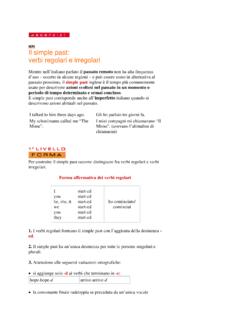
1 U2U18989 Present perfectPresent Perfect Il Present Perfect esprime azioni o fatti del passato che hanno una relazione con il presente. Non importante il momento del passato in cui successa l azione per cui non necessario dare indicazioni di tempo. Si forma con il Present simple dell ausiliare have seguito dal participio passato del verbo principale. Forma affermativasoggettoausiliareparticipio passatoI / You / We / You / They have ( ve)arrived / / She / (It)has ( s)Forma negativasoggettoausiliareparticipio passatoI / You / We / You / They have not (haven t)slept / She / (It)has not (hasn t)Forma interrogativaausiliare soggettoparticipio passatoHaveI / you / we / you / they slept well?
2 Hashe / she / (it)NON si usa mai il verbo to be come ausiliare con il Present s dad? He has gone to the supermarket. (NON He is gon e to th e sup ermarket .) Il participio passato dei verbi regolari si forma aggiungendo -ed alla forma base. Ha la stessa forma del Past simple dei verbi regolari e le stesse variazioni ortografiche ( pagina 51).I ve taken a lot of pictures today!8A2 Pearson Italia Perfect Il participio passato dei verbi irregolari corrisponde alla terza colonna del paradigma dei verbi irregolari ( pagina 165) e va imparato a memoria.
3 Buy boughtThey have bought a new madeMum has made a cake for doneYouhave done something strange (=qualcosa di strano).see seenI have seen a ghost!Per esprimere il verbo andareal Present Perfect occorre scegliere tra due forme con significato differente: have / has + been to She s been to the dentist s. = stata dal dentista (adesso tornata). have / has + gone toShe s gone to the dentist s. = andata dal dentista (e non ancora tornata).1 Scrivi il Present perfectdei ..2 Coniuga al Present Perfect utilizzando gli elementi / be / to England / recently.
4 1we / drink / the last cup of sister / burn / some / break / a glass ..4you / do / the right have been to England recently. Pearson Italia Perfect con ever / never / just / already / yetPresent Perfect con ever / never / just / already / yet Gli avverbi ever (mai) e never (non mai) sono spesso usati con il Present Perfect per descrivere esperienze. Ever si usa nella forma you ever played cricket? Yes, I have. / No, I haven t. = Hai mai giocato a cricket? S . / No. Never, che ha significato negativo, si usa con le frasi in cui il verbo alla forma s never read Harry Potter.
5 = Non ha mai letto Harry Potter. Altri avverbi che spesso accompagnano il Present Perfect sono just (appena), already (gi ) e yet (ancora). Just precede il participio passato in frasi affermative e al Present .. (be) to London three .. (do) all their .. Bart .. (buy) any food?3 She .. (not hear) about the accident .. (forget) my book. Sorry!4 Grammar rocks! Leggi la prima strofa di una famosa canzone di John Lennon, sottolinea i verbi al Present Perfect e prova a tradurla. So this is ChristmasAnd what have you done?
6 Another year overAnd a new one (has) just begun ve beenA2 Pearson Italia perfect1 Inserisci l avverbio al posto lesson has finished. (just) ..1We ve had breakfast. (already)2 They haven t done their homework. (yet)3It s late! Have you checked in? (yet)4 Danielle has called. She ll be here at 8. (just)5 Has Neil found a new job? (already) 6I ve bought some ice cream. Would you like some? (just)2 Completa con il Present Perfect ed ever o .. to China. (be)1 Lisa .. (play) you .. (meet) a famous actor?
7 3My uncle .. (marry). He s a bachelor (= scapolo). your sister .. (try) sushi?5I .. (want) to work at a your children .. (sleep) at a friend s house without you?The lesson has just finished. ve never beenWe ve just left. = Siamo appena andati via. Have they just finished their homework? = Hanno appena finito i compiti? Already precede il participio passato nelle frasi affermative e interrogative per indicare che l azione gi ve already packed. = Ho gi fatto i you already packed? = Hai gi fatto i bagagli?
8 Yet si usa alla fine della frase e significa ancora nelle frasi negative e gi nelle frasi interrogative. I haven t found my keys yet. = Non ho ancora trovato le they learned the poem yet? = Hanno gi imparato la poesia? Pearson Italia Perfect con for e mai mangiato la paella? S . Quando siamo stati a ho mai guidato nel Regno abbiamo ancora parlato con il ha gi comprato i biglietti? 5 Siamo appena arrivati in gi fatto la doccia? Per parlare di azioni iniziate nel passato che ancora durano nel presente si usa il Present Perfect con for e since.
9 For indica da quanto tempo dura un azione (for an hour / a week / a month, etc.). Since indica il momento in cui l azione iniziata (since Monday / January / 2016).I ve lived in Boston for twenty years. = Vivo a Boston da vent ve lived in Boston since 1990. = Vivo a Boston dal 1990. Per chiedere da quanto tempo dura una certa azione, si usa How long ..?How long have you studied French? = Da quanto tempo studi francese?This bakery has been here since Perfect con for e sinceA2 Pearson Italia 94948 Present perfect1 Completa con for o have been friends.
10 25 have known Patricia .. we were have worked together .. a long haven t seen my sister .. six hasn t had a break .. 9 o you tried any new sports .. you started college?6It hasn t rained .. le frasi al Present Perfect con for e since. 1I / not drink / coffee / three months2I / not see / Jessica / 20153We / have / this boat / five years4 She / be / a teacher / six months5 Mum / have / a headache / this morning3 Per ogni suggerimento dato scrivi una domanda con How long ..? e poi rispondi / Bob.