Transcription of Peer Review and Focused Professional Practice Evaluation ...
1 This policy applie s to: Stanford Health Care Date Writte n or Las t Re vis ion Revised 1/14/2016 Name of Policy Pe er Re view and Focus e d Profe s sional Practice Evaluation (FPPE) Policy for Me dical Staff and Advance d Practice Provide rs (APPs ) Page 1 o f 11 Departments Affected: All Departments I. PURPOSE To ensure that the Medical Staff participates in peer Review , assesses the competence of SHC credentialed providers, conducts Professional Practice Evaluation , and uses the results of such assessments and evaluations to improve Professional competency, Practice , and the system of care. This attention to the care patterns of individua l practitioners is also considered an integral component of our ongoing efforts to evaluate and improve performance of clinical groups and enterprise-based systems of care.
2 II. POLICY STATEMENT Each clinical service will have a mechanism for peer Review operationalized through their P rofessional P ractice Evaluation Committee (P P EC). The findings of the committees defined in this policy will be included in the information used to assess the quality of care of each practitioner at the time of reappointment to the Medical Staff and on an ongoing basis as appropriate. The Care Improvement Committee (CIC) will supervise the work of the P P ECs and adjudicate inter P P EC opinions and issues. The CIC will report to the Medical Executive Committee (MEC) annually. This policy also applies to advanced Practice providers (AP P s), including nurse practitioners, physician assistants, certified registered nurse anesthetists and c linic a l nur s e s pe c ia lis ts.
3 These committees findings will also be forwarded (with safeguards to ensure confidentialit y of individual practitioners) to the appropriate venues for potential system improvements. III. DEFINITIONS A. Professional Practice Evaluation Committee (PPEC) is a peer Review committee authorized to conduct peer Review for providers within a designated clinical service or services. B. Care Improvement Committee (CIC) is designated as the parent P P EC and is ultimately accountable to the Medical Executive Committee and the SHC Board of Directors for oversight of the peer Review processes of all clinical services ( all of the P P ECs). Services, divisions and/or interdisciplinary groups may form P P ECs when approved by the CIC.
4 C. Peer Review is a process that allows the Medical Staff to evaluate an individua l s Professional Practice and systems issues that may affect the quality of care and patient safety . The process includes an Evaluation of a practitioner s Professional performance based on recognized standards. The Evaluation may This policy applie s to: Stanford Health Care Date Writte n or Las t Re vis ion Revised 1/14/2016 Name of Policy Pe er Re view and Focus e d Profe s sional Practice Evaluation (FPPE) Policy for Me dical Staff and Advance d Practice Provide rs (APPs ) Page 2 o f 11 Departments Affected: All Departments also identify systems or processes of care that do not adequately protect against foreseeable human error.
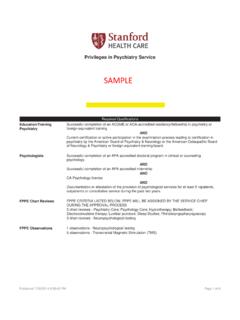
5 (These system issues will be referred to the patient safety Committee for Evaluation and improvement). D. Ongoing P rofessional P ractice Evaluation (OP P E) is a summary of ongoing data collected for the purpose of assessing a practitioner s clinical competence and Professional behavior. This process is described in the OP P E policy. E. Focused P rofessional P ractice Evaluation (FP P E) is a systematic process to ensure that there is sufficient information available to evaluate a practitioner's Professional competence. A Focused Review can be requested by the Credentia ls Committee, a PPEC, the CIC or by the Service Chief. FPPE occurs: 1. A t the time of initia l c r e de ntia ling. ( I nitia l FP P E) 2.
6 As the result of data evaluated during OP P E. 3. When additional data or reports indicate the need for a Focused Review of adverse events. F. Care Ratings: Practitioner (as determined by the PPECs) 1. Care Appropriate: Despite a complication or adverse outcome (or some other question about the quality of care), it is determined that a majority of peers may have responded similarly under similar circumstances (substitution test). This designation adjudicates that there was no clear deviation from our standards. 2. Improvement Opportunity: Care that involved simple errors in diagnosis, treatment or judgment, or inadvertently doing other than what should have been done: a slip, lapse, or mistake.
7 3. At Risk Behavior: Care that requires education or coaching to prevent recurrence, or behavioral choice that increases risk where risk is not recognized or is mistakenly believed to be justified. 4. Reckless Behavior: Care that suggests reckless disregard of the practitioner s duty to the patient through gross negligence, general incompetence or actual intent to provide substandard care, or behavioral choice to consciously disregard a substantial and unjustif ia b le r is k. G. Care Rating: System of Care (as determined by the PPECs) 1. Care System Improvement Opportunity: Designates an event as resulting at least in part from an opportunity to improve the care system to reduce caregiver errors, mitigate the effects of any errors or otherwise This policy applie s to: Stanford Health Care Date Writte n or Las t Re vis ion Revised 1/14/2016 Name of Policy Pe er Re view and Focus e d Profe s sional Practice Evaluation (FPPE) Policy for Me dical Staff and Advance d Practice Provide rs (APPs ) Page 3 o f 11 Departments Affected: All Departments better support the care process.
8 This rating will apply whenever a system improvement opportunity is identified, independent of any individua l practitioner s care rating. H. P rofessional Behavior As defined in the Medical Staff Code of P rofessional Behavior P olicy, a high standard of Professional behavior, ethics, and integrity is expected of each individua l member of the Medical Staff at SHC in order to promote an environment conducive to providing the highest quality of care. I. Peer An individua l who practices in the same profession or who has expertise in the appropriate subject matter. The P P EC designated to perform a Review will determine the degree of subject matter expertise required for a provider to be considered a peer for all Professional Practice evaluations performed by the Medical Staff.
9 IV. PEER Review PROCESS/PROCEDURE A. Individua l Case Reviews: 1. Cases for individua l case Review will be based on individua l P P EC selection and may be identified by: a) Review indicators; each PPEC identifies relevant indicators for its divisions and/or services. Cases will be pre-screened by the P P EC Q ua lity lia is on from Quality, P atient safety , and Effectiveness (QPSED) and applicable cases will be presented to the PPEC chair or designee for screening. b) Case referrals identified by: (1) SAFE reports (2) P a tie nt/f a mily c ompla ints (3) Sentinel/adverse events (4) Regulatory agencies (5) C linic ia n( s ) (6) Morbidity and Mortality conferences (7) Risk Management This policy applie s to: Stanford Health Care Date Writte n or Las t Re vis ion Revised 1/14/2016 Name of Policy Pe er Re view and Focus e d Profe s sional Practice Evaluation (FPPE) Policy for Me dical Staff and Advance d Practice Provide rs (APPs ) Page 4 o f 11 Departments Affected: All Departments 2.
10 Individua l case reviews may also be performed when a threshold for an indicator is exceeded. B. Indications for Focused P rofessional P ractice Evaluation (FP P E) 1. Any single egregious or sentinel event, as judged by the relevant P P EC, CIC, Service Chief, APP Administrator, MEC or Chief of Staff may be referred to the CIC for consideration of a FPPE. 2. When indicator thresholds are exceeded within the agreed upon time: a) The number of cases rated care inappropriate or improvement opportunity exceeds a threshold for concern as determined by the relevant P P EC or in consultation with the CIC. b) An indicator exceeds a threshold as determined by the P P EC. However, exceeding those indicators does not result in automatic referral to CIC for consideration of FPPE.