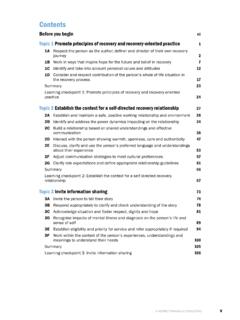
Transcription of Peer work framework - Mind Australia
1 Peer work framework This document will provide a framework for Mind's peer workforce. The framework will illustrate the value Mind places on a lived experience of mental ill health as the foundation of our peer practitioner workforce as well as guide and inform consistent practice across the organisation. Contents Acknowledgment i Definitions 2. Introduction 4. About Mind 5. The way we work 5. Peer work at Mind 6. Evidence base for peer support 7. Mind's Model of Peer Work 8. Lived experience knowledge base 8. Peer work values 9. Peer practice principles 10. How Mind supports an effective peer workforce 14. Conclusion 16. References 17. Acknowledgement Mind acknowledges that Aboriginal and Torres Strait Islander peoples are the Traditional Custodians of the lands on which we work and we pay our respects to Elders past, present and emerging. We recognise the intergenerational impact of the history of invasion, dispossession and colonisation and are committed to the recognition, respect, inclusion and wellbeing of Australia 's First Peoples.
2 Inclusion statement Mind values the experience and contribution of people from all cultures, genders, sexualities, bodies, abilities, spiritualities, ages and backgrounds. We are committed to inclusion for all our clients, families and carers, employees and volunteers. This framework was written by Bianca Childs, Mind's Senior Lived Experience Advisor. Bianca has over 17. years' experience in designated lived experience roles across the community and clinical mental health sectors. Bianca also has formal qualifications in mental health peer work, training and assessment and community and consumer engagement. Bianca would like to acknowledge the valuable contributions of Mind's peer workforce, Mind Supported Independent Living (SIL) residents, consumer and carer members of Mind's Lived Experience Advisory Team, lived experience staff, managers and members of the leadership team. Childs, B. (2021) Mind's peer work framework .
3 Mind Australia , Melbourne. 1. Definitions Advocacy and self-advocacy Dignity of risk Advocacy means speaking on behalf of or Dignity of risk means people having the right to representing the views of another person to take risks in their decision-making and actions. help get their voice heard and their needs met. This can create confidence and hope, and also Self-advocacy is when a person speaks up for provide opportunities for learning. themselves and the things that are important to them. It is still self-advocacy even if the person Discipline needs support to do this. The qualities required to follow a particular way Clients of working and to maintain agreed standards of practice are called a discipline. In this framework , people receiving Mind services are called clients. Depending on the type of Families and carers service at Mind, clients may also be referred to as residents, customers, participants or consumers.
4 Families and carers refer to people who provide practical and emotional support to someone with Co-design mental ill health including relatives, friends or neighbours (Bartolo & Sanders, 2008). Co-design is where members of the Mind community (consumers, carers and families) Lived experience become equal partners in decision-making. Rather than being viewed as a source of information to Lived experience refers to a personal experience input, participants work actively to shape the of mental ill health and recovery . In this document definition and direction of a project. it also acknowledges living experience , noted as important by Mind's Peer practitioners as it Community mental health practitioners acknowledges the work that they do every day to maintain their wellbeing. In most services at Mind, staff who are employed to provide direct and indirect support to clients Consumer lived experience is the direct are called community mental health practitioners.
5 Experience of mental ill health and recovery . Whilst in some services at Mind, they are called Carer lived experience is the experience gained community support workers, for the purpose of when caring for a person with mental ill health this framework , all staff involved in client service and recovery . delivery will be referred to as community mental health practitioners. Designated lived experience roles Consumers A designated lived experience role is one that requires the person to have a lived experience A consumer is a person who has used or is of mental ill health. This requirement is specified currently using public or private mental health in the position description. In this document, services, also known as a service user, service people who are employed in these roles are called recipient or user/survivor. A person who has lived experience staff. Lived experience staff experienced mental ill health or has survived include but are not limited to peer practitioners trauma is also sometimes called a consumer.
6 And may include people in roles across service development, research and learning and development. Lived experience staff do not include staff who have a lived experience if it is not a requirement of the role. 2. Mutuality Peer workforce Mutuality is about having and creating Peer workforce is the collective term for all peer relationships that are equal and that acknowledge practitioners at Mind. and minimise power imbalances. Reflective practice Peer practitioners Reflective practice is an active process of looking At Mind, lived experience staff who are employed at your practice or the work you do in order to to provide direct and indirect therapeutic support examine it more closely, give meaning to it and to clients are called peer practitioners. learn from it. Peer support recovery Peer support in mental health is a form of support Personal recovery means that you are able to live provided by individuals with a personal lived a meaningful life.
7 Personal recovery is individual experience of mental ill health and recovery , who to you. What is important to you, is likely to be are trained to use their experiences to support different to what is important to someone else. others in their recovery (Slade et al, 2014) (Rethink Mental Illness UK). In peer support, the consumer and carer roles Secondary consultations are not interchangeable; it is only peer support if both parties have the same experience. For A secondary consultation is when a staff member example, whilst a practitioner with experience of supports a client they do not normally work being a carer can provide support to a consumer, directly with. This can be through providing it is not peer support. Similarly, a practitioner with support or advice to the staff member who is experience as a consumer cannot provide peer working with them, or through working with the support to a carer.
8 Client directly. Peer work For the purpose of this framework , peer work refers to the work of lived experience staff involved in client service delivery (peer practitioners). 3. Introduction Mind believes in the value and expertise of those Mind's Model of Peer Work is unique and distinct. with lived experience of mental illness, distress It is delivered by trained peer practitioners who and recovery and strives for the inclusion of draw on their personal lived experience to model these perspectives across our workforce. Mind and hold hope, empowerment and mutuality. Mind has a strong commitment to employing peer supports their capacity to do this effectively in practitioners across all service models, as well their work with clients, those close and important as employing staff in designated lived experience to them, staff and external stakeholders through roles in other key departments. Over 50% of our specialised training informed by best practice peer staff have disclosed a lived experience of mental practitioner principles including a sophisticated ill health.
9 Community of Practice and support model. Mind has developed this framework to guide the This document has been developed in consultation way we develop and support our peer workforce. with consumers, carers, peer practitioners, Included in this framework is Mind's Model of Peer other lived experience staff, community mental Work, which articulates the knowledge, values and health practitioners, managers and Mind's practice principles that inform peer work at Mind. executive team. Quotes used throughout this document have The purpose of this framework been taken from the Peer workforce development is to: project report (2015), the Peer practitioner survey ensure our organisational and service culture report (2018), the Working effectively with peer values and centres lived experience practitioners managers' survey report (2019), Mind establish peer work as a discipline at Mind peer work program evaluations and consultations as part of the development of this framework .
10 Guide consistent practice within peer practitioner roles across the diverse This framework is to be used in conjunction with services at Mind other Mind documents including Mind's approach provide role clarity for peer practitioners, to recovery oriented practice, Mind's approach managers, clients, staff teams and the to working with families and carers, Mind code of organisation at large conduct, Mind diversity and inclusion framework , articulate how peer practitioner roles differ Mind workforce capability framework , Mind practice from other roles at Mind (as well as how they governance framework , My Better Life model are similar) and Mind Yourself wellbeing program, as well as assist with the design and implementation of relevant policies and procedures. new services assist with the development of policies and I'm new to peer work and Mind. This document procedures helped outline the role better than I knew before, and where I fit in the team.