Transcription of Pennsylvania Statewide Basic Life Support Protocols
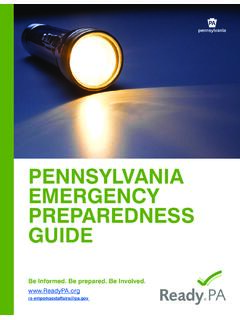
1 Pennsylvania Statewide Basic Life Support Protocols Pennsylvania Department of Health Bureau of Emergency Medical Services 2021 (717) 787-8740 September 09, 2021 Dear EMS Provider: The Bureau of EMS, Department of Health, is pleased to provide these updated Statewide BLS Protocols to the EMS providers of Pennsylvania . This 2021 update contains many important changes. Some major changes include: recognition of carbon monoxide measuring devices that use exhaled breath. emphasis on the care of patients with traumatic brain injury (TBI)/ head injury that has been proven to improve patient outcome. addition of the optional use of a glucagon prefilled intranasal powder or intramuscular autoinjector for the treatment of hypoglycemia. addition of an option for mRACE scoring for EMTs and attention to recognizing stroke patients with possible large vessel occlusions. various updates to care of pregnant patients and childbirth.
2 Updated care for agitated and combative patients. Additionally, there are two new Protocols and a new reference chart: 590 Ventricular Assist Device (VAD) Management 621 Tooth Avulsion Pennsylvania has used Statewide BLS Protocols since Sept. 1, 2004, and this edition is an update to the version that was effective since September 1, 2019 and the emergency update for coronavirus on March 16, 2020. To assist EMS providers when reviewing the changes, new sections of the Protocols that correspond to this 2021 version are identified with yellow highlighting and sections that have been removed are struck through and highlighted. EMS providers may use this 2021 version of the Statewide BLS Protocols as soon as they are familiar with the changes, but all providers must be using these updated Protocols by the effective date of November 01, 2021. EMS providers are permitted to perform patient care, within their Pa. defined scope of practice, when following the appropriate protocol(s) or when following the order of a medical command physician.
3 Each EMS provider is responsible for being knowledgeable regarding current state-approved Protocols so that he/she may provide the safest, highest quality and most effective care to patients. To assist providers in becoming familiar with the changes to the Protocols , a continuing education presentation is available to regions and agencies. This update is available for in-person presentations or the course can be completed on TRAIN PA, the on-line Learning Management System (LMS). The 2021 BLS Protocol Update (BEMS course #1000035305) will be considered a core requirement for all levels of EMS providers that register their certification during the current time period. Additionally, the separate 2021 Traumatic Brain Injury Protocol Update (BEMS course #1000035549) is also considered a core continuing education requirement for all levels of EMS provider. If an EMS provider previously completed Applying Head Injury Guidelines Saves Lives: The EPIC TBI Trial (BEMS Course #1000034503) they are exempt from the 2021 TBI course.
4 Furthermore, the completion of these courses should be used by EMS agencies when ensuring that the agency s providers have been educated to the current Protocols . When providing patient care under the EMS Act, EMS providers of all levels must follow applicable Protocols . Although the Statewide BLS Protocols are written for BLS-level care, they also apply to the BLS-level care that is performed by all providers at or above the level of AEMT. Since written Protocols cannot feasibly address all patient care situations that may develop, the Department expects EMS providers to use their training and judgment regarding any protocol-driven care that would be harmful to a patient. When the practitioner believes that following a protocol is not in the best interest of the patient, the EMS practitioner should contact a medical command physician if possible. Cases where deviation from the protocol is justified are rare. The reason for any deviation should be documented.
5 All deviations are subject to investigation to determine whether or not they were appropriate. In all cases, EMS providers are expected to deliver care within the scope of practice for their level of certification. The Department of Health s Bureau of EMS website will always contain the most current version of the EMS Protocols , the scope of practice for each level of provider, important EMS Information Bulletins, and many other helpful resources. This information can be accessed online at The Statewide BLS Protocols may be directly printed or downloaded into a mobile device for easy reference. The Department is committed to providing Pennsylvania s EMS providers with the most up-to-date Protocols , and to do this requires periodic updates. The Protocols will be reviewed regularly, and EMS providers are encouraged to provide recommendations for improvement at any time. Comments should be directed to the Commonwealth EMS Medical Director, Pennsylvania Department of Health, Bureau of EMS, 1310 Elmerton Avenue, Harrisburg, PA 17110.
6 Dylan Ferguson Douglas F. Kupas, MD, EMT-P, FAEMS Director Commonwealth EMS Medical Director Bureau of Emergency Medical Services Bureau of Emergency Medical Services Pennsylvania Department of Health Pennsylvania Department of Health Pennsylvania Department of Health TABLE OF CONTENTS BLS Adult/Peds Effective 11/01/21 i of ii SECTION 100: Operations 102 Scene Safety .. (GUIDELINES) .. 102-1 thru 102-2 103 Infection Control / Body Substance Isolation .. (GUIDELINES) .. 103-1 thru 103-2 111 Refusal of Treatment / Transport .. 111-1 thru 111-5 112 Non-Transport of Patient or Cancellation of Response .. 112-1 thru 112-2 123 EMS Vehicle Operations/Safety .. 123-1 thru 123-3 124 Safe Transportation of Children in Ground (GUIDELINES)..124-1 thru 124-3 150 Rehabilitation at Fire/ Incident Scene .. (GUIDELINES) 150-1 thru 150-4 170 Patient Destination Ground thru 170-4 180 Trauma Patient Destination .. 180-1 thru 180-4 181 Air Medical Transport for Non-Trauma Patients.
7 181-1 thru 181-2 190 Trauma Patient Destination [AIR AMBULANCE PROTOCOL] .. 190-1 thru 190-4 192 Air Ambulance Safety 192-1 thru 192-2 SECTION 200: Assessments & Procedures 201 Initial Patient Contact .. 201-1 202 Oxygen Administration .. 202-1 thru 202-2 204 Abuse & Neglect (Child and Elder) .. 204-1 thru 204-2 206 Human (GUIDELINES)..206-1 thru 206-2 210 Indications for ALS Use .. 210-1 thru 210-2 222 Ventilation via Endotracheal Tube or Alternative/Rescue Airway (ASSIST ALS) 222-1 thru 222-2 226 Pulse Oximetry .. 226-1 thru 226-2 227 Carbon Monoxide [Optional]..227-1 thru 227-2 228 Glucose Measurement (Glucometer).. [Optional]..228-1 250 12-Lead [Optional]..250-1 251 ECG Monitor Preparation .. (ASSISTING ALS)..251-1 thru 251-2 261 Spine Care .. 261-1 thru 261-3 SECTION 300: Resuscitation 322 Dead on Arrival (DOA) .. 322-1 324 Out-of-Hospital Do Not Resuscitate .. 324-1 331A General Cardiac Arrest Adult.
8 331A-1 thru 331A-4 331P General Cardiac Arrest Pediatric .. 331P-1 thru 331P-3 332 Cardiac Arrest Traumatic .. 332-1 333 Newborn Resuscitation .. 333-1 thru 333-2 SECTION 400: Respiratory 411 Allergic Reaction / Anaphylaxis .. 411-1 thru 411-2 421 Respiratory Distress / Respiratory Failure .. 421-1 thru 421-3 SECTION 500: Cardiac 501 Chest Pain .. 501-1 thru 501-2 590 Ventricular Assist Device (VAD) thru 590-2 SECTION 600: Trauma & Environmental 601 Bleeding Control .. 601-1 thru 601-2 602 Multisystem Trauma or Traumatic Shock .. 602-1 thru 602-2 605 Blast / Explosive Injury .. 605-1 thru 605-2 611 Head Injury / Traumatic Brain Injury .. 611-1 thru 611-2 621 Tooth 632 Impaled Object .. 632-1 662 Amputation .. 662-1 671 Burn .. 671-1 thru 671-2 681 Hypothermia / Cold Injury / Frostbite .. 681-1 thru 681-2 686 Heat Emergency .. 686-1 691 Near Drowning and Diving Injury .. 691-1 SECTION 700: Medical & Ob/Gyn 702 Altered Level of Consciousness/ Diabetic thru 702-2 706 Suspected Stroke.
9 706-1 thru 706-4 Pennsylvania Department of Health TABLE OF CONTENTS BLS Adult/Peds Effective 11/01/21 ii of ii 781 Emergency Childbirth .. 781-1 thru 781-3 SECTION 800: Behavioral & Poisoning 801 Agitated Behavior/Psychiatric Disorders .. 801-1 thru 801-3 831 Poisoning / Toxin Exposure (Ingestion / Inhalation / Absorption / Injection) .. 831-1 thru 831-3 SECTION 900: Special Considerations 901 Medical Command Contact .. 901-1 thru 901-3 904 On-Scene Physician / RN .. 904-1 thru 904-2 910 Transportation of Service Animals .. (GUIDELINES) .. 910-1 915 Civil Disturbance (GUIDELINES) .. 915-1 thru 915-3 919 Crime Scene Preservation .. (GUIDELINES) .. 919-1 921 Indwelling Intravenous Catheters / Other Medical Devices .. 921-1 thru 921-2 931 Suspected Influenza-Like Illness .. 931-1 thru 931-4 APPENDICES Appendix A - Apgar Scoring Chart ..A-2 Appendix B- Burn Chart - Rule of Nines ..A-3 Appendix C- Glasgow Adult Coma Scale.
10 A-4 Appendix D - Rehabilitation Patient Tag ..A-5 Appendix E - Heat Stress Index ..A-6 Appendix F- Wind Chill Chart ..A-7 Appendix G - Pediatric Vital Signs ..A-8 Appendix H - Remaining Oxygen Supply Table ..A-9 Appendix I - Pennsylvania EMS Handoff Report ..A-10 Appendix J - Pediatric Weight Conversion Chart ..A-11 Index .. I-1 thru I-2 Pennsylvania Department of Health Operations 102 - BLS Adult/Peds Effective 07/01/11 102-1 of 2 SCENE SAFETY GUIDELINES Criteria: A. This guideline applies to every EMS response, particularly if dispatch information or initial scene size-up suggests: 1. Violent patient or bystanders 2. Weapons involved 3. Industrial accident or MVA with potential hazardous materials 4. Patient(s) contaminated with chemicals System requirements: A. These guidelines provide general information related to scene safety. These guidelines are not designed to supersede an EMS agency s policy regarding management of providers safety [as required by EMSS Act regulation(s), but this general information may augment the agency s policy.]