Transcription of performance criteria rubric example
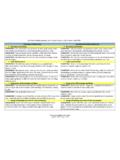
1 University of Arkansas Teacher Education performance criteria with Attributes and Examples 2012 Based upon criteria Framework, Teachscape, 2011 1 performance criteria rubric with Attributes and Examples Domain 1: Planning and Preparation 1a: Demonstrating Knowledge of Content and Pedagogy In order to guide student learning, teachers must have command of the subjects they teach. They must know which concepts and skills are central to a discipline, and which are peripheral; they must know how the discipline has evolved into the 21st century, incorporating such issues as global awareness and cultural diversity, as appropriate . Accomplished teachers understand the internal relationships within the disciplines they teach, knowing which concepts and skills are prerequisite to the understanding of others. They are also aware of typical student misconceptions in the discipline and work to dispel them. But knowledge of the content is not sufficient; in advancing student understanding , teachers are familiar with the particularly pedagogical approaches best suited to each discipline.
2 The elements of component 1a are: Knowledge of content and the structure of the discipline Every discipline has a dominant structure, with smaller components or strands, central concepts and skills Knowledge of prerequisite relationships Some disciplines, for example mathematics, have important prerequisites; experienced teachers know what these are and how to use them in designing lessons and units. Knowledge of content-related pedagogy Different disciplines have signature pedagogies that have evolved over time and found to be most effective in teaching. Indicators include: Lesson and unit plans that reflect important concepts in the discipline Lesson and unit plans that accommodate prerequisite relationships among concepts and skills Clear and accurate classroom explanations Accurate answers to student questions Feedback to students that furthers learning Inter-disciplinary connections in plans and practice University of Arkansas Teacher Education performance criteria with Attributes and Examples 2012 Based upon criteria Framework, Teachscape, 2011 2 Unsatisfactory Basic Proficient Distinguished 1a: Demonstrating Knowledge of Content and Pedagogy Teacher s plans and practice display little knowledge of the content, prerequisite relationships between different aspects of the content, or of the instructional practices specific to that discipline.
3 Teacher s plans and practice reflect some awareness of the important concepts in the discipline, prerequisite relations between them and of the instructional practices specific to that discipline. Teacher s plans and practice reflect solid knowledge of the content, prerequisite relations between important concepts and of the instructional practices specific to that discipline. Teacher s plans and practice reflect extensive knowledge of the content and of the structure of the discipline. Teacher actively builds on knowledge of prerequisites and misconceptions when describing instruction or seeking causes for student misunderstanding. Critical Attributes Teacher makes content errors. Teacher does not consider prerequisite relationships when planning. Teacher s plans use inappropriate strategies for the discipline. Teacher is familiar with the discipline but does not see conceptual relationships. Teacher s knowledge of prerequisite relationships is inaccurate or incomplete.
4 Lesson and unit plans use limited instructional strategies and some are not be suitable to the content. The teacher can identify important concepts of the discipline, and their relationships to one another. The teacher consistently provides clear explanations of the content. The teacher answers student questions accurately and provides feedback that furthers their learning. The teacher seeks out content-related professional development. In addition to the characteristics of proficient, Teacher cites intra- and interdisciplinary content relationships. Teacher is proactive in uncovering student misconceptions and addressing them before proceeding. Possible Examples The teacher says, The official language of Brazil is Spanish, just like other South American countries. The teacher says, I don t understand why the math book has decimals in the same unit as fractions. The teacher has students copy dictionary definitions each week to help his students learn to spell difficult words.
5 The teacher plans lessons on area and perimeter independently of one another, without linking the concepts together. The teacher plans to forge ahead with a lesson on addition with regrouping, even though some students have not fully grasped place value. The teacher always plans the same routine to study spelling: pre-test on Monday, copy the words 5 times each on Tuesday and Wednesday; test on Friday. The teacher s plan for area and perimeter invites students to determine the shape that will yield the largest area for a given perimeter. The teacher realized her students are not sure how to use a compass, so she plans to practice that before introducing the activity on angle measurement. The teacher plans to expand a unit on civics by having students simulate a court trial. In a unit on 19th century literature, the teacher incorporates information about the history of the same period. Before beginning a unit on the solar system, the teacher surveys the class on their beliefs as to why it is hotter in the summer than in the winter.
6 University of Arkansas Teacher Education performance criteria with Attributes and Examples 2012 Based upon criteria Framework, Teachscape, 2011 3 Domain 1: Planning and Preparation 1b: Demonstrating Knowledge of Students Teachers don t teach content in the abstract; they teach it to students. In order to ensure student learning, therefore, teachers must not only know their content and its related pedagogy, but the students to whom they wish to teach that content. In ensuring student learning, teachers must appreciate what recent research in cognitive psychology has confirmed: namely that students learn through active intellectual engagement with content. While there are patterns in cognitive, social, and emotional developmental stages typical of different age groups, students learn in their individual ways and may come with gaps or misconceptions that the teacher needs to uncover in order to plan appropriate learning activities.
7 In addition, students have lives beyond school, lives that include athletic and musical pursuits, activities in their neighborhoods, and family and cultural traditions. Students whose first language is not English, as well as students with other special needs must be considered when planning lessons and identifying resources that will ensure their understanding . The elements of component 1b are: Knowledge of child and adolescent development Children learn differently at different stages of their lives Knowledge of the learning process Learning requires active intellectual engagement Knowledge of students skills, knowledge, and language proficiency Children s lives beyond school influence their learning Knowledge of students interest and cultural heritage Children s backgrounds influence their learning Knowledge of students special needs Children do not all develop in a typical fashion Indicators include: Teacher gathers formal and informal information about students for use in planning instruction Teacher learns student interests and needs for use in planning Teacher participation in community cultural events Teacher-designed opportunities for families University of Arkansas Teacher Education performance criteria with Attributes and Examples 2012 Based upon criteria Framework, Teachscape, 2011 4 Unsatisfactory Basic Proficient Distinguished 1b: Demonstrating Knowledge of Students Teacher demonstrates little or no knowledge of students backgrounds, cultures, skills, language proficiency, interests, and special needs, and does not seek such understanding .
8 Teacher indicates the importance of understanding students backgrounds, cultures, skills, language proficiency, interests, and special needs, and attains this knowledge for the class as a whole. Teacher actively seeks knowledge of students backgrounds, cultures, skills, language proficiency, interests, and special needs, and attains this knowledge for groups of students. Teacher actively seeks knowledge of students backgrounds, cultures, skills, language proficiency, interests, and special needs from a variety of sources, and attains this knowledge for individual students. Critical Attributes Teacher does not understand child development characteristics and has unrealistic expectations for students. Teacher does not try to ascertain varied ability levels among students in the class. Teacher is not aware of student interests or cultural heritages. Teacher takes no responsibility to learn about students medical or learning disabilities.
9 Teacher cites developmental theory, but does not seek to integrate it into lesson planning. Teacher is aware of the different ability levels in the class, but tends to teach to the whole group. The teacher recognizes that children have different interests and cultural backgrounds, but rarely draws on their contributions or differentiates materials to accommodate those differences. The teacher is aware of medical issues and learning disabilities with some students, but does not seek to understand the implications of that knowledge. The teacher knows, for groups of students, their levels of cognitive development The teacher is aware of the different cultural groups in the class. The teacher has a good idea of the range of interests of students in the class. The teacher has identified high, medium, and low groups of students within the class. The teacher is well-informed about students cultural heritage and incorporates this knowledge in lesson planning.
10 The teacher is aware of the special needs represented by students in the class. In addition to the characteristics of proficient, The teacher uses ongoing methods to assess students skill levels and designs instruction accordingly. The teacher seeks out information about their cultural heritage from all students. The teacher maintains a system of updated student records and incorporates medical and/or learning needs into lesson plans. Possible Examples The lesson plan includes a teacher presentation for an entire 30 minute period to a group of 7-year olds. The teacher plans to give her ELL students the same writing assignment she gives the rest of the class. The teacher plans to teach his class Christmas carols, despite the fact that he has four religions represented The teacher s lesson plan has the same assignment for the entire class, in spite of the fact that one activity is beyond the reach of some students.