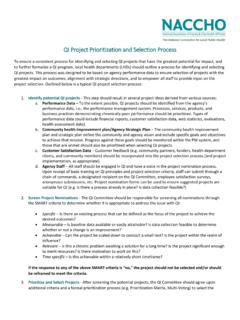
Transcription of Performance Management Plan Quality Improvement …
1 June 2017 Performance Management plan & Quality Improvement plan June 2017 Key Terms Accountability Subject to the obligation to report, explain or justify something; responsible; answerable. Accreditation Public health department accreditation is the development of a set of standards, a process to measure health department Performance against those standards, and reward or recognition for those health departments who meet the standards. Aim Statement A written, measurable, and time-sensitive description of the accomplishments a group expects to make from its Improvement efforts.
2 The AIM Statement answers the question: What are we trying to accomplish? CHA (Community Health Assessment) The CHA is a collaborative process conducted in partnership with other organizations and describes the health status of the population, identifies areas for health Improvement , determines factors that contribute to health issues, and identifies assets and resources that can be mobilized to address population health Improvement . Public Health Accreditation Board, 2011 CHIP (Community Health Improvement plan ) The purpose of the CHIP is to describe how a health department and the community it serves will work together to improve the health of the population of the jurisdiction that the health department serves.
3 Public Health Accreditation Board, 2011 Continuous Quality Improvement (CQI) An ongoing effort to increase an agency s approach to manage Performance , motivate Improvement , and capture lessons learned in areas that may or may not be measured as part of accreditation. Also, CQI is an ongoing effort to improve the efficiency, effectiveness, Quality , or Performance of services, processes, capacities, and outcomes. These efforts can seek incremental Improvement over time or breakthrough all at once. Among the most widely used tools for continuous Improvement is a four-step Quality model, the plan -Do-Check-Act (PDCA) cycle.
4 Effectiveness The degree to which a decided, decisive, or desired effect is achieved; the degree to which desired objectives are achieved and a valid result is produced. Efficiency Accomplishment of, or ability to accomplish, a job with a minimum expenditure of time and effort. Evaluation To judge or determine the significance, worth, or Quality of. Evidence The available body of facts or information indicating whether a belief or proposition is true or valid. June 2017 Evidence-Based Practice (EBP) Entails making decisions about how to promote health or provide care by integrating the best available evidence with practitioner expertise and other resources, and with the characteristics, state, needs, values and preferences of those who will be affected.
5 Improvement Theory A hypothesis that includes what the data will show and what outcome is expected. Organizational Culture of Quality Improvement The use of a deliberate and defined Improvement process, supported by the organization, and focused on activities that are responsive to community needs and improving population health. It refers to a continuous and on-going effort to achieve effectiveness, Performance , accountability, outcomes, and other indicators of Quality in services or processes which achieve equity and improve the health of the community.
6 Performance Management System A fully functioning Performance Management system that is completely integrated into WEDCO District Health Department and Home Health Agency s daily practice at all levels includes: 1) setting organizational objectives across all levels of the department, 2) identifying indicators to measure progress toward achieving objectives on a regular basis, 3) identifying responsibility for monitoring progress and reporting, and 4) identifying areas where achieving objectives requires focused Quality Improvement processes.
7 Performance Standards Performance Standards are organizational or system standards, targets, and goals to improve public health practices. Standards may be set based on national, state, or scientific guidelines, benchmarking against similar organizations, the public s or leaders expectations, or other methods. plan -Do-Check-Act (PDCA) An on-going, four-step Management method used for the control and continuous Improvement of processes and projects. WEDCO District Health Department and Home Health Agency uses the PDCA method for all QI Projects.
8 Quality Culture QI is fully embedded into the way the agency does business, across all levels and programs. Leadership and staff are fully committed to Quality , and results of QI efforts are communicated internally and externally. They do not assume that an intervention will be effective, but rather they establish and quantify progress toward measurable objectives. Roadmap to a Culture of Quality Improvement , NACCHO, 2012. Quality Improvement (QI) An integrative process that links knowledge, structures, processes, and outcomes to enhance Quality throughout an organization.
9 The intent is to improve the level of Performance of key processes and outcomes within an organization. Quality Improvement plan A structured plan to promote, support, and implement a culture of Quality within the organization. The QI plan defines the roles and responsibilities of the QI Team, Leadership, and staff; states the vision of the organization related to Quality ; identifies the goals and objectives of the plan ; outlines how Improvement is measured; and describes how the plan is monitored, reviewed, and updated.
10 Quality Improvement Project Team June 2017 A group of multi-skilled employees charged with the oversight and responsibility of developing, implementing, evaluating, and reporting QI Projects to improve a process or develop new ones that support the Health Department s Quality Improvement and Performance Management System. Quality Improvement Roadmap A guide that describes six key phases on a path to a QI culture, outlining common characteristics for each phase and strategies an agency can implement to move to the next phase.