Transcription of Performance Measurement for - PHF
1 Performance Measurement for Public Health Policy This tool was developed jointly by the American Public Health Association (APHA) and the Public Health Foundation (PHF), and was made possible through a cooperative agreement with the Centers for Disease Control and Prevention (CDC) with funding from the National Public Health Improvement Initiative. August 1, 2012 Table of Contents About This Tool 1 I. Applying Performance Measurement to Public Health Policy Activities 2 Public Health Policy and the Role of Health Departments 2 What is Performance Measurement ? 3 Applying Performance Measurement to Policy: Why is it Challenging? 3 Process for Applying Performance Measurement to Policy 4 II. Sample Measures 6 About the Tables 6 Problem Identification & Definition 7 Policy Analysis 8 Policy Development & Adoption 10 Education & Outreach 11 Policy Implementation 15 Impact Evaluation 17 III.
2 Putting it All Together 18 Bibliography 21 1 About This Tool This tool is intended to help health departments assess and improve the Performance of their policy activities. The tool is geared towards health departments that are somewhat familiar with Performance Measurement and are already engaging in policy activities. The tool was developed based on existing Performance Measurement and evaluation guides, as well as on conversations with health departments engaged in policy work. The first section of the tool gives a brief overview of the role of health departments in public health policy, followed by an introduction to Performance Measurement within the context of Performance management. It also includes a framework on page 5 for conceptualizing the goals and activities of policy work in a health department. The second section of the tool consists of tables with examples of activities that a health department might engage in and sample measures and outcomes for these activities.
3 The tables are intended to provide possible examples of measures that health departments could use to assess the Performance of their policy activities. Tool users are encouraged to use or adapt measures to meet their needs. The final section of the tool provides three examples of how a health department might apply Performance Measurement and the sample measures to assess its policy activities. Suggestions for improvement and other feedback on the tool is encouraged and welcomed. Please send feedback to 2 I. Applying Performance Measurement to Public Health Policy Activities Public Health Policy and the Role of Health Departments Policy is recognized as a cornerstone of public health practice. In fact, few public health interventions can affect people's health so broadly and with such impact as policy. Policy changes such as clean indoor air laws and tobacco taxes, for example, are responsible for much of the 50 percent decrease in smoking that occurred in the latter half of the 20th Development of policies and plans that support individual and community health is one of the ten Essential Public Health Policy development is also one of the standards for public health As described in the text box to the right, there are several different types of policies that health departments can use to improve public health.
4 Today, health departments are actively utilizing public health policy to solve our nation s toughest public health challenges. Policy activities in health departments range from identifying critical health problems, researching and analyzing various policy options, helping to implement solutions, increasing public awareness of existing policies or laws, and evaluating the impacts of policies. Some health departments may be accustomed to engaging in many of these types of policy activities, while some health departments may engage in only one or two. Health departments may also engage in these activities through partnerships with other organizations or government agencies. Regardless of the type of policy activities, this guide is designed to provide a general framework for thinking about Performance Measurement for policy activities, as well as possible indicators for a range of activities. 1 Warner KE, Mendez D.
5 Tobacco control policy in developed countries: yesterday, today, and tomorrow. Nicotine Tob Res. 2010 Sep;12(9):876-87. 2 CDC. 10 Essential Public Health Services. 3 Public Health Accreditation Board. Standards and Measures. Types of Policy Policies for addressing critical public health problems can be grouped into three types. The most appropriate type of policy for a health department to pursue will vary depending on the particular issue and situation. Organizational (also known as internal policies) rules or practices established within an agency or organization, such as those developed by the health department, schools or school districts, private hospitals or other health care delivery sites, or businesses or industries Regulatory rules, guidelines, principles, or methods created by government agencies with authority to regulate products or services (a government agency receives authorization to make regulations through legislation), such as standards for child care facilities Legislative laws or ordinances established by a federal or state legislature or local governing body 3 What is Performance Measurement ?
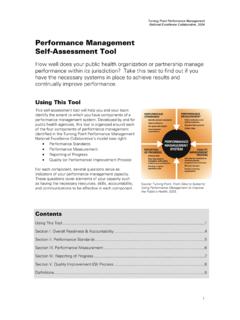
6 Performance Measurement consists of quantitative or qualitative measures of capacities, processes, or outcomes relevant to the assessment of a Performance indicator ( , the number of outbreak investigations completed within five days of reporting or the percentage of clients who rate health department services as good or excellent ). Performance Measurement is a central element to any Performance Management System. Performance Management is the strategic use of Performance standards, measures, progress reports, and ongoing quality improvement efforts to ensure an agency achieves desired results. In the case of public health, the ultimate purpose of these efforts is to improve the public s health and make the community a better place to live. Thus, Performance Measurement is most meaningful within a robust Performance Management System that has the following other elements: Objective standards of Performance with targets or benchmarks to be met Reliable reporting of measures to intended users of the indicator data A program or process to manage change and quality improvement in policies, programs, processes, or infrastructure based on Performance standards, measures, and reports The Turning Point Performance Management System Framework4 developed for the Performance Management National Excellence Collaborative shows how these elements work together.
7 In 2012, the Public Health Foundation ( ) led a process to review and refresh the Framework to optimize its relevance and applicability to public health organizations. Changes to the Framework included adding representation of organizational leadership and culture to support Performance Management, as well as the arrows to indicate continuous interplay between elements of the Framework. This tool focuses primarily on Performance Measurement , because that area can be the most challenging for those carrying out public health policy activities. Applying Performance Measurement to Policy: Why is it Challenging? Policy work is an essential component of effective public health practice, regardless of whether that work focuses on organizational, regulatory, or legislative policy. Stating the objectives of policy work is a straightforward challenge; achieving those objectives is another matter entirely. Defining the standards that represent success against policy objectives and defining the measures used to evaluate 4 Figure 1: Public Health Performance Management System 4 Performance are not complicated activities; however, a framework for doing so in a public health context has not existed until now.
8 Much of the work in public health consists of the same activities completed in a predictable sequence, with a sequence recurring periodically ( , chlorine level inspections, immunization programs). The recurring patterns of steps lend themselves naturally to quality improvement efforts, so that over time activities become more effective and efficient. Public health policy work does not follow this pattern. Policy work tends to be time-bound conducted within a defined set of circumstances and is not repeated again and again. However, adopting the practice of assessing Performance and considering Performance improvement opportunities makes it more likely that future policy work will meet its objectives. Process for Applying Performance Measurement to Policy While applying Performance Measurement to policy work may at first appear challenging, the basic steps are the same as for any other activity. Below are the basic questions health departments can ask themselves to assess and improve their Performance and their relationship to the Turning Point Framework: Questions to Guide Performance Measurement of Policy Work Corresponding Element of the Turning Point Framework 1.
9 What are the goals of the policy work? Performance Standards 2. How can we measure and report on the effectiveness of our policy work ( , to figure out if policy goals have been met)? Performance Measures and Reporting 3. What can we do differently that might improve the effectiveness of our policy work? Quality Improvement One of the reasons Performance Measurement of policy work can be challenging is that it is sometimes difficult to define and identify the components of policy work, and the associated goals or results. Figure 2 on the next page offers one framework for conceptualizing the goals and activities of policy work in a health department. 5 Inside the pyramid, results needed at each phase of policy work appear in black text. To the left of the pyramid, the activities required to accomplish those results appear in green text. As policy work progresses up the pyramid, health departments can select standards against which to measure success at achieving the result, as well as measures for assessing Performance against each standard.
10 The menus of activities provided in the tables that follow include ideas for standards at each level of the pyramid, and examples of quantity, quality, and outcome measures that may be applicable. Figure 2: Framework for conceptualizing goals and activities of policy work * High-impact policies refer to policies that address an important public health problem and are evidenced-based such that their implementation is expected to have a meaningful impact on population health outcomes. 6 Tips for Selecting Measures There are a few things a health department should keep in mind when selecting from among the measures in the tables below or creating others: 1. Reporting cycle Some of the measures below can be reported on monthly, while others can be reported on every few months or even only once during the policy process. Thus, health departments should select measures that are appropriate for their reporting cycle. 2. Existing logic models Health departments should review existing logic models or defined objectives before selecting or creating measures as a logic model lays out expected changes or results.