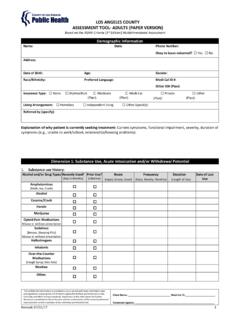
Transcription of PERSONALITY ASSESSMENT INVENTORY ADOLESCENT …
1 PAR Psychological ASSESSMENT Resources, Inc. 16204 North Florida Ave. Lutz, FL 33549 Copyright 1990, 1991, 1993, 1995, 1998, 2000, 2005, 2007 by Psychological ASSESSMENT Resources, Inc. All rights reserved. May not be reproduced in whole or in part in any form or by any means without written permission of Psychological ASSESSMENT Resources, Inc. PERSONALITY ASSESSMENT INVENTORY is a trademark and PAI is a registered trademark owned by Psychological ASSESSMENT Resources, Inc. Version: ( ) PERSONALITY ASSESSMENT INVENTORY - ADOLESCENT clinical Interpretive Report by Leslie C.
2 Morey, PhD and PAR Staff Client Information Name: Sample Client Client ID: SC 01 Gender: Female Age: 16 Grade: 10th Date of Birth: 02/05/1991 Test Date: 11/08/2007 Ethnicity: Caucasian/White Referred By: Dr Gerhard Working Diagnosis: Mood Disorder NOS The interpretive information contained in this report should be viewed as only one source of hypotheses about the individual being evaluated. No decisions should be based solely on the information contained in this report. This material should be integrated with all other sources of information in reaching professional decisions about this individual.
3 This report is confidential and intended for use by qualified professionals only. It should not be released to the individual being evaluated. Client: Sample Client Test Date: 11/08/2007 Client ID: SC 01 Page 2 of 9 Full Scale Profile T score 2030405060708090100 110T score 2030405060708090100 110 Scale: ICNINFNIMPIMSOMANXARDDEPMANPARSCZBORANTA LCDRGAGGSUISTRNONRXRDOMWRMRaw score: 5366155144401732224227015141515130213T score: 5549603463938684466964726043854579807419 2246% Completed: Plotted T scores are based upon a census matched standardization sample of 707 community adolescents 12 to 18 years of age.
4 Indicates that the score is more than two standard deviations above the mean for a sample of 1,160 clinical patients. indicates that the scale has 20% or more missing items. Client: Sample Client Test Date: 11/08/2007 Client ID: SC 01 Page 3 of 9 Subscale Profile 30405060708090100 110 30405060708090100 110 ScoreRawTSOM-CConversion353 SOM-SSomatization1079 SOM-HHealth Concerns251 ANX-CCognitive1682 ANX-AAffective1890 ANX-PPhysiological1791 ARD-OObsessive-Compulsive1161 ARD-PPhobias1887 ARD-TTraumatic Stress1576 DEP-CCognitive1584 DEP-AAffective1073 DEP-PPhysiological1580 MAN-AActivity Level1067 MAN-GGrandiosity027 MAN-IIrritability750 PAR-HHypervigilance1263 PAR-PPersecution864 PAR-RResentment1267 SCZ-PPsychotic Experiences658 SCZ-SSocial Detachment861 SCZ-TThought Disorder862 BOR-AAffective
5 Instability1272 BOR-IIdentity Problems1578 BOR-NNegative Relationships1579 BOR-SSelf-Harm036 ANT-AAntisocial Behaviors1571 ANT-EEgocentricity963 ANT-SStimulus-Seeking341 AGG-AAggressive Attitude852 AGG-VVerbal Aggression030 AGG-PPhysical Aggression654 Plotted T scores are based upon a census matched standardization sample of 707 community adolescents 12 to 18 years of age. indicates that the score is more than two standard deviations above the mean for a sample of 1,160 clinical patients. indicates that the scale has 20% or more missing items. Client: Sample Client Test Date: 11/08/2007 Client ID: SC 01 Page 4 of 9 Validity of Test Results The PAI-A provides a number of validity indices that are designed to provide an ASSESSMENT of factors that could distort the results of testing.
6 Such factors could include failure to complete test items properly, carelessness, reading difficulties, confusion, exaggeration, malingering, or defensiveness. For this protocol, there are no uncompleted items. Also evaluated is the extent to which the respondent attended appropriately and responded consistently to the content of test items. The respondent s scores suggest that she did attend appropriately to item content and responded in a consistent fashion to similar items. The degree to which response styles may have affected or distorted the report of symptomatology on the INVENTORY is also assessed.
7 The scores for these indicators fall in the normal range, suggesting that the respondent answered in a reasonably forthright manner and that there do not appear to be factors that might distort the profile which would make it appear either more negative or more positive than the clinical picture would warrant. clinical Features The PAI-A clinical profile is marked by significant elevations across several scales, indicating a broad range of clinical features and increasing the possibility of multiple diagnoses. Profile patterns of this type are usually associated with marked distress and severe impairment in functioning.
8 The configuration of the clinical scales suggests a person with marked anxiety and tension. The respondent may be particularly uneasy and ruminative about her personal relationships, some of which are probably not going well; these relationships may be an important source of her current distress and she may be responding to these circumstances by becoming socially withdrawn. The disruptions in her life have left her uncertain about her goals and priorities, and tense and fearful about what the future may hold. The respondent reports a degree of anxiety that is unusual even in clinical samples.
9 Her life is probably severely constricted by her tension and she may not be able to meet even minimal role expectations without feeling overwhelmed. Relatively mild stressors may be sufficient to precipitate a major crisis. She is likely to be plagued by worry to the degree that her ability to concentrate and attend are significantly compromised, probably leading to a noticeable decline in her school performance. Peers are likely to comment about her overconcern regarding issues and events over which she has no control. Affectively, she feels a great deal of tension, has difficulty relaxing, and likely experiences fatigue as a result of high perceived stress.
10 Overt physical signs of tension and stress, such as sweaty palms, trembling hands, complaints of irregular heartbeats, and shortness of breath are also present. The respondent indicates that she is experiencing severe, specific fears or anxiety surrounding certain situations; these fears are of a degree that is unusual even in clinical samples. Her life is probably severely constricted by her psychological turmoil. Although efforts to control anxiety are probably present, these patterns are having little effect on preventing anxiety from intruding into experience and affecting functioning.