Transcription of PHYSICAL ACTIVITY AND PLAY FOR TODDLERS
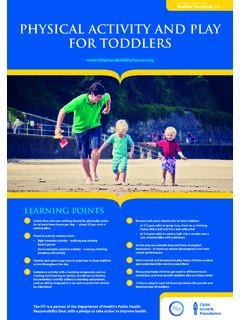
1 For Healthcare Professional useToddler Factsheet ACTIVITY AND PLAY FOR LEARNING POINTS1 Under-fives who are walking should be physically active for at least three hours per day about 25 per cent of waking time2 PHYSICAL ACTIVITY includes both: light intensity ACTIVITY walking and playing board games more energetic PHYSICAL ACTIVITY running, climbing, jumping and cycling3 Parents and carers may have to plan how to keep TODDLERS active throughout the day4 Sedentary ACTIVITY with a learning component, such as reading and listening to stories, should not be limited, but sedentary ACTIVITY without a learning component, such as sitting strapped in a car seat or pushchair should be minimised5 Parents and carers should aim to have TODDLERS .
2 At 2-3 years able to jump, hop, climb on a climbing frame, kick a ball and hit a ball with a bat at 3-4 years able to catch a ball, ride a scooter and a two-wheeled bike with stabilisers6 Active play has benefits beyond those of PHYSICAL movement it improves mental development and later school performance7 Unstructured and imaginative play helps children explore and understand the world around them8 Messy play helps children get used to different touch sensations, and may benefit TODDLERS who are fussy eaters 9 12 hours sleep in each 24 hours promotes the growth and development of TODDLERS . The ITF is a partner of the Department of Health's Public Health Responsibility Deal, with a pledge to take action to improve ACTIVITY and Playfor Toddlers02 Children of all ages should be active it is vital for their PHYSICAL and mental health and development.
3 PHYSICAL ACTIVITY also helps TODDLERS maintain a normal weight. See Factsheet Department of Health (DH) recommends that children under five years who can walk should be active for at least three hours each day. All sorts of PHYSICAL activities, including walking, running and unstructured, active and energetic play, count towards this recommendation. The amount of ACTIVITY is more important than its type or intensity. PHYSICAL ACTIVITY can be spread over the day, in short bursts and interspersed with periods of rest, as TODDLERS tire quickly, especially with prolonged PHYSICAL DH classifies PHYSICAL ACTIVITY into three types: sedentary, light intensity and more energetic. Light intensity ACTIVITY and more energetic PHYSICAL ACTIVITY contribute to the recommended three hours of PHYSICAL ACTIVITY per 1: Classification of ACTIVITY for under-fives who can walkClassificationType of ACTIVITY ExamplesSedentary ACTIVITY Activities that typically occur while seated or lying down and which require very low levels of energy expenditureSleeping, TV viewing, fidgeting, reading, drawing, travelling by car, bus or train.
4 Or restrained while strapped into a pushchairLight intensity activityMinimal movement of the trunk (chest and abdomen) and slow movement of the trunk from one place to anotherPottering, moving about, standing up, walking at a slow pace, washing, dressing, playing board games, craft activities, playing at a sand tableMore energetic PHYSICAL activityRapid movement of the trunk from one place to another. This makes children huff and puff and exercises their cardiorespiratory systemRunning, climbing, playing games in the park with friends, skipping, swimming, dancing to music, riding a bikeAdapted from CMO s report Start Active, Stay Active 20111 Three hours of PHYSICAL ACTIVITY each day are recommendedSome parents may need to plan how to keep their TODDLERS physically active for a full three hours each day, especially in families who do not have a garden and on days when they do not attend child in early years settings should plan how to keep TODDLERS active while in their care this may be for 21/2-3 hours for TODDLERS who spend all day at the are given on pages TODDLERS are naturally active.
5 But research shows that some are active for only 2-21/2 hours per day1. Three hours is 25 per cent of a TODDLERS time awake each day, and many spend more than 75 per cent of the waking day in sedentary ACTIVITY . Insufficient PHYSICAL ACTIVITY , as a result of inactive lifestyles, predisposes preschool children to meet the DH recommendation some families may need to change their lifestyles and early years settings (nurseries, play groups, cr ches and child minders) may need to adopt new policies and procedures that allow TODDLERS : more time being active less time being sedentary, apart from resting or sleeping to spend some active time outside every day even in inclement The strength, endurance and skill of skeletal muscles improve with PHYSICAL ACTIVITY and with this TODDLERS competence and co-ordination skills get better3.
6 Young children who enjoy PHYSICAL ACTIVITY , through gaining competence and confidence, will be more likely to continue to participate in it as they get older PHYSICAL ACTIVITY helps to maintain a healthy weight sedentary lifestyles in three year olds are a risk factor for overweight and obesity. Three year old children who watched more than eight hours of television per week were more likely to be overweight or obese at seven years of age4. See Factsheet PHYSICAL ACTIVITY helps to space out periods of learning young children need more opportunities for PHYSICAL exercise than older children. They are more likely to get restless after being sedentary for extended periods and run around when released from them3 Different types of active play offer a variety of additional developmental benefits that are discussed on pages 6 and 7.
7 Reported benefits in older children who continue active lifestyles include: Blood pressures and blood lipid levels are closer to the normal healthy range in five to ten year olds who have optimal aerobic fitness5,6 Academic performance in school children improves in those that participate in PHYSICAL activity7. When children had more to time to play at school, their academic performance improved despite spending less time in lessons Overweight sedentary school children who had an hour of vigorous PHYSICAL ACTIVITY every day showed improvements in memory skills, problem-solving, concentration and the ability to think and genetic factors influence child development, including PHYSICAL abilities during infancy and the toddler influences: Genotype Antenatal and prenatal environment and events Temperament Health and nutrition Vision and influences.
8 Family social and economic conditions Learning opportunities Parent-child interaction Parenting behaviour Social network and community learning Benefits of PHYSICAL ACTIVITY for ToddlersDevelopment of PHYSICAL Skills in ToddlersPhysical skills are acquired gradually and sequentially. While they are attained in a fixed order ( Table 2) each child develops specific skills at his or her own rate9, which depends upon the opportunities to engage in activities and to attain the skills development is tightly interwoven with development of perception, cognition, motivation and communication. Talking to TODDLERS and interacting with them on simple learning tasks improves understanding and language development.
9 Table 2 shows the average age ranges for achieving milestones in PHYSICAL skills development3,9, 2: Average age ranges for achieving milestones in PHYSICAL skills developmentAverage age rangeSkill7-14 months Starting to try to crawlCrawling9-14 months Standing alone momentarily and walking with hands held9-18 monthsWalking alone flat footed gaitFrom 18 months Walking with heel to toe gait16-24 months Climbing onto an object chair15-24 months or 6 months after beginning to walkRunning18-24 months Walking down stairsLearning to kick or throw a ballAround 22 months Galloping2-3 yearsJumpingStanding on one foot2 years after walking Hopping 3 yearsWalking in a straight line3-4 yearsThrowing a ball overarm with one handCatching a large ball with both handsClimbing the rungs of a ladderBy 4 years Mature walking pattern3-4
10 YearsPedalling a tricycle5 years Skipping step and hop on each foot alternately Most children begin to walk towards the end of their first year and begin running during their second. It should be remembered that the achievement of milestones in TODDLERS born preterm may be delayed. Children who bottom shuffle rather than crawl may begin walking as late as two years or for parents and carersParents and carers of TODDLERS should aim to give young children the opportunities to achieve the following skills: By 2-3 years of age: jumping hopping climbing on a climbing frame kicking a ball hitting a ball with a bat. By 3-4 years of age: catching a large ball with both hands riding a scooter riding a two-wheeled bike with of local amenities can be collated for parents that offer: green spaces where TODDLERS can enjoy outdoor play the local authority usually has this information activities such as swimming, outdoor play parks, indoor soft play areas, active play sessions run by children s centres, structured ACTIVITY programmes ( SoccerTots and Tumble Tots).