Transcription of PHYSICIAN LABELING I. CIRCULATORY DISEASE …
1 PHYSICIAN LABELING6065802 LEVLEN 21 Tablets(levonorgestrel and ethinyl estradiol tablets)Patients should be counseled that this product does not protect againstHIV infection (AIDS) and other sexually transmitted 21 tablets:Each LEVLEN 21 tablet (Levonorgestrel and Ethinyl Estradiol Tablets)contains mg of levonorgestrel (d(-)-13 beta-ethyl-17-alpha-ethinyl 17 beta-hydroxygon-4-en-3-one) a totally synthetic progestogen, mg of ethinyl estradiol (19-nor-17 -pregna-1,3,5(10)-trien-20-yne-3,17-diol ). The inactive ingredients present are cellulose, FD&C Yellow 6,lactose, magnesium stearate, and polacrilin 28 Tablets(levonorgestrel and ethinyl estradiol tablets)Patients should be counseled that this product does not protect againstHIV infection (AIDS) and other sexually transmitted 28 tablets:21 light-orange LEVLEN (Levonorgestrel and Ethinyl Estradiol Tablets)tablets, each containing mg of levonorgestrel (d(-)-13 beta-ethyl 17-alpha-ethinyl 17 beta-hydroxygon-4-en-3-one) a totally synthetic pro-gestogen,and mg of ethinyl estradiol (19-nor-17 -pregna-1,3,5(10)-trien-20-yne-3,17-diol ) and 7 pink inert tablets.
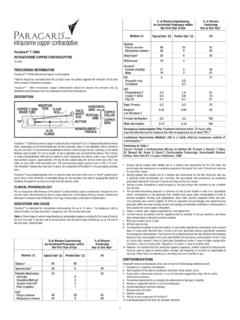
2 The inactive ingredientspresent are cellulose, D&C Red 30, FD&C Yellow 6, Iactose, magnesiumstearate, and polacrilin PHARMACOLOGYC ombination oral contraceptives act by suppression of the primary mechanism of this action is inhibition of ovulation,other alterations include changes in the cervical mucus (which increasethe difficulty of sperm entry into the uterus) and the endometrium (whichreduce the likelihood of implantation).INDICATIONS AND USAGEOral contraceptives are indicated for the prevention of pregnancy inwomen who elect to use this product as a method of contraceptives are highly effective. Table Ilists the typical accidentalpregnancy rates for users of combination oral contraceptives and othermethods of contraception.
3 The efficacy of these contraceptive methods,except sterilization and the IUD, depends upon the reliability with whichthey are used. Correct and consistent use of methods can result in lowerfailure EXPECTED AND TYPICAL FAILURE RATES DURINGTHE FIRST YEAR OF CONTINUOUS USE OF A METHOD% of Women Experiencing an Accidental Pregnancyin the First Year of Continuous UseLowestMethodExpected*Typical**(No contraception)(89)(89)Oral **progestin **Diaphragm with spermicidal318cream or jellySpermicides alone (foam,321creams, jellies andvaginal suppositories)Vaginal Spongenulliparous518multiparous>8>28 IUD (medicated)16#Condom without spermicides212 Periodic abstinence2-1020(all methods)Female from J. Trussell and K.
4 Kost, Table II, Studies in Family Planning,18(5), 1987.*The authors best guess of the percentage of women expected to ex-perience an accidental pregnancy among couples who initiate amethod (not necessarily for the first time) and who use it consistentlyand correctly during the first year if they do not stop for any otherreason.**This term represents typical couples who initiate use of a method(not necessarily for the first time) who experience an accidental preg-nancy during the first year if they do not stop use for any other reason. **N/A = Data not available# Combined typical rate for both medicated and nonmedicated IUD. Therate for medicated IUD alone is not contraceptives should not be used in women with any of the followingconditions: Thrombophlebitis or thromboembolic disorders.
5 A past history of deep-vein thrombophlebitis or thromboembolic dis-orders. Cerebral-vascular or coronary-artery DISEASE . Known or suspected carcinoma of the breast. Carcinoma of the endometrium or other known or suspected estrogen-dependent neoplasia. Undiagnosed abnormal genital bleeding. Cholestatic jaundice of pregnancy or jaundice with prior pill use. Hepatic adenomas or carcinomas. Known or suspected use of oral contraceptives is associated with increased risks of severalserious conditions including myocardial infarction, thromboembolism,stroke, hepatic neoplasia, gallbladder DISEASE , and hypertension,although the risk of serious morbidity or mortality is very small in healthywomen without underlying risk factors.
6 The risk of morbidity and mortalityincreases significantly in the presence of other underlying risk factorssuch as hypertension, hyperlipidemias, obesity and prescribing oral contraceptives should be familiar with thefollowing information relating to these risks. The information contained in this package insert is principally based onstudies carried out in patients who used oral contraceptives with higherformulations of estrogens and progestogens than those in common usetoday. The effect of long-term use of the oral contraceptives with lower for-mulations of both estrogens and progestogens remains to be this LABELING , epidemiologic studies reported are of two types:retrospective or case control studies and prospective or cohort control studies provide a measure of the relative risk of a DISEASE ,namely, a ratio of the incidence of a DISEASE among oral-contraceptiveusers to that among nonusers.
7 The relative risk does not provide informa-tion on the actual clinical occurrence of a DISEASE . Cohort studies providea measure of attributable risk, which is the difference in the incidence ofdisease between oral-contraceptive users and nonusers. The attributablerisk does provide information about the actual occurrence of a DISEASE inthe population. For further information, the reader is referred to a text onepidemiologic THROMBOEMBOLIC DISORDERS AND OTHER VASCULAR PROBLEMSa. Myocardial infarctionAn increased risk of myocardial infarction has been attributed to oral-contraceptive use. This risk is primarily in smokers or women with otherunderlying risk factors for coronary-artery DISEASE such as hypertension,hypercholesterolemia, morbid obesity, and diabetes.
8 The relative risk ofheart attack for current oral-contraceptive users has been estimated to betwo to six. The risk is very low under the age of in combination with oral-contraceptive use has been shown tocontribute substantially to the incidence of myocardial infarctions inwomen in their mid-thirties or older with smoking accounting for themajority of excess cases. Mortality rates associated with circulatorydisease have been shown to increase substantially in smokers over the ageof 35 and nonsmokers over the age of 40 (Table II) among women whouse oral .(Adapted from Layde and V. Beral, Lancet,1:541-546, 1981.)Oral contraceptives may compound the effects of well-known risk factors,such as hypertension, diabetes, hyperlipidemias, age and obesity.
9 In par-ticular, some progestogens are known to decrease HDL cholesterol andcause glucose intolerance, while estrogens may create a state of hyperin-sulinism. Oral contraceptives have been shown to increase blood pressureamong users (see section 9 in WARNINGS ). Similar effects on risk fac-tors have been associated with an increased risk of heart DISEASE . Oral con-traceptives must be used with caution in women with cardiovasculardisease risk ThromboembolismAn increased risk of thromboembolic and thrombotic DISEASE associatedwith the use of oral contraceptives is well established. Case control studieshave found the relative risk of users compared to nonusers to be 3 for thefirst episode of superficial venous thrombosis, 4 to 11 for deep-veinthrombosis or pulmonary embolism, and to 6 for women withpredisposing conditions for venous thromboembolic DISEASE .
10 Cohortstudies have shown the relative risk to be somewhat lower, about 3 for newcases and about for new cases requiring hospitalization. The risk ofthromboembolic DISEASE due to oral contraceptives is not related to lengthof use and disappears after pill use is two- to four-fold increase in the relative risk of post-operative throm-boembolic complications has been reported with the use of oral con-traceptives. The relative risk of venous thrombosis in women who havepredisposing conditions is twice that of women without such medical con-ditions. If feasible, oral contraceptives should be discontinued from atleast four weeks prior to and for two weeks after elective surgery of a typeassociated with an increase in risk of thromboembolism and during andfollowing prolonged immobilization.