Transcription of Physics Experiments in Mechanics
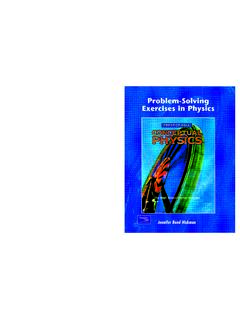
1 Houston Community College System Physical Sciences Department Northwest College Physics Experiments IN Mechanics Edited by Juan Carlos Reina, and Carol S. Monahan, Acknowledgements In the sciences much more than the arts, most works cannot be accomplished by a single individual. This manual is no exception. Carol Monahan began to work in the Natural Sciences Department of HCC-NW in 2002, she held a degree in Physics and hoped to shake off the cobwebs in her preparation in order to pursue graduate studies in Physics . I am glad to report that she has succeeded in both regards.
2 She is now a Texas A&M University graduate student. It has been Carol s enthusiasm, her true concern for the students progress and her attention to the students learning processes that led to the constant revision of the lab exercises, which resulted in the present manual. Her motivating energy inspired other professors to collaborate in the development of the laboratory exercises. We were all beneficiaries of the work done by Professors Dwight Kranz and Bart Sheinberg who procured the state of the art lab equipment, and Dr. William Askew who has led the Natural Sciences Department at HCC-Northwest in constant growth and development.
3 Juan Carlos Reina, And what a delightful collaboration it has been! Dr. Juan Carlos Reina has great energy and enthusiasm for the Physics labs, and that enthusiasm is contagious! All of the professors at HCC have been a tremendous example in their competence and kindness, and I am forever grateful to all of them. Most of the students at HCC who are enrolled in a Physics course are at least pursuing a Bachelor s degree, by completing the first two years of a four year program at HCC. Therefore, it is imperative to have a complete Physics program that is comparable to any high quality four-year institution.
4 Our hope is that this manual enables the success of the HCC Physics program. Above all, we wish the greatest success to the terrific students of Houston Community College! Carol Monahan, June, 2004 Table of Contents Introduction 4 The Laboratory Report 5 Graphing 6 The
5 Experiments 10 Lab 1 Error Analysis 11 Lab 2 Length Measurements with Error Analysis 20 Determining Density ( Physics 2125) 25 Lab 3 Vector Analysis with the Force Table 31 Lab 4 Projectile Launch 36 Lab 5 Motion Studies: Position vs. Time 41 and Velocity vs.
6 Time Lab 6 Measuring the Acceleration of Gravity 51 Lab 7 Conservation of Momentum 57 Lab 8 Dynamics: Atwood s Machine 65 Lab 9 Dynamics with Friction: Kinetic Friction 72 Lab 10 Rotational Dynamics: Angular Velocity 79 and Angular Acceleration Lab 11 Centripetal Force on a Pendulum 87 Lab 12 Calorimetry ( Physics 1401) 93 Lab 13 Simple Harmonic Motion ( Physics 1401) 99 Lab 14 Harmonics: The Speed of Sound 102 3 Introduction Measure what is measurable and make measurable what is not.
7 Galileo Galilei (1564-1642) Since Antiquity and until the Renaissance in order to understand natural phenomena, it was only necessary in order to develop a model, to make observations, to present a hypothesis and by reason alone to arrive to the model. Galileo is considered the father of modern science due to his insistence in introducing measurements, , data acquisition and its subsequent analysis by mathematical formulation, in order to arrive to a verifiable model. Since then, at the core of all work in science lies a set of procedures that we call the scientific method.
8 First there is an observation of natural phenomena, then a hypothesis is developed to explain it. In order to test this hypothesis an experiment is designed with the purpose of making precise and accurate measurements. The data obtained in the experiment is analyzed using the appropriate mathematical formulation. The main objective of the method is to arrive to a conclusion that is verifiable, a theory in which the observations and the mathematical formulation agree, hopefully a theory that would fit within a larger model. This reliance in mathematics as a tool to understand experimental observations and measurements has led to a revolution in our understanding of nature.
9 We are still in the midst of it. The purpose of the Experiments outlined in this manual is that the student understands the scientific method thoroughly and that he or she is capable of applying it. Physics distinguishes itself from the other sciences by its strong emphasis and focus in precise and accurate measurements. Therefore, every experiment should follow this method. The corresponding laboratory report should also reflect the scientific method, as it will be explained in the following section. It is our hope that the students will find that the concepts learned in the lecture part of the Physics courses will be enhanced by the laboratory experience.
10 The interplay between the abstract mathematical formulation and the practical simulations of natural phenomena will show how scientists of all fields try to discover the hidden laws in nature. The Laboratory Report Your instructor will indicate which of the Experiments will require a full laboratory report. Some Experiments will only require filling out a worksheet, graphs or tables. You should use the format below when you are required to complete a full laboratory report. Whether it is a student report or a paper published in a scientific journal, the report s format usually consists of these five sections: I.