Transcription of Physics Placement Exam Study Guide - Biola University
1 Physics Placement Exam Study Guide The Physics Placement exam checks that a student s high school math background was strong enough to succeed in studying college-level Physics , where algebra, trigonometry, and word-problem-solving skills are critical. The exam is not a test of Physics knowledge, although a high-school Physics course is definitely recommended before taking a college-level course. You should be able to work simple problems involving the following skills. The exam is closed book, closed notes, but a nonprogrammable calculator is permitted. Conversion factors between units (lb. to kg. etc.) will be given to you in a table. You should know the basic metric conversions (cm or km to meters). The test mostly covers: Simple algebra involving manipulation of equations involving exponents, multiplication, division, addition and subtraction of positive and negative numbers.
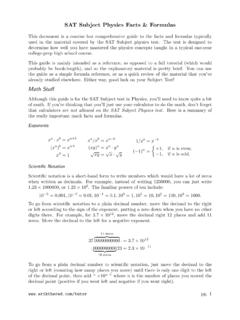
2 Simplification of equations using basic algebra. Solving of an equation for a particular variable. Basic trigonometry problems involving sines, cosines, tangents, and their inverse functions. Working with algebraic equations involving inequalities (<, >, etc.). Conversions involving various measurement units, when the conversion factors are provided. (The type of problems that can be solved by cancelling units .) Using simple geometric concepts (circles, radii, diameters, and areas) and trigonometry (sides and hypotenuse of right triangles) to set up and solve word problems. Correct use of rounding, significant figures and places to the right of the decimal to express precision in calculations involving addition, subtraction, multiplication, and division. Expressing numbers in scientific notation, and calculations involving numbers written this way.
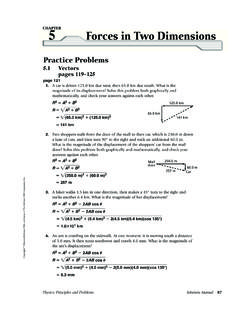
3 Using substitution of variable s units to check whether an equation is reasonable. Convert between masses, volumes, and densities (grams per cubic meter, etc.). Recognize quadratic equations (the quadratic formula need not be memorized). Express equations involving powers (xa, etc.) in terms of logarithms (a log(x), etc.). Recognize the equation of a line (y = mx + b), understand and use the concepts of slope, x-intercept, and y-intercept. Recognize when equations are not linear (y = mx2 + b, for example). Know and use simple metric prefixes: (micro, milli, centi, kilo, mega). Understand in very basic conceptual terms what a vector is, and how vectors are added. To review these topics, we recommend the following resources: Physics for Dummies, or the newer Physics I for Dummies and Physics II for Dummies are good texts. It is especially helpful to get the Physics Workbook for Dummies in order to build your math and problem-solving skills.
4 Precalculus for Dummies, along with its companion workbook, is also helpful if you are math-challenged. Online resources: These resources cover much more material than the test does, so please focus your studying on only the topics listed above. This exam mainly tests your math proficiency, not your specific knowledge of Physics . Notes: Health-professions students entering Biola as freshmen or sophomores have the advantage of being able to take the pre- Physics course, PHSC 092 Introduction to Physics , during the spring here at Biola if they do not pass the exam. Other colleges offer similar introduction to Physics courses, but please check with us before you take it elsewhere, to verify that it meets our requirements (GE conceptual Physics courses like our Physics in Everyday Life will not give you the math preparation necessary for the level of Physics that your major requires).
5 Most engineering students entering Biola as freshmen need to take Physics this fall, so if you did not pass the Placement exam when we offered it during the freshman advising day in June, please take an appropriate summer course elsewhere, or Study the materials above so that you will be prepared. Delaying Physics may mean that you will not stay on schedule for completing the 3/2 program on time. If you are a health-professions student already at Biola or a transfer student, you may face an additional year here if you do not take Physics 1 on schedule. You are especially encouraged to take an appropriate summer course elsewhere. The self- Study tools above are offered for those who are unable to take a Physics preparation course either here or elsewhere. Remember that the goal is not simply to pass the exam, but to gain the math skills you need so that you will succeed in the real course(s).
6