Transcription of Phytoremediation: Technology Overview Report
1 ground - water RemediationTechnologies Analysis Center615 William Pitt Way Pittsburgh, PA 15238 (412) 826-5511 (800) 373-1973 Homepage: E-mail: For:TechnologyOverview ReportPrepared By:SERIESOGWRTACTO-96-03 PhytoremediationOctober 1996 Ralinda R. Miller, RemediationTechnologies Analysis CenterO Series: TO-96-03 PhytoremediationiFOREWORDA bout GWRTACThe ground - water Remediation Technologies Analysis Center (GWRTAC) is a national environmentaltechnology transfer center that provides information on the use of innovative technologies to clean-up contaminated in 1995, GWRTAC is operated by the National Environmental Technology ApplicationsCenter (NETAC) in association with the University of Pittsburgh s Environmental Engineering Programthrough a Cooperative Agreement with the Environmental Protection Agency s (EPA) TechnologyInnovation Office (TIO).
2 NETAC is an operating unit of the Center for Hazardous Materials Researchand focuses on accelerating the development and commercial use of new environmental wishes to acknowledge the support and encouragement received for the completion ofthis Report from the EPA O Series ReportsThis Report is one of the GWRTAC O Series of reports developed by GWRTAC to provide a generaloverview and introduction to a groundwater -related remediation Technology . These Overview reportsare intended to provide a basic orientation to the Technology . They contain information gatheredfrom a range of currently available sources, including project documents, reports, periodicals, Internetsearches, and personal communication with involved parties. No attempts are made to independentlyconfirm or peer review the resources makes no warranties, express or implied, including without limitation, warranty forcompleteness, accuracy, or usefulness of the information, warranties as to the merchantability, orfitness for a particular pur pose.
3 Moreover, the listing of any Technology , corporation, company,person, of facility in this Report does not constitute endorsement, approval, or recommendation byGWRTAC, NETAC, or the Series: TO-96-03 PhytoremediationiiiiABSTRACTThis Technology summary Report provides a brief Overview of an environmental remediationtechnology, including an introduction to its general principles, reported applicability and utilization,and cited advantages/disadvantages. Also provided are locations of, and information about,organizations conducting research related to phytoremediation (Appendix A) and other referencescompiled during preparation of this Report (Appendix B). This Report is provided for informationalpurposes only and is not intended as a state-of-the-ar t peer reviewed analysis of this used in the preparation of this Report was gathered from periodicals, through Internetsearches, and in some cases, from personal communications with involved par ties.
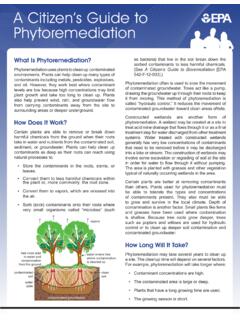
4 No attemptwas made to confirm the veracity of interpretations and/or representations made in any informationresource used. In addition, listing of any Technology , corporation, company, person, or facility doesnot constitute endorsement, approval, or recommendation by the National Environmental TechnologyApplications Center (NETAC). phytoremediation uses plants to cleanup contaminated soil and groundwater , taking advantage ofplants natural abilities to take up, accumulate, and/or degrade constituents of their soil and waterenvironments. Results of research and development into phytoremediation processes and techniquesreport it to be applicable to a broad range of contaminants including numerous metals andradionuclides, various organic compounds (such as chlorinated solvents, BTEX, PCBs, PAHs,pesticides/insecticides, explosives, nutrients, and surfactants.)
5 According to information reviewed,general site conditions best suited for potential use of phytoremediation include large areas of low tomoderate surface soil (0 to 3 feet) contamination or large volumes of water with low-level contaminationsubject to low (stringent) treatment standards. Depth to groundwater for in situ treatment is limitedto about 10 feet, but ex situ treatment in constructed troughs or wetlands has also been are five basic types of phytoremediation techniques: 1) rhizofiltration, a water remediationtechnique involving the uptake of contaminants by plant roots; 2) phytoextraction, a soil techniqueinvolving uptake from soil, 3) phytotransformation, applicable to both soil and water , involving thedegradation of contaminants through plant metabolism, 4) phyto-stimulation or plant-assistedbioremediation, also used for both soil and water , which involves the stimulation of microbialbiodegradation through the activities of plants in the root zone, and 5)
6 Phytostabilization, usingplants to reduce the mobility and migration potential of contaminants in advantages reported for phytoremediation as compared to traditional remediation technologiesinclude the possibility of generating less secondary wastes, minimal associated environmentaldisturbance, and the ability to leave soils in place and in a usable condition following disadvantages include the long lengths of time required (usually several growing seasons),depth limitations (3 feet for soil and 10 feet for groundwater ), and the possibility of contaminantentrance into the food chain through animal consumption of plant document was prepared for distribution by the ground - water Remediation Technologies AnalysisCenter (GWRTAC). GWRTAC is being operated by NETAC, under a Cooperative Agreement withthe United States Environmental Protection Agency s (EPA) Technology Innovation Office (TIO).
7 O Series: TO-96-03 PhytoremediationiiiTABLE OF of of of Plant Remediation Plant-Assisted Remediation Plant-Assisted CITED10 APPENDIX A: RESEARCH LOCATIONS/INFORMATIONA-1 APPENDIX B: OTHER REFERENCESB-1 LIST OF TABLEST ableTitlePage1 Advantages of Type of Phytoremediaton8O Series: INTRODUCTIONP hytoremediation, the use of plants to remediate environmental media, is being pursued as a newapproach for the cleanup of contaminated soils and waters, including groundwater . Plant-assistedbioremediation, sometimes referred to as a type of phytoremediation , involves the interaction ofplant roots and the microorganisms associated with these root systems to remediate soils containingelevated concentrations of organic compounds. These techniques could provide cost-effectivemethods of remediating soils and groundwater contaminated with metals, radionuclides, and varioustypes of organics, with fewer secondary wastes and less environmental impact than would begenerated using traditional remediation plants extract necessary nutrients, including metals, from their soil and water plants, called hyperaccumulators, have the ability to store large amounts of metals, evensome metals that do not appear to be required for plant functioning.
8 In addition, plants can take upvarious organic chemicals from environmental media and degrade or otherwise process them foruse in their physiological technologies are in the early stages of development, with laboratory research andlimited field trials being conducted to determine processes and refine methods. Additional research,including genetic engineering, is being conducted to improve the natural capabilities of plants toperform remediation functions and to investigate other plants with potential phytoremediationapplications (2, 3, 11, 17).O Series: that have been remediated in laboratory and/or field studies using phytoremediationor plant-assisted bioremediation include: Heavy metals (Cd, Cr(VI), Pb, Co, Cu, Pb, Ni, Se, Zn) Radionuclides (Cs, Sr, Ur) Chlorinated solvents (TCE, PCE) Petroleum hydrocarbons (BTEX) Polychlorinated biphenyls (PCBs) Polynuclear aromatic hydrocarbons (PAHs) Chlorinated pesticides Organophosphate insecticides ( , parathion) Explosives (TNT, DNT, TNB, RDX, HMX) Nutrients (nitrate, ammonium, phosphate) CONDITIONSP hytoremediation and plant-assisted bioremediation are most effective if soil contamination is limitedto within 3 feet of the surface, and if groundwater is within 10 feet of the surface (4, 17).
9 Thesetechnologies are applicable to sites with low to moderate soil contamination over large areas, and tosites with large volumes of groundwater with low levels of contamination that have to be cleaned tolow (strict) standards (3, 6, 15).O Series: OF PHYTOREMEDIATIONP hytoremediation is based on certain natural processes carried out by plants including: Uptake of metals and certain organic compounds ( , moderately water soluble, log Kow= 3, such as BTEX) from soil and water ; Accumulation or processing of these chemicals via lignification, volatilization, metabolization,mineralization (transformation into CO2 and water ); Use of enzymes to breakdown complex organic molecules into simpler molecules (ultimatelyCO2 and water ); Increasing the carbon and oxygen content of soil around roots (and so promoting microbial/fungal activity) through release of chemicals (exudates) and decay of root tissue; Capture of groundwater (even contaminated groundwater ) and utilization for plant processes(17, 19, 20).
10 OF PHYTOREMEDIATIONS everal classification schemes were found relating to the types of phytoremediation , the most commonof which is presented below. Rhizofiltration, the absorption, concentration, and precipitation of heavy metals by plantroots; Phytoextraction, the extraction and accumulation of contaminants in harvestable planttissues including roots and surface shoots; Phytotransformation, the degradation of complex organic molecules to simple moleculesand the incorporation of these molecules into plant tissues; Phytostimulation or plant-assisted bioremediation, the stimulation of microbial and fungaldegradation by release of exudates/enzymes into the root zone (rhizosphere); Phytostabilization, involving absorption and precipitation of contaminants, principally metals,by plants, reducing their mobility and preventing their migration to groundwater (leaching) orair (wind transport), or entry into the food chain (4, 16, 19).