Transcription of Pipe Flow/Friction Factor Calculations using Excel ...
1 pipe Flow/Friction Factor Calculations using Excel Spreadsheets Harlan H. Bengtson, PE, PhD Emeritus Professor of Civil Engineering Southern Illinois University Edwardsville Table of Contents Introduction Section 1 The Basic Equations Section 2 Laminar and Turbulent Flow in Pipes Section 3 Fully Developed Flow and the Entrance Region Section 4 Obtaining friction Factor Values Section 5 calculation of Frictional Head Loss and/or Frictional Pressure Drop Section 6 A Spreadsheet for calculation of pipe Flow Rate Section 7 A Spreadsheet for calculation of Required pipe Diameter Summary References Introduction The Darcy-Weisbach equation or the Fanning equation and the friction Factor (Moody friction Factor or Fanning friction Factor )
2 Are used for a variety of pressure pipe flow Calculations . Many of these types of Calculations require a graphical and/or iterative solution. The necessary iterative Calculations can be carried out conveniently through the use of a spreadsheet. This tutorial starts with discussion of the Darcy-Weisbach and the Fanning equations along with the parameters contained in them and the and units typically used in the equations. Several example Calculations are included and spreadsheet screenshots are presented and discussed to illustrate the ways that spreadsheets can be used for pressure pipe Flow/Friction Factor Calculations , including both laminar and turbulent flow and cases in which minor losses are included in the Calculations . 1.
3 The Basic Equations The Darcy-Weisbach equation and the Fanning equation are two flexible, widely used relationships for pressure pipe flow Calculations . The Darcy-Weisbach equation, in its most widely used form (including minor losses and with uniform pipe diameter and reference velocity for Ks) is: This is a semi-empirical equation, but it is dimensionally consistent, so it has no dimensional constants and any consistent set of units can be used. The parameters in the equation are defined below along with their commonly used and units. L is the pipe length, in ft ( ) or m ( ) D is the pipe diameter, in ft ( ) or m ( ) V is the average velocity of the fluid flowing through the pipe , in ft/sec ( ) or m/s ( ). Note that V is defined as V = Q/A, where Q is the volumetric flow rate of the fluid and A is the cross-sectional area of flow.
4 HL is the frictional head loss due to fluid flowing at an average velocity, V, through a pipe of length, L, and diameter, D, with Moody friction Factor equal to fm. The frictional head loss will be in ft for units and in m for units. g is the acceleration due to gravity. (g = ft/sec2 = m/s2) fm is the Moody friction Factor , which is dimensionless and is a function of Reynolds number (Re = DV / ) and relative roughness ( /D). Note that this parameter is also called the Darcy friction Factor . The two terms can be used interchangeably. The m subscript is usually not present on the symbol for the Moody friction Factor . It is being used in this tutorial to differentiate it from the Fanning friction Factor , which will be introduced shortly.
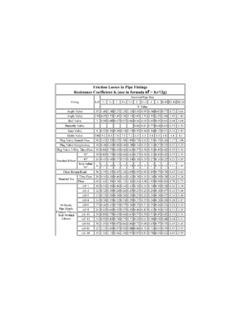
5 Is an empirical pipe roughness parameter, in ft for or mm for units. K is the sum of the minor loss coefficients for the pipe system. Minor loss coefficients are dimensionless. They are used to account for frictional head loss or frictional pressure drop due to pipe fittings, changes in cross-section, entrances and exits. Typical K values for common fittings are available in many handbooks, textbooks and websites. Table 1 below shows some typical values. Table 1. Typical Values of Minor Loss Coefficients For a table with additional minor loss coefficient values, see: Perry's Chemical Engineer's Handbook, 8th Ed. Table 6-4 For more discussion of the Darcy-Weisbach equation, see: Standard Handbook for Civil Engineers, 5th Ed, Sec.
6 Darcy-Weisbach Formula A common form of the Fanning equation (including minor losses and with uniform pipe diameter and reference velocity for Ks) is: Like the Darcy-Weisbach equation, the Fanning equation is also a semi-empirical, dimensionally consistent equation. The parameters D, V, K, and L are the same as in the Darcy-Weisbach equation just described above. The other parameters in the Fanning equation are as follows: is the density of the flowing fluid in slugs/ft3 for or kg/m3 for units. Pf is the frictional pressure drop due to the flowing fluid in lb/ft2 for or Pa for units. (Note that lb is being used for a unit of force and lbm as a unit of mass in this tutorial.)
7 Ff is the Fanning friction Factor , which is dimensionless and is a function of Reynolds number and /D. The relationship between the Fanning friction Factor and the Moody friction Factor is: fm = 4 ff. Note that the m and f subscripts are not typically used. The symbol f is commonly used for both the Moody friction Factor and the Fanning friction Factor . The subscripts are being used in this book to avoid confusion between the two different friction factors , which are both in common use. For more discussion of the Fanning equation, see: Perry's Chemical Engineers' Handbook, 8th Ed. Sec Incompressible Flow in Pipes and Channels Values of for common pipe materials are available in many handbooks and textbooks, as well as on a variety of websites.
8 Table 2 below shows some typical values. Table 2. Values of pipe Roughness, The surface roughness values in Table 1 came from the following two sources: Perry's Chemical Engineers' Handbook, 8th Ed., Table 6-1 - units Mark's Standard Handbook for Mechanical Engineers, 11th Ed., Table - units You may have noticed that the Fanning equation is written in terms of frictional pressure drop, while the Darcy-Weisbach equation is written in terms of frictional head loss. The relationship between these two measures of frictional loss is as follows: Pf = ghL = hL The parameters in this equation are as follow: hL is the frictional head loss in ft ( ) or m ( ) as defined above Pf is the frictional pressure drop in lb/ft2 ( ) or Pa ( ).
9 Is the density of the flowing fluid in slugs/ft3 ( ) or kg/m3 ( ) is the specific weight of the flowing fluid in lb/ft3 ( ) or N/m3 ( ) g is the acceleration due to gravity = ft/sec2 = m/s2. The Darcy-Weisbach equation and the Fanning equation can both be used only for fully developed, pressure flow (either laminar or turbulent) in a pipe , piping system, or closed conduit with a non-circular cross-section. The next two chapters contain discussion of laminar and turbulent flow and of the meaning of fully developed flow. 2. Laminar and Turbulent Flow in Pipes Determination of whether a given flow is laminar or turbulent is important for several types of fluid flow situations. Here we will be concerned in particular with pressure flow in pipes and whether a given flow is laminar or turbulent.
10 In general, laminar flow is characterized by a lack of turbulence to cause mixing within the fluid and will be present with low fluid velocity and/or high fluid viscosity. Turbulent flow, however, has turbulence and mixing within the flow and takes place with high fluid velocity and/or low fluid viscosity. Differences between laminar and turbulent flow are illustrated in the diagrams below. Figure 2. Laminar and Turbulent pipe Flow Osborne Reynolds, a pioneer in the study of differences between laminar and turbulent flow, performed his experiments in the late 1800s. He injected dye into fluids flowing through pipes under varied conditions and came up with a group of variables to predict whether pipe flow would be laminar or turbulent.