Transcription of Planning an Effective Practice - Babe Ruth League
1 PPllaannnniinngg aann EEffffeeccttiivvee PPrraaccttiiccee [This article is from Ripken Baseball s Parents and Coaches Clipboard. To subscribe to this very informative email newsletter, please visit ] By Bill and Cal Ripken Baseball is a simple game. However, Planning an Effective baseball Practice can be challenging. With this article, we are going to take a look at some of the basic components of a baseball Practice and outline some sample practices for older and younger youth teams. Warming Up So many times a coach will show up and immediately tell the team to go run around the soccer goalposts and come back. As players get older they begin to understand that this is a warm-up.
2 They know what it means to jog and get loose. Younger players usually do not grasp this concept. They will view this as a race and will run as hard as they can in an effort to win the race. Some players will not be able to complete the run at this pace and will get tired quickly. Others will push themselves to the very end and will exhaust their energy. Either way you are going to have a bunch of tired kids. It might take them 10 minutes or longer to recover, which is not a good situation to be in when there only is an hour block allotted for Practice . A better idea for the younger ages is to open Practice with base running. Kids love to run bases. In fact, they love it so much you can begin and end Practice with base running.
3 There is a drill we call Big League base running that we really like. The players run from home to first as if they are trying to beat out an infield hit. The concepts of touching the front of the bag and running through the base are stressed. Next, the players run from first to third. After that they walk home and then run a double. Then they simulate scoring on a hit from second base. Beyond that, if the players are not too tired they can run out a triple or a home run. Each time specific base running fundamentals are stressed. As players get older (above the age of 13) the concept of a dynamic warm-up, including jogging, running, bounding, skipping, high knees, etc.
4 Can be introduced. The team should be able to arrive at Practice and start this type of warm-up as a team on its own before beginning a daily stretching routine. Cold muscles should never be stretched, but it is important to introduce a stretchingroutine to any age group. After the base running or dynamic warm-up, players can sit in a circle to begin their stretching routine. Younger players will not have a real physical need to stretch. They roll out of bed and are loose and ready to go. There is not much danger ofthem pulling muscles. However, understanding the importance of stretching anddeveloping a routine will be habit forming and will help them throughout their athletic careers.
5 So the earlier the concept of stretching is introduced the better. Team stretchingalso provides coaches with an opportunity to go over the Practice plan that has beendeveloped for that day, which will eliminate wasted time once the Practice begins. The Importance of Having a Plan It is important for a coach to spend at least some time in advance putting the day spractice on paper. It is even better if this plan can be emailed to all of the players andparents the night before Practice . If the coach comes to Practice with a plan and cancommunicate and organize the plan effectively while the team stretches, the confidencelevel of the players and parents will increase.
6 They will understand that the coach is takinghis or her responsibilities seriously and is attempting to make the experience as rewardingas possible for all involved. Players are more likely to give maximum effort and attentionto a coach who is organized, and parents are less likely to question an organized,dedicated coach. Dealing With Limited Field Space It can be very easy for us to tell coaches not to fall into the trap of running a Practice whereone kid is hitting and everyone else is standing around in the field. After all, we haveaccess to a new youth baseball academy that we have built in Aberdeen, MD, that has fouryouth fields, a synthetic turf Practice infield, four batting cages with a tee and soft tossarea and a large multi-purpose grass field.
7 Most coaches come to Practice and have use ofone field for an hour. Some coaches don t even get to use a field with a backstop. Thosecircumstances make it harder to plan an Effective Practice . Harder, but not impossible. Youjust have to get a little creative! Batting Practice can be set up so that there are actually several different stations going onat the same time. Let s say you have a team with 15 players. You might break your teaminto three groups of five. One group goes to the outfield, where a coach or volunteer hitsfly balls and ground balls to the players between pitches. Another group goes to theinfield, where a coach or volunteer hits ground balls to the players between pitches.
8 Thethird group is a hitting and base running group. One player goes to first base andsimulates situational base running (seeing a bunt hit the ground before breaking, hit andrun, advancing on a hit, reading a fly ball, etc.). Another player is hitting at home plate(two bunts, two hit and runs, 10 swings). The other three players are hitting plastic, rubberor foam balls off of a tee or by doing a soft-toss drill into the backstop or a fence. In this scenario players are working on hitting, throwing and catching. If you spend 15minutes on warm-up, throwing and catching before starting batting Practice , you then can let the groups hit for 10-15 minutes each and still accomplish quite a bit.
9 There might evenbe more time left over at the end to go over a team fundamental for older groups or to domore base running or have skills contests for younger teams. This is just one example of how to make efficient use of limited field space to run aneffective Practice . Another way is to purchase some portable pop-up nets. These screens are light and fold up into a bag. They can be taken anywhere and set up in a matter of minutes, allowing for a coach to create his or her own hitting stations under virtually anyconditions. Perfect Practice Makes Perfect We ve all heard the saying, Practice Makes Perfect. Well, that s not really true. If youpractice a skill over and over again, but you are practicing it the wrong way, when itcomes to a game situation you are going to do it wrong.
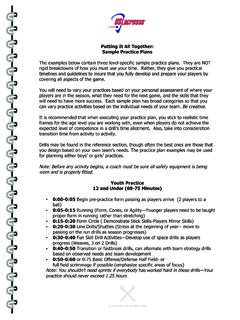
10 Our dad, Cal Ripken, Sr., whoplayed, coached and managed in the Baltimore Orioles organization for nearly 40 years,was famous for saying, Perfect Practice Makes Perfect. He also used to say, If it s worthdoing, it s worth doing right. Both of these sayings reflect the idea that we tend to playthe way we Practice . Sample Practice Plan Ages 13 and up 20 minutes - Stretch, run, throw 20 minutes - Ground balls and fly balls use buckets and systems to minimize throws andmaximize repetitions: Not taking infield Two infield fungo stations One outfield fungo station 20 minutes -Team fundamentals Bunt defenses First and third defenses Cutoffs and relays Pickoffs and rundowns Team base running 60 minutes - Team batting Practice four stations, 15 minutes each (or four stations, 10minutes each if you want to do another team fundamental) stations can be rotated daily always include free hitting.