Transcription of Plant Growth Regulator - CDMS
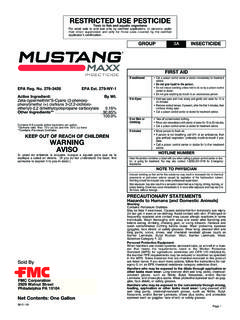
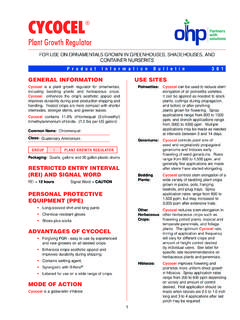
1 1 gallonNet ContentsPULL HERE TO OPENFor Turf Growth ManagementFor managing Growth , improving quality andstress tolerance, and edging of warm- and cool-season turfgrassesActive Ingredient:Trinexapac-ethyl(CAS No. 95266-40-3) .. Ingredients: : MAXX is a microemulsion concentratecontaining one pound trinexapac-ethyl per OUT OF REACH OF additional precautionary statements anddirections for use inside Reg. No. 100-937 EPA Est. 62171-MS-001 Product of SwitzerlandFormulated in the USASCP 937A-L1K 12154061879 Plant Growth RegulatorFIRST AIDIf on skin orclothing Take off contaminated clothing.
2 Rinse skin immediately with plenty of water for 15-20 minutes. Call a poison control center or doctor for treatment adviceIf in eyes Hold eye open and rinse slowly and gently with water for 15-20 minutes. Remove contact lenses, if present, after the fi rst 5 minutes, then continue rinsing eye. Call a poison control center or doctor for treatment TO PHYSICIANIf a large amount has been ingested, lavage stomach. An aqueous suspension of activated charcoal can be given to absorb remaining toxicant. Treat the product container or label with you when calling a poison control center or doctor, or going LINE NUMBERFor 24-Hour Medical Emergency Assistance (Human or Animal) orChemical Emergency Assistance (Spill, Leak, Fire, or Accident),Call1-800-888-8372 PRECAUTIONARY STATEMENTSH azards to Humans and Domestic AnimalsCAUTIONH armful if absorbed through skin.
3 Causes moderate eye irritation. Avoid contact with eyes, skin, or Protective Equipment (PPE)Some materials that are chemical-resistant to this product are listed below. If you want more options, follow the instructions for Category C on an EPA chemical resistance category selection PRECAUTIONARY STATEMENTS (continued)Applicators and other handlers must wear: Long-sleeved shirt and long pants Chemical-resistant gloves (such as nitrile, butyl, neoprene, or barrier laminate) Shoes plus socksDiscard clothing and other absorbent materials that have been drenched or heavily contaminated with this product s concentrate. Do not reuse them. Follow manufacturer s instructions for cleaning/maintaining PPE.
4 If no such instruc-tions for washables, use detergent and hot water. Keep and wash PPE separately from other Control StatementsWhen handlers use closed systems or enclosed cabs in a manner that meets the requirements listed in the Worker Protection Standard (WPS) for agricultural pesticides [40 CFR (d)(4-6)], the handler PPE requirements may be reduced or modified as specified in the Safety RecommendationsUsers should: Wash hands before eating, drinking, chewing gum, using tobacco, or using the toilet. Remove clothing immediately if pesticide gets inside. Then wash thoroughly and put on clean HazardsDo not apply directly to water, to areas where surface water is present, or to intertidal areas below the mean high water mark.
5 Do not contaminate water when disposing of equipment wash water. Do not apply when weather conditions favor drift from treated areas. CONDITIONS OF SALE AND LIMITATION OF WARRANTY AND LIABILITYNOTICE: Read the entire Directions for Use and Conditions of Sale and Limitation of Warranty and Liability before buying or using this product. If the terms are not acceptable, return the product at once, unopened, and the purchase price will be Directions for Use of this product must be followed carefully. It is impossible to eliminate all risks inherently associated with the use of this product. Crop injury, ineffectiveness or other unintended consequences may result because of such factors as manner of use or application, weather or crop conditions, presence of other materials or other influencing factors in the use of the product, which are beyond the control of SYNGENTA CROP PROTECTION, LLC or Seller.
6 To the extent permitted by applicable law, Buyer and User agree to hold SYNGENTA and Seller harm-less for any claims relating to such warrants that this product conforms to the chemical description on the label and is reasonably fit for the purposes stated in the Directions for Use, subject to the inherent risks referred to above, when used in accordance with directions under normal use conditions. To the extent permitted by applicable law: (1) this warranty does not extend to the use of the product contrary to label instructions, or under conditions not reasonably foreseeable to or beyond the control of Seller or SYNGENTA, and, (2) Buyer and User assume the risk of any such use. TO THE EXTENT PERMITTED BY APPLICABLE LAW, SYNGENTA MAKES NO WARRANTIES OF MERCHANTABILITY OR OF FITNESS FOR A PARTICULAR PURPOSE NOR ANY OTHER EXPRESS OR IMPLIED WARRANTY EXCEPT AS WARRANTED BY THIS the extent permitted by applicable law, in no event shall SYNGENTA be liable for any incidental, consequential or special damages resulting from the use or handling of this product.
7 TO THE EXTENT PERMITTED BY APPLICABLE LAW, THE EXCLUSIVE REMEDY OF THE USER OR BUYER, AND THE EXCLUSIVE LIABILITY OF SYNGENTA AND SELLER FOR ANY AND ALL CLAIMS, LOSSES, INJURIES OR DAMAGES (INCLUDING CLAIMS BASED ON BREACH OF WARRANTY, CONTRACT, NEGLIGENCE, TORT, STRICT LIABILITY OR OTHERWISE) RESULTING FROM THE USE OR HANDLING OF THIS PRODUCT, SHALL BE THE RETURN OF THE PURCHASE PRICE OF THE PRODUCT OR, AT THE ELECTION OF SYNGENTA OR SELLER, THE REPLACEMENT OF THE and Seller offer this product, and Buyer and User accept it, subject to the foregoing Conditions of Sale and Limitation of Warranty and Liability, which may not be modified except by written agreement signed by a duly authorized representative of FOR USEIt is a violation of Federal law to use this product in a manner inconsistent with its not apply this product in a way that will contact workers or other persons, either directly or through drift.
8 Only protected handlers may be in the area during application. For any requirements specific to your State or Tribe, con-sult the agency responsible for pesticide USE REQUIREMENTSUse this product only in accordance with its labeling and with the Worker Protection Standard, 40 CFR part 170. This Standard contains requirements for the protection of agricultural workers on farms, forests, nurseries, and greenhouses, and handlers of agricultural pesticides. It contains requirements for training, decontamination,notification, and emergency assistance. It also contains specific instructions and exceptions pertaining to the state-ments on this label about personal protective equipment (PPE) and restricted-entry interval.
9 The requirements in this box only apply to uses of this product that are covered by the Worker Protection restricted-entry interval (REI) for this product is 0 not enter treated areas without footwear until sprays have USE REQUIREMENTSThe requirements in this box apply to uses of this product that are NOT within the scope of the Worker Protec-tion Standard for agricultural pesticides (40 CFR Part 170). The WPS applies when this product is used to produce agricultural plants on farms, forests, nurseries, or not enter treated areas without footwear until sprays have all precautions and limitations on this label and on the labels of each product used in tank mixture with this TO FOLLOW THE DIRECTIONS FOR USE AND PRECAUTIONS ON THIS LABEL MAY RESULT IN UNEVEN Growth REDUCTION OR SEVERELY STUNTED TURF.
10 USE INFORMATIONP rimo MAXX for turf Growth management reduces the frequency of mowing and the amount of grass clippings by reducing the vertical Growth of warm- and cool-season turfgrasses. Other benefits, such as increased turf density, increased color, and increased turf quality, are frequently observed after Primo MAXX MAXX can be applied to well-maintained, quality turfgrass areas, such as residential and commercial lawns, golf courses, sod farms, sports fields, cemeteries, and similar areas. Primo MAXX is useful in the management of difficult-to-mow areas and can be used to minimize the need for edging turfgrass along sidewalks, curbs, parking lots, driveways, flower beds, fences and around posts, storage sheds, and Pre-Stress ConditioningMultiple Primo MAXX applications along with cultural practices such as fertilization, irrigation, drainage, mowing height, etc.