Transcription of PLASMA-LYTE 148 (An Electrolyte Solution) …
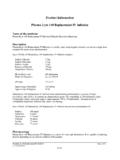
1 PLASMA-LYTE 148 (An Electrolyte Solution) Injection/ PLASMA-LYTE A (An Electrolyte Solution) Injection Baxter Description PLASMA-LYTE 148 Injection/ PLASMA-LYTE A Injection are sterile, nonpyrogenic intravenous solutions which contain no bacteriostatic or antimicrobial agents or added buffers. The composition, osmolarity and approx. pH of the individual solutions are shown in Table 1. Normal physiologic isotonicity range is approximately 280 310 mOsmol/litre. PLASMA-LYTE 148 Injection/ PLASMA-LYTE A Injection have an osmolarity of 294 mOsmol/litre. Table 1 DIN Size (mL) Composition (g/L) Osmolarity (mOsmol/L) pH Ionic Concentration (mmol/L) Caloric Content (kcal/L) Sodium Chloride, USP Potassium Chloride, USP Sodium Gluconate, USP Sodium Acetate, USP Magnesium Chloride, USP Sodium Potassium Chloride Magnesium Calcium Acetate Gluconate Lactate Dextrose PLASMA-LYTE 148 Injection (JB2534) 00260576 1000 294 ( ) 140 5 98 0 27 23 0 0 15 PLASMA-LYTE A Injection (JB2544) 02339358 1000 294 ( )
2 140 5 98 0 27 23 0 0 15 Actions PLASMA-LYTE 148 Injection/ PLASMA-LYTE A Injection are a source of water for hydration and provide electrolytes. Both are capable of inducing diur esis depending on the clinical conditions of the patient. See Table 1 for ionic concentrations of PLASMA-LYTE 148 Injection/ PLASMA-LYTE A Injection. PLASMA-LYTE 148 Injection/ PLASMA-LYTE A Injection both contain acetate and gluconate anions which produce a metabolic alkalinizing effect. These anions are metabolized in the liver to glycogen, and ultimately to carbon dioxide and water, which requires the consumption of hydrogen cations.
3 Indications PLASMA-LYTE 148 Injection/ PLASMA-LYTE A Injection are indicated for volume replacement, as a source of water and electrolytes, and as an alkalinizing agent. 1 Contraindications PLASMA-LYTE 148 Injection/ PLASMA-LYTE A Injection are contraindicated in patients with a known hypersensitivity to the product. [See WARNINGS AND PRECAUTIONS] Warnings and Precautions General PLASMA-LYTE 148 Injection/ PLASMA-LYTE A Injection are not indicated for the treatment of hypochloremic hypokalemic alkalosis and should be used with caution, if at all, in patients with hypochloremic hypokalemic alkalosis ( , due to prolonged vomiting, pyloric stenosis, prolonged nasogastric suctioning).
4 PLASMA-LYTE 148 Injection/ PLASMA-LYTE A Injection are not indicated for the primary treatment of severe metabolic acidosis. Although PLASMA-LYTE 148 Injection/ PLASMA-LYTE A Injection have a potassium concentration similar to the concentration in plasma, it is insufficient to produce a useful effect in case of severe potassium deficiency; therefore, it should not be used for correction of severe potassium deficiency. PLASMA-LYTE 148 Injection/ PLASMA-LYTE A Injection are not indicated for the treatment of hypomagnesemia. Warnings Hypersensitivity Reactions Hypersensitivity/infusion reactions, including anaphylactoid reactions, have been reported with PLASMA-LYTE 148 Injection/ PLASMA-LYTE A Injection.
5 The infusion must be stopped immediately if any signs or symptoms of a suspected hypersensitivity reaction develop. Appropriate therapeutic countermeasures must be instituted as clinically indicated. Risk of Fluid and/or Solute Overload and Electrolyte Disturbances Depending on the volume and rate of infusion, the intravenous administration of PLASMA-LYTE 148 Injection/ PLASMA-LYTE A Injection can cause fluid and/or solute overload resulting in dilution of serum Electrolyte concentrations, overhydration/hypervolemia, congested states, pulmonary edema or acid-base imbalance. The risk of dilutional states is inversely proportional to the Electrolyte concentrations of PLASMA-LYTE 148 Injection/ PLASMA-LYTE A Injection.
6 The risk of solute overload causing congested states with peripheral and pulmonary edema is directly proportional to the Electrolyte concentrations of PLASMA-LYTE 148 Injection/ PLASMA-LYTE A Injection. 2 Clinical evaluation and periodic laboratory determinations may be necessary to monitor changes in fluid balance, Electrolyte concentrations, and acid-base balance during prolonged parenteral therapy or whenever the condition of the patient or the rate of administration warrants such evaluation. Use in Patients with or at Risk for Hypermagnesemia solutions containing magnesium should be used with caution, if at all, in patients with hypermagnesemia or conditions predisposing to hypermagnesemia, including but not limited to severe renal impairment or magnesium therapy such as for eclampsia.
7 Myasthenia gravis. Use in Patients with or at Risk for Alkalosis PLASMA-LYTE 148 Injection/ PLASMA-LYTE A Injection should be administered with particular caution, if at all, to patients with alkalosis or at risk for alkalosis. Excess administration of PLASMA-LYTE 148 Injection/ PLASMA-LYTE A Injection can result in metabolic alkalosis. Use in Patients with Hypervolemia or Overhydration, or Conditions that Cause Sodium Retention and Edema PLASMA-LYTE 148 Injection/ PLASMA-LYTE A Injection should be administered with particular caution, if at all, to hypervolemic or overhydrated patients. PLASMA-LYTE 148 Injection/ PLASMA-LYTE A Injection should be administered with particular caution, if at all, to patients with conditions that may cause sodium retention, fluid overload and edema, such as patients with primary hyperaldosteronism, secondary hyperaldosteronism (associated with, for example, hypertension, congestive heart failure, renal artery stenosis, or nephrosclerosis), or preeclampsia.
8 Use in patients with Hypocalcemia PLASMA-LYTE 148 Injection/ PLASMA-LYTE A Injection contains no calcium, and an increase in plasma pH due to its alkalinizing effect may lower the concentration of ionized (not protein-bound) calcium. PLASMA-LYTE 148 Injection/ PLASMA-LYTE A Injection should be administered with particular caution, if at all, to patients with hypocalcemia. Use in Patients with or at Risk for Hyperkalemia PLASMA-LYTE 148 Injection/ PLASMA-LYTE A Injection should be administered with particular caution, if at all, to patients with hyperkalemia or conditions predisposing to hyperkalemia (such as severe renal impairment or adrenocortical insufficiency, acute dehydration, or extensive tissue injury or burns) and in patients with cardiac disease.
9 3 Use in Patients with Severe Renal Impairment PLASMA-LYTE 148 Injection/ PLASMA-LYTE A Injection should be administered with particular caution, if at all, to patients with severe renal impairment. In such patients administration of PLASMA-LYTE 148 Injection/ PLASMA-LYTE A Injection may result in sodium and/or potassium or magnesium retention. Risk of Air Embolism Do not connect flexible plastic containers in series in order to avoid air embolism due to possible residual air contained in the primary container. Pressurizing intravenous solutions contained in flexible plastic containers to increase flow rates can result in air embolism if the residual air in the container is not fully evacuated prior to administration.
10 Use of a vented intravenous administration set with the vent in the open position could result in air embolism. Vented intravenous administration sets with the vent in the open position should not be used with flexible plastic containers. Precautions Caution must be exercised in the administration of parenteral fluids, especially those containing sodium ion, to patients receiving corticosteroids or corticotropin. Special Populations Use in Pediatric Patients Safety and effectiveness of PLASMA-LYTE 148 Injection/ PLASMA-LYTE A Injection in children have not been established by adequate and well controlled trials. Use in Geriatric Patients When selecting the type of infusion solution and the volume/rate of infusion for a geriatric patient, consider that geriatric patients are generally more likely to have cardiac, renal, hepatic, and other diseases or concomitant drug therapy.