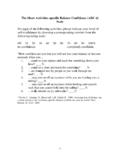
Transcription of (Please keep in mind that a power mobility device is ...
1 Date: power mobility Seating and mobility Total Minutes: Seating/ mobility Evaluation Timed Minutes: (Please keep in mind that a power mobility device is covered by Medicare only if there is a documented need for it within the home.). PATIENT INFORMATION: Pt. Name: DOB: Height: Weight: MEDICAL HISTORY: What are the diagnoses that limit ambulation? Difficulty walking, Lack of coordination, generalized weakness, limited endurance pain: Osteoarthritis: What other treatments have been tried to address these symptoms? Medication Physical Therapy Surgery . WSplints Cane Walker Manual Wheelchair Are there other diagnoses that may relate to mobility problems? hypertension, diabetes Surgeries: How has the patient's ambulation difficulty progressed over time? Cardio Status: Functional Limitations: Intact Impaired.
2 Respiratory Status: Functional Limitations: Intact Impaired Description Required: . What is the patient's home setting? SENSATION: Intact Impaired Absent Hx of Pressure Sores Yes No Current Pressure Sores Yes No Location & Stage: Able to Independently Perform Functional Weight Shifts? Yes No Hours Spent Sitting in w/c each day: CLINICAL CRITERIA / ALGORITHM SUMMARY. Please observe how far the patient can ambulate without stopping. _____. Describe their pace of ambulation: Was an assistive device used for this trial? Cane Walker None Is the patient able to stand up from a seated position without assistance? Yes No Balance (Standing) Balance (Sitting). WFL Min assist Mod assist Unable WFL Min assist Mod assist Unable Page 1 of 4. Transfer Ability: Independent Min assist Mod assist Max assist Sliding board Lift/Sling required What ambulatory assistance is currently used by the patient in their home?
3 Cane Walker None . Is the currently used ambulatory assistance sufficient for safe, independent mobility in their home? Yes No If the patient is not a safe, independent ambulator within their home, what physical condition (s) is responsible for the impairment? Does the patient have a history of falls Yes No Please describe frequency of falls, and circumstances leading to falls: What is or would be the patient's ADL ability with an appropriately fitted cane, crutches, or walker: Dressing Entirely limited Can accomplish but with risk to safety Can accomplish but not within reasonable time Not impaired Bathing Entirely limited Can accomplish but with risk to safety Can accomplish but not within reasonable time Not impaired Feeding Entirely limited Can accomplish but with risk to safety Can accomplish but not within reasonable time Not impaired Grooming/Hygiene Entirely limited Can accomplish but with risk to safety Can accomplish but not within reasonable time Not impaired Toileting Entirely limited Can accomplish but with risk to safety Can accomplish but not within reasonable time Not impaired Meal Prep Entirely limited Can accomplish but with risk to safety Can accomplish but not within reasonable time Not impaired Home Management
4 Entirely limited Can accomplish but with risk to safety Can accomplish but not within reasonable time Not impaired Why would the patient not be functional using an appropriately fitted cane, crutches, or walker to complete the impaired ADLs indicated above? What is or would be the patient's ADL ability with an optimally configured manual wheelchair: Dressing Entirely limited Can accomplish but with risk to safety Can accomplish but not within reasonable time Not impaired Bathing Entirely limited Can accomplish but with risk to safety Can accomplish but not within reasonable time Not impaired Feeding Entirely limited Can accomplish but with risk to safety Can accomplish but not within reasonable time Not impaired Grooming/Hygiene Entirely limited Can accomplish but with risk to safety Can accomplish but not within reasonable time Not impaired Toileting Entirely limited Can accomplish but with risk to safety Can accomplish but not within reasonable time Not impaired Meal Prep Entirely limited Can accomplish but with risk to safety Can accomplish but not within reasonable time Not impaired Home Management
5 Entirely limited Can accomplish but with risk to safety Can accomplish but not within reasonable time Not impaired What is or would be the patient's ability to propel a manual wheelchair? Patient does not possess the physical abilities and is unable to propel manual wheelchair functional distances thru out the day for their living situation: Page 2 of 4. If their ability to propel a manual wheelchair is impaired, what physical condition (s) is responsible for the impairment? Patient is unable to propel a manual wheelchair functional distances thru out the day due to: Functional upper extremity flexibility deficits--as evidenced by Back Scratch Test results Functional upper extremtiy strength deficits--as evidenced by Arm Curl Test results Upper extremity pain: Core weakness low/mid back pain limiting ability to self propel Advanced age: Functional endurance limitations Yes No Would the patient be able to complete MRADLs using a power scooter (POV) inside their home?
6 N/A. If NO, why? ( , Home environment is too small, UE are too weak to operate tiller, poor trunk control, requires seating not available on a scooter, cannot safely and independently transfer on/off scooter). Home environment too small Unable to safely transfer on/off POV. Unable to operate tiller due to upper extremity impairments Would the patient be able to complete MRADLs using a power wheelchair inside their home? Yes No N/A. How has the patient's condition/functional limitations changed so that they now require a power mobility device to complete their MRADLs inside the home? Does the patient have the cognition, judgement, vision, and physical strength to operate the recommended power Yes No mobility device ? N/A. MUSCULOSKELETAL EXAMINATION: SHOULDERS ELBOWS.
7 Left Right Deficit: Left Right See Functional Testing Impaired Impaired WFL WFL. E Secion for resutls and elev / dep elev / dep WFL WFL. X Strength concerns: Strength concerns: U T pro-retract pro-retract Deficit: P R subluxed subluxed See Functional Testing Section P E for resutls and interpretation E M WRIST & HAND. R I Left Right T. Strength/Dexterity: Impaired Impaired Y. WFL WFL. HIPS KNEES. E Range Strength concerns: X of Deficit: Left Right L T Motion WFL WFL See Functional Testing Secion for resutls and interpretation O R _____. W E Flex____ Flex____ Hamstring ROM Limitations: E M. Left Right Ext ____ Ext ____ (Measured at ____ Hip Flex). R I. T Flex WFL. _____ WFL. _____ . Y Left ____ Right ____. Ext. WFL. _____ WFL. _____ . WFL WFL ROM Deficit: Int R: _____ _____.
8 See Functional Testing Section for resutls and interpretation Ext. R: WFL. _____ WFL. _____ . Page 3 of 4.. WFL WFL. WFL WFL. WFL WFL. WFL WFL. WNL.. RECOMMENDATION/ GOALS: MANUAL Wheelchair SCOOTER (POV) power Wheelchair POSITIONING SYSTEM: TILT RECLINE ELEVATE STANDING. ADDITIONAL COMMENTS / RECOMMENDATIONS: Patient presents with the following functional limitations per objective testing developed by Rickli and Jones: Upper extremity functional flexibility deficits per results of Back Scratch Test-- Upper extremtiy functional strength deficits per results of Arm Curl Test-- Lower extremtiy functional flexibility deficits per the Sit and Reach Test-- Lower extremtiy functional strength deficits per the 30 Second Sit to Stand Test-- Generalized endurance deficits per the Two Minute Step Test Safety issues: Patient presents with the following functional and particpations limitations: Benefit of power mobility : Patient/client/Caregiver Date: Signature: Therapist Name Therapist's Signature: Date.
9 I have reviewed the report/additional information provided by the outside referral source to help me determine the patient's mobility limitations. I concur with this information and I have provided the above order for equipment to be supplied for my patient. I agree with the above findings and recommendations of the therapist and supplier: Physician's Name Printed: Physician's Signature: Date: Physician Address: Physician Phone: Page 4 of 4. Functional mobility Transfers, Gait, Endurance, and Safety BORG RATE OF. PARAMETER SCORE INTERPRETATION PERCEIVED. EXERTION. TRANSFERS Sit to Stand Score Score of 8 Repetitions or less 30 Second Reps predicts risk for loss of functional Sit to Stand Test mobility requiring lower body strength (Rickli and Jones, 2001). Timed Up and Over seconds indicates Go Score heightened fall risk in community FALL RISK/ Seconds dwelling older adults.
10 (Dite W &. TRANSFERS/ Temple V, 2002). GAIT. Timed Up and Go Test 30 seconds or more was found to be the cutoff for ADL. Dependence. (Podsiadlo D &. Richardson S, 1991). Gait Speed of .6 m/sec or slower Normal Gait fairly predicts increased risk of Speed Score falls in community dwelling older m/sec adults (Van Swearingon JM 1998). Gait speed less than .6 m/sec is predictive of decline in physical function and new difficulty in GAIT. personal care (over the following Normal Gait Speed year). (Studenski, Perera, et al 2003). Gait velocity .6m/sec or less was a predictor of hospitalization, requirement of a caregiver, and new falls (Montero-Odasso, Schapira, et al 2005). Fast Gait Speed Score GAIT. m/sec Fast Gait Speed 2 Minute Step Score of <65 steps Test Score indicates risk for loss endurance ENDURANCE.