Transcription of POLICY FOR TOURS AND EXCURSIONS - …
1 POLICY FOR TOURS AND EXCURSIONS Revised 2012 All school TOURS , domestic and international, are governed by regulations set out by the gauteng department of education in the General Notice of 2003. It is imperative for any person arranging a tour to study the instructions contained in this document and follows the procedures laid out by the GDE. These regulations detail conditions for a tour , access to pupils, safety precautions, financial implications and procedures to be adopted by the school and the tour personnel. Each specific school s POLICY must comply in all respects with departmental POLICY , although it will reflect the needs and values of the individual school. Set out below is the POLICY adopted at Wendywood High School. PREAMBLE TOURS and EXCURSIONS are to be encouraged at schools. They provide a means to extend knowledge and develop expertise beyond the classroom.
2 At the same time they help to develop healthy relationships amongst pupils and to build school spirit. They offer learners an opportunity to exchange ideas and broaden their horizons. They play an important role in developing the whole child , one of the basic tenets of education . The Governing Body and School Management Team should encourage teachers to arrange TOURS and EXCURSIONS for pupils of an academic, sporting or cultural nature bearing in mind the important aspects mentioned above. The tour should be educationally sound and affordable for the group undertaking it. If at all possible TOURS should be arranged after school hours or during school holidays. In the case of day or weekend TOURS children should not be out of the classroom for extended periods. APPLICATION TO THE GDE FOR tour APPROVAL Application must be made in writing three months in advance to the District Senior Manager.
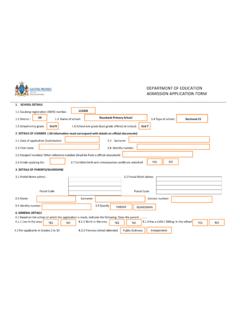
3 A copy of the official application form is attached. The Manager is obliged to respond within 30 days of receipt of this application. PLANNING For TOURS to be effective and enjoyable they must be properly planned, well in advance of departure. This planning must include arrangements to ensure the safety and security of the tourists with regard to transport, accommodation and any entertainment scheduled. Pupils must be supervised at all times by competent and responsible adults. There is a further need for the school to ensure that there is proper financial planning ahead of the tour and that the day to day arrangements are well organised. All TOURS must have the prior approval of the Principal and, in the case of international TOURS , the approval of the Governing Body. All TOURS must comply with the regulations of the gauteng department of education .
4 Updated regulations are available from the Office of the Senior Manager Strategic POLICY Development. A request must be sent to the District Office for approval three months before the tour is scheduled. A teacher organising a tour should work with his/her Subject Head when planning the tour to ensure that the dates chosen are suitable and fit in with the school programme. ACCESS TOURS may be arranged for a specific team, a particular grade or class, a specific gender or for pupils taking a certain subject. All children eligible for such a tour must be considered. The only reason to deny access is if a child s behaviour has violated the school s Code of Conduct and he/she has accumulated a specific number of demerits which render him/her ineligible. No child may be refused access for financial reasons. SAFETY AND SECURITY The safety and security of every child is of paramount importance.
5 A school must be careful to choose responsible and trustworthy adults to arrange the tour and to accompany pupils. There should be one teacher for every 10 pupils of a specific gender. These teachers act in loco parentis and must be extremely vigilant about the safety of their charges. A reliable and dependable transport company or school driver and vehicle are essential. Drivers must be legally licensed and must have valid Public Driver Permits. School vehicles must be serviced before each tour . Insurance against accident, injury or illness must attained for each tour member. Wherever possible the tour leader should have indemnity forms completed and signed by parents and must be given any prescription medication a child may require. Contact details of parents, guardians must be given to the tour leader as well as medical aid details and contact details of medical professionals in the case of pupils with medical problems.
6 The tour leader must see to it that appropriate medical intervention is sought should the need arise. No child may be permitted to carry or purchase alcohol or recreational drugs on the tour and the teacher in charge must be given the right to search for these and to administer drug or alcohol tests. In general the tour leader must take all the necessary steps to ensure the safety and well-being of pupils at all times. He/she must ensure that the transport and accommodation used is safe and in good order. He/she should also do his/her best to protect the property of the tour party, although each member must take responsibility for his own belongings. Children should be advised to bring as few valuables as is possible on the tour . Educators accompanying the tour are on duty for the entire duration of the tour and are bound by all codes of conduct as may be prescribed by the school s governing body and the teaching profession.
7 CONCLUSION At the end of the tour a detailed report must be submitted to the Principal. This report must not only give details of the events that took place, but must determine whether or not the tour was successful and whether the intended goals were achieved. It should also offer advice for future TOURS and the changes that should be made to ensure future success. A report on each child his participation, behaviour and achievements will be useful for the school and for the parents. A check list attached to this POLICY gives a summary of actions the tour organiser must take for short EXCURSIONS . It will assist the teacher in ensuring that every eventuality has been covered. Important considerations for every tour include: 1. consulting the school calendar to find a suitable date 2. discussing budget with the financial controller 3.
8 Deciding on the venue for the tour 4. determining transport arrangements 5. informing parents of all tour arrangements 6. signing of indemnity forms 7. giving pupils details re transport, uniform, times of arrival and departure, collection of money, security of bags during the tour ADDENDUM Checklist Planning Schedule 1